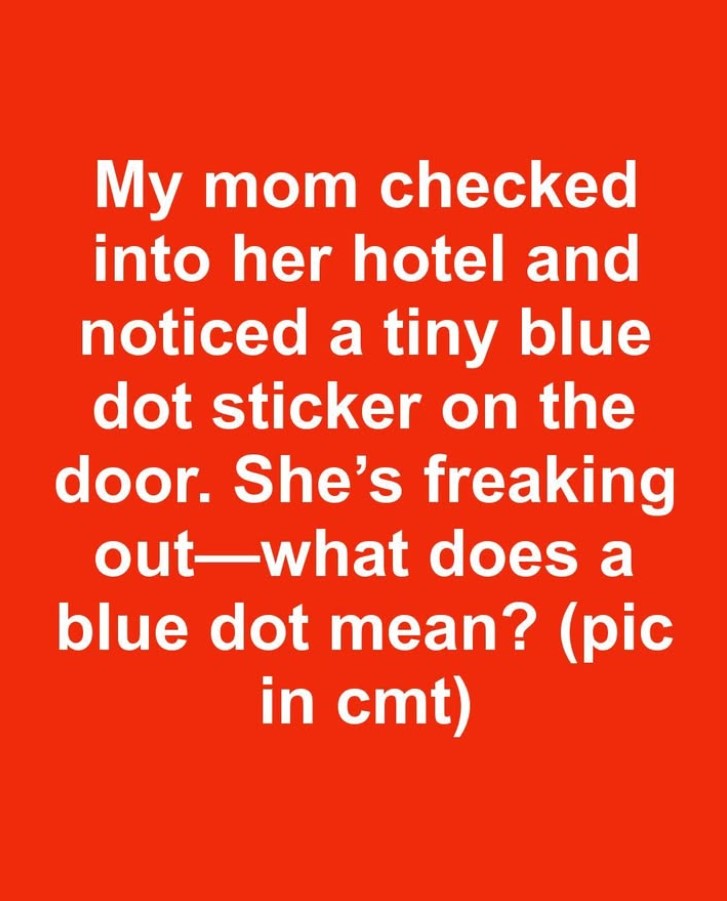
Travel is supposed to be relaxing—but sometimes, the smallest and most unexpected details can turn a normal stay into a moment of anxiety. Imagine checking into a hotel, settling into your room, and then noticing something strange: a tiny blue sticker on your door that wasn’t there before.
It might seem insignificant at first. Just a dot. But in today’s world—where social media is full of warnings, theories, and viral “danger signs”—even something small like this can feel alarming. Is it a signal? A warning? Or something more serious?
If your first instinct is to worry, that’s completely understandable. But before jumping to conclusions, it’s important to understand what these markings usually mean—and what they don’t mean.
Let’s break it down clearly, calmly, and realistically.
What a Blue Dot on a Hotel Door Usually Means
In the vast majority of cases, a small blue dot sticker on a hotel door is not dangerous at all.
Hotels often use simple visual systems—like colored stickers or dots—to help staff manage daily operations. These markings are typically used by housekeeping or maintenance teams as quick references.
A blue dot might indicate things like:
- A room that has been cleaned or sanitized
- A room that has passed inspection
- A maintenance check that has been completed
- A task scheduled for later (like minor repairs)
These systems help staff work efficiently without needing to check digital records constantly.
In other words, what looks mysterious to guests is often just a behind-the-scenes organizational tool.
Why It Feels So Scary
Even though the explanation is usually simple, the reaction is often emotional—and for good reason.
We’re living in a time where stories spread quickly online. You’ve probably seen posts claiming that:
- Marks on doors are used by criminals
- Stickers signal that someone is alone
- Symbols are used for targeting rooms
The problem? These claims are rarely supported by real evidence.
In fact, most reports of colored dots on hotel doors trace back to internal hotel systems—not criminal activity.
Still, when something unfamiliar appears in a private space like your hotel room door, it’s natural to feel uneasy.
Could It Ever Be Something Suspicious?
Let’s be realistic: while the explanation is usually harmless, it’s still okay to stay alert.
A marking might be worth questioning if:
- It appears suddenly and wasn’t there before
- No other doors nearby have similar markings
- It looks hand-drawn (pen, chalk, scratches) instead of a sticker
- You notice unusual behavior in the hallway
These situations are uncommon—but they’re the kind of details that justify asking questions.
The key is not to panic, but to pay attention to context.
The Truth About “Secret Codes”
A lot of fear around things like blue dots comes from viral theories about “secret codes.”
Here’s the honest truth:
👉 There is no verified, widespread system where criminals use colored stickers on hotel doors to mark victims.
Most of these ideas spread through:
- Social media posts without sources
- Anecdotes that get exaggerated
- Misinterpretations of normal hotel practices
Experts consistently point out that modern hotels rely on real security systems, such as:
- Electronic key cards
- Surveillance cameras
- Staff monitoring
- Controlled access points
A tiny sticker simply doesn’t fit into how real security threats operate.
What You Should Do If You Notice a Blue Dot
Even if it’s likely harmless, your comfort matters. Here’s what to do:
1. Ask the Front Desk
This is the simplest and most effective step.
Just say:
“Hi, I noticed a small blue sticker on my door—can you tell me what it means?”
In most cases, you’ll get an immediate, reassuring answer.
2. Check Your Surroundings
Look at nearby doors. If you see similar dots, it’s almost certainly part of a hotel system.
3. Trust Your Instincts—But Stay Rational
If something truly feels off (not just unfamiliar), you can:
- Request a room change
- Ask for security to check the area
But avoid jumping to worst-case conclusions without evidence.
4. Use Basic Safety Habits
Regardless of the sticker, always follow simple hotel safety practices:
- Lock your door and use the latch
- Don’t share your room number publicly
- Keep valuables secure
- Be aware of your surroundings
These habits matter far more than any small marking.
Why Communication Matters
One of the biggest reasons situations like this escalate is lack of information.
Hotels don’t usually explain these internal systems to guests, because they’re not meant for public use. That’s why a harmless sticker can suddenly feel suspicious.
But the moment you ask, the mystery usually disappears.
In many real-life situations, guests who reported these dots were told something simple like:
“It’s just a maintenance or cleaning marker.”
And just like that—the fear is gone.
The Bigger Lesson
This situation isn’t really about a blue dot.
It’s about how quickly uncertainty can turn into anxiety—especially when influenced by online information.
Feeling concerned doesn’t mean you’re overreacting. It means you’re paying attention. But the goal is to balance that awareness with facts and calm thinking.
Most of the time, the simplest explanation is the correct one.
Conclusion :
A small blue dot on a hotel door might look strange, but in nearly every case, it’s nothing more than an internal marker used by hotel staff for cleaning, inspection, or maintenance.
While it’s always smart to stay aware and ask questions if something feels off, there’s no evidence that these stickers are part of any widespread danger or secret signaling system.
So if you—or someone you know—ever notices one of these dots, remember:
Pause.
Ask.
Confirm.
Chances are, it’s just a routine detail behind the scenes—not a warning sign.
And sometimes, what feels like a mystery is simply a small piece of a much bigger, perfectly ordinary system.