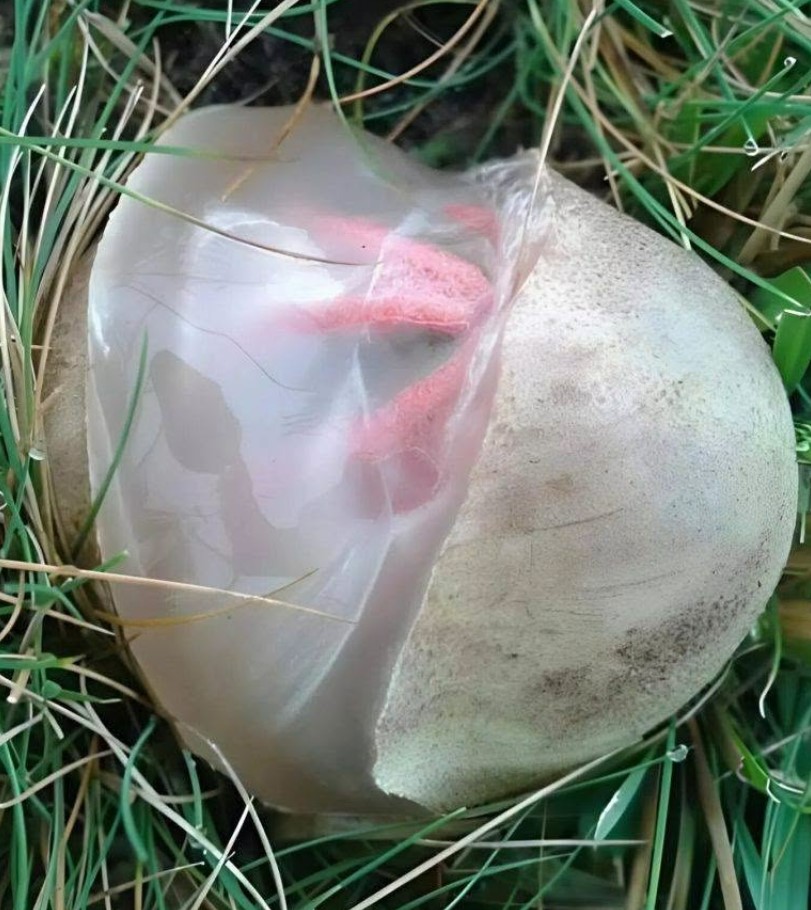
If you came across something like the strange object shown in the picture, your first reaction might be to get closer, cut it open, or touch it to figure out what you’re looking at. It certainly doesn’t resemble an ordinary mushroom. With its pale, rounded outer shell and unusual pink structure visible underneath the translucent surface, it can look almost like something from a science-fiction movie.
But there is a much more natural explanation for this bizarre-looking discovery.
The object appears consistent with the immature “egg” stage of a stinkhorn fungus, although a precise species identification cannot be made from a photograph alone. Stinkhorns are unusual fungi that begin life inside a rounded, egg-like structure before rapidly expanding into their mature form. University extension sources describe these immature structures as white, pinkish, or purplish eggs containing a developing mushroom inside.
What Is That Strange White Object?
The most likely explanation is that you’re looking at a stinkhorn mushroom before it has fully emerged.
Unlike the familiar mushrooms people picture with a cap and stem, stinkhorns have a fascinating development process. Their fruiting bodies initially form as compact, egg-shaped structures, often partly hidden in soil, mulch, grass, or decaying organic material.
Inside that outer layer is essentially a miniature version of the mature fungus waiting to expand.
When conditions become favorable—particularly when there is sufficient moisture—the developing mushroom can burst through its outer covering surprisingly quickly. Some stinkhorns can go from an inconspicuous egg to a recognizable mushroom within hours.
That explains why someone can discover a strange white ball one day and then find a bizarre-looking mushroom occupying the same spot shortly afterward.
Why Does It Look Like There Is Something Pink Inside?
That’s one of the most fascinating features of the photograph.
The pale outer layer acts as a protective covering around the developing fruiting body. Depending on the species, the developing structure inside may have white, pink, orange, red, or other coloration.
Some stinkhorn species produce particularly colorful stalks. For example, the elegant stinkhorn develops an orange-to-pinkish stalk as it emerges from its egg stage. Other stinkhorns can develop red, pink, orange, white, or lattice-like structures.
So the unusual pink shape visible through the outer membrane isn’t necessarily an animal, parasite, or strange object trapped inside the sphere. It can be the developing mushroom itself.
Stinkhorns Have a Very Strange Life Cycle
The name “stinkhorn” comes from what happens later in the fungus’s development.
When the mushroom emerges, many species produce a sticky, foul-smelling material called gleba. This material contains the fungus’s spores.
Instead of relying primarily on the wind to distribute those spores, stinkhorns use insects.
The unpleasant odor attracts flies and other insects, which are drawn to the spore-containing slime. As the insects visit the mushroom and move away, they can carry spores with them and help spread the fungus.
It’s certainly not the most pleasant strategy in nature, but it is remarkably effective.
Why Would Something So Strange Grow in a Lawn?
Stinkhorns aren’t usually growing because something is wrong with the grass.
They are saprophytic fungi, meaning they obtain nutrients from dead and decaying organic material. That’s why they are often associated with mulch, wood chips, decaying vegetation, leaf litter, buried wood, and other organic matter.
University extension specialists report finding stinkhorns in lawns, flowerbeds, mulch, woodland soil, and around decaying wood.
In other words, the strange object may actually be evidence of an active decomposition process happening beneath the surface.
The fungus is breaking down organic material and participating in the natural recycling of nutrients.
Should You Touch It?
There’s an important distinction here.
Stinkhorns are generally not considered poisonous or harmful to plants or people, according to several university extension resources.
However, that doesn’t mean you should casually handle an unidentified wild fungus.
A photograph isn’t enough to guarantee the exact species, and some other fungi can have superficially similar egg-like stages. North Carolina Extension specifically notes that although some stinkhorn “eggs” have been reported as edible, dangerous Amanita species can also produce egg-like structures.
That’s why the safest approach is simple:
Don’t eat it, don’t taste it, and don’t handle an unidentified mushroom unnecessarily.
If children or pets have access to the area, it’s especially sensible to keep them away from unknown fungi.
What Happens If You Leave It Alone?
Probably nothing dramatic—at least from a safety perspective.
If this is a stinkhorn egg, it will eventually develop and emerge. The mature fungus is usually short-lived and eventually breaks down naturally.
You may notice a strange smell once the mature stage appears. That unpleasant odor is actually part of the fungus’s reproductive strategy because it helps attract insects that transport its spores.
After a relatively short period, the visible mushroom will wither.
The underground fungal network can remain in the surrounding organic material, however, so removing one visible fruiting body doesn’t necessarily eliminate future appearances.
Do You Need to Remove It?
Usually, no special treatment is necessary.
Stinkhorns don’t normally require fungicides or other chemical treatments. Because they are decomposers rather than plant pathogens, their presence doesn’t automatically mean that your lawn, flowers, or trees are being attacked.
Some gardeners simply leave them alone.
If the appearance bothers you, or you’re concerned that a child or pet might try to eat it, you can remove the visible fruiting body and dispose of it without disturbing the surrounding area more than necessary.
Just remember that another one may appear later because the underlying fungal network can remain.
Don’t Mistake an Unidentified Egg for Something Edible
One of the biggest reasons to be cautious with strange mushroom “eggs” is that several fungi can look remarkably similar during their early stages.
A mushroom that looks harmless when young may become much easier to identify after it develops. Conversely, relying solely on a photograph or a general description isn’t enough to determine whether a wild fungus is safe to consume.
So although some immature stinkhorns have been described as edible, that isn’t a reason to experiment with a mysterious specimen found outdoors.
When it comes to wild fungi, accurate identification matters.
The Strange Discovery Is Actually Part of Nature’s Recycling System
It may look alarming at first, but the object in the photograph is a good reminder that gardens and lawns are full of activity that isn’t immediately visible.
Beneath grass and mulch, fungi are constantly breaking down leaves, wood, roots, and other organic material. Stinkhorns are one of the more dramatic ways that this hidden fungal world briefly becomes visible.
Their bizarre appearance, rapid growth, and unusual method of spreading spores make them some of the more memorable fungi a gardener can encounter.
And that translucent “shell” isn’t evidence of something mysterious living inside. It can simply be the protective egg stage of a fungus preparing to emerge.
Final Thoughts
Finding a strange white, egg-shaped object with a pink or reddish structure inside can certainly be unsettling, especially when it appears to have appeared overnight. But the photograph is consistent with an immature stinkhorn fungus, a fascinating group of decomposing fungi that begin life inside an egg-like structure before rapidly producing their mature fruiting bodies.
The best response isn’t to panic or start digging around trying to uncover whatever might be underneath. Leave an unidentified specimen alone, don’t eat or taste it, and keep children and pets away from it. If you’re simply curious, observing it from a safe distance can be surprisingly interesting—you may even see the fungus change dramatically as it develops.
What looks like something mysterious or dangerous may actually be a perfectly ordinary part of the ecosystem: a strange-looking fungus quietly doing the important work of breaking down organic material and returning nutrients to the soil.