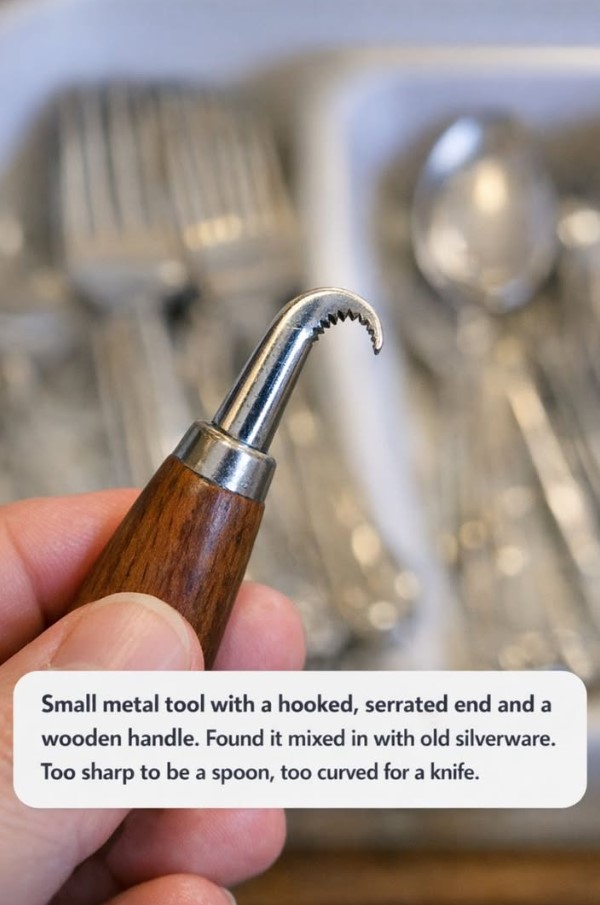
Finding strange, unfamiliar tools hidden among everyday items can be both exciting and confusing. Sometimes, objects that look like kitchen utensils turn out to have completely different purposes. A small metal tool with a curved, serrated edge and a wooden handle might seem like a broken spoon or an oddly shaped knife—but its design suggests something far more specialized.
When something feels “almost familiar” but not quite right, it’s usually because it belongs to a time when tools were made for very specific tasks—many of which aren’t common anymore. And once you discover its true purpose, everything about its shape suddenly makes sense.
What this tool actually is
This object is most likely a vintage grapefruit knife (or citrus knife).
It was designed specifically to:
Cut and separate citrus fruit—especially grapefruit—from its peel and membranes.
Why it looks so unusual
At first glance, the tool can be confusing because it doesn’t match modern utensils. But each part of its design serves a purpose:
- Hooked shape → lets you follow the curve of the fruit
- Serrated edge → helps slice through tough membranes
- Narrow tip → allows precise cutting inside the fruit
- Wooden handle → provides grip and control
Unlike regular knives, this tool is made for delicate, curved movements rather than straight cutting.
How it was used
Using a grapefruit knife was simple but very effective:
- Cut the fruit in half
- Insert the curved blade between the fruit and the peel
- Gently slide it along the inside edge
- Use the serrated side to separate individual segments
This made it easier to eat grapefruit neatly—without tearing it apart or making a mess.
Why it was common in the past
Tools like this were much more popular decades ago because:
- Grapefruit was a very common breakfast food
- People used specialized utensils for different foods
- Kitchen tools were designed for specific tasks, not multi-use
Back then, it wasn’t unusual to have:
- Butter spreaders
- Fish knives
- Citrus knives
- And other highly specialized utensils
Why you don’t see them anymore
Today, most people just use:
- A regular knife
- A spoon
- Or pre-cut fruit
As kitchen habits became simpler, many single-purpose tools disappeared from everyday use.
That’s why finding one today can feel confusing—it looks like it should be something familiar, but it’s not commonly used anymore.
Could it be something else?
There are a few similar-looking tools, but they don’t match as closely:
- Cheese knives → usually wider and less curved
- Bar tools → rarely have serrated hooked ends
- Gardening tools → typically larger and more rugged
The small size + curved serrated edge + tableware context strongly points to a citrus knife.
Is it valuable?
Most vintage citrus knives are:
- Affordable collectibles
- Often worth $5–$20 depending on condition
However, value can increase if:
- It’s part of a full set
- Made from high-quality materials
- Has a unique or antique design
Conclusion :
What may seem like a strange or out-of-place object is actually a clever tool from a time when kitchen utensils were designed with precision and purpose. This small metal piece with a hooked, serrated edge isn’t broken or incomplete—it’s a grapefruit knife, made to simplify a very specific task.
Its unusual shape is exactly what makes it effective. Every curve, edge, and detail was designed to follow the natural form of citrus fruit, making it easier to separate segments cleanly and neatly.
Today, as kitchens have shifted toward simplicity and multi-purpose tools, items like this have quietly disappeared from daily use. But discovering one offers a small glimpse into the past—when even something as simple as eating fruit had its own specialized tool.
So instead of a mystery, what you’ve found is a practical piece of everyday history—proof that even the smallest objects can have a surprisingly thoughtful design.