Some riddles look like simple math problems, but they are actually tests of how carefully you follow a sequence of events. The “A Man Steals $100 From a Shop” puzzle is a perfect example. At first, the numbers seem to create several possible answers. Did the shop owner lose $100? $130? $170? Or perhaps even $200?
The trick is that the same $100 bill is involved throughout the entire situation. Once you follow that bill from the moment it is stolen until the moment the thief leaves the shop, the answer becomes much easier to see.
This brain teaser has circulated widely online and has sparked plenty of debate because people often count the same loss more than once. So, can you solve it without looking at the answer?
The Riddle
Here is the challenge:
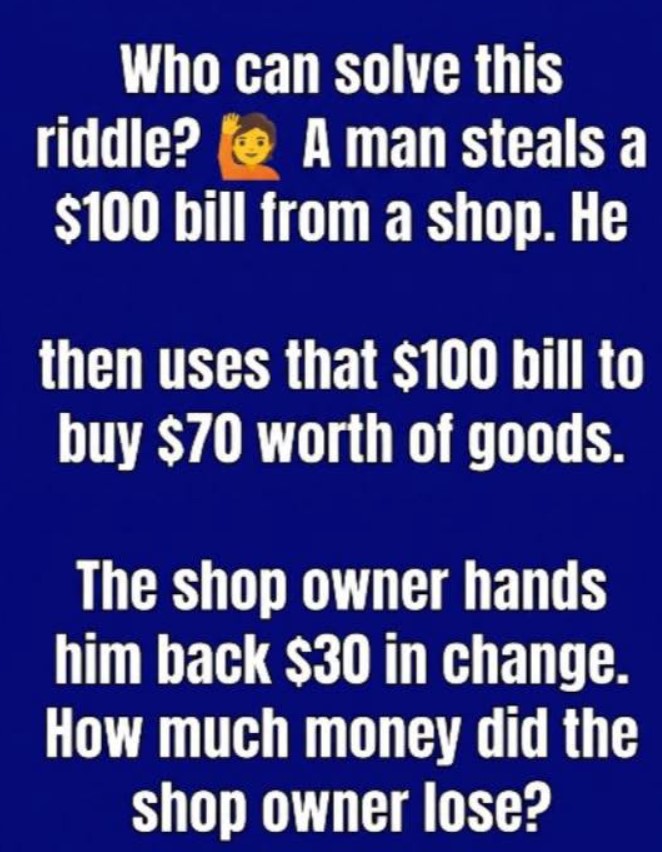
A man steals a $100 bill from a shop. He then uses that same $100 bill to buy $70 worth of goods from the shop. The shop owner accepts the bill and gives the man $30 in change.
The question is:
How much money did the shop owner lose?
Take a moment before reading further. Many people immediately reach for a calculator, but this puzzle is less about complicated mathematics and more about tracking what actually leaves the shop.
Why This Riddle Is So Confusing
The puzzle is designed to make you count several things separately.
First, there is the $100 bill that disappears from the shop when the man steals it.
Then, the thief returns to the same shop and spends that stolen $100.
Next, the shop owner gives him $30 in change.
Finally, the thief walks away with $70 worth of merchandise and $30 in cash.
Because there are several exchanges, it can feel as though the shop owner has suffered multiple losses. Some people add the stolen $100 to the $70 worth of goods and then add the $30 change, arriving at $200.
That seems reasonable at first—but there is an important problem with that calculation.
The original $100 bill comes back to the shop.
The thief did not steal one $100 bill and then spend another $100. He used the exact same bill.
That single detail is what makes the puzzle work.
Follow the Money Step by Step
Let’s slow everything down.
Step 1: The man steals $100
The first event is straightforward.
The thief takes a $100 bill from the shop.
At this point:
Shop’s loss = $100
The thief now has $100, while the shop is missing that bill.
Step 2: The thief returns to the shop
The man then comes back and decides to purchase $70 worth of goods.
Instead of using his own money, he uses the $100 bill he previously stole from the shop.
This is the key moment.
When the shop owner receives the $100 bill as payment, the stolen cash has effectively returned to the shop’s cash register.
So the shop owner is no longer missing that particular $100 bill.
However, the owner has now handed over something worth $70 in merchandise.
Step 3: The shop owner gives $30 in change
The goods cost $70, but the thief paid with $100.
Therefore, the shop owner gives him:
$100 − $70 = $30
The thief leaves with $70 worth of goods and $30 in cash.
Add those two amounts together:
$70 + $30 = $100
That is the important calculation.
The shop owner has ultimately given the thief $100 worth of value: $70 in merchandise and $30 in cash.
So, What Is the Final Answer?
The shop owner lost $100.
The easiest way to understand it is to ignore the confusing movement of the $100 bill and look at what the thief takes away when he leaves.
Before entering the shop, the thief had nothing from the shop.
After the transaction, he has:
- $70 worth of goods
- $30 in cash
Together, those items are worth:
$70 + $30 = $100
Therefore, the shop’s total loss is $100.
This is also the standard answer given for this popular version of the riddle.
Why Isn’t the Answer $130?
A common answer is $130.
The reasoning usually goes something like this:
- The thief stole $100.
- Then the owner gave him another $30 in change.
- Therefore, the owner lost $130.
But this counts the $30 twice.
Remember, the thief used the original stolen $100 to pay for the merchandise. The $30 change is not an additional $30 on top of the original theft. It is part of the $100 value that the thief ultimately takes away.
The final outcome is $70 in merchandise plus $30 in cash.
That’s $100—not $130.
Why Isn’t It $170?
Another tempting answer is $170.
Someone might reason:
$100 stolen + $70 worth of merchandise = $170
But once again, the calculation counts the same value twice.
The stolen $100 bill is returned to the shop when the thief uses it to pay.
The owner does not lose the original $100 bill and then separately lose $70 in merchandise. Instead, the original $100 is exchanged for $70 worth of goods and $30 in change.
The $100 has simply changed form.
It begins as cash stolen from the register and ends up as:
$70 in goods + $30 in cash in the thief’s possession.
So the total value that leaves the shop is still $100.
Why Some People Say $200
The most extreme calculation is $200:
$100 stolen + $70 goods + $30 change = $200
This sounds convincing if every event is treated as a separate loss.
But that is precisely the trap.
The $100 bill stolen at the beginning is the same $100 bill used to purchase the goods. It cannot be counted as a permanent $100 loss while also treating the $70 and $30 received in exchange for that bill as entirely separate losses.
The transaction needs to be viewed as one continuous chain.
The thief takes $100.
He gives that $100 back.
The shop gives him $70 worth of goods and $30 change.
The thief therefore leaves with $100 worth of value.
A Simple Way to Remember the Answer
If the numbers are still confusing, forget about the $100 bill for a moment.
Ask yourself one simple question:
What does the thief have when he leaves the store?
He has:
$70 worth of products + $30 cash = $100
That is exactly what the shop owner has lost in value.
The stolen $100 bill itself is no longer missing because it was returned to the register during the purchase.
This is why the puzzle is more about logical thinking than arithmetic.
One Important Detail About the Riddle
There is a small real-world distinction worth mentioning.
The puzzle asks how much the shop owner lost, and the conventional answer treats the merchandise at its stated $70 value. In an actual business, however, the shop’s financial loss could be different if the $70 of merchandise originally cost the shop less than $70 to purchase or manufacture.
For example, if the shop sold $70 worth of goods that had cost the owner $40, the owner’s accounting loss would not necessarily be $100 in terms of cost. The question is therefore a simplified brain teaser rather than a detailed accounting problem.
For the intended version of the riddle, though, the answer is clearly $100 because the thief leaves with $100 worth of value.
The Real Trick Behind the Puzzle
The biggest lesson from this riddle is that you should not automatically add every number you see.
When a puzzle involves several transactions, it is important to determine whether each amount represents a new gain or loss—or whether it is simply part of an earlier amount changing hands.
Here, the $100 bill is the central piece of the puzzle.
It starts in the shop.
The thief takes it.
He brings it back.
The shop owner exchanges it for $70 worth of merchandise and $30 in change.
The final loss is therefore:
$70 + $30 = $100
Once you see the entire transaction as one continuous sequence, the confusing numbers stop being confusing.
Can You Solve Similar Riddles?
This type of puzzle is a great reminder to slow down before doing calculations.
When you encounter another brain teaser involving money, try asking:
- What did the person have at the beginning?
- What did they take?
- Did any of that value return?
- What did they receive in the final transaction?
- Am I counting the same money or object more than once?
Those questions can prevent you from falling into the same trap.
Conclusion :
The answer to the riddle is $100.
The shop owner initially loses a $100 bill when the man steals it. However, the thief later uses that same bill to purchase $70 worth of goods. The owner receives the $100 bill back but gives the thief $70 in merchandise and $30 in change.
When the thief leaves, he has received exactly $100 worth of value from the shop:
$70 in goods + $30 in cash = $100.
The biggest mistake is to count the stolen $100, the merchandise, and the change as three separate losses. They are not. The original $100 bill is part of the same transaction and returns to the shop before the final loss is calculated.
That’s what makes this riddle so clever. The arithmetic is simple, but the wording encourages you to overthink the situation. Once you follow the money carefully and avoid counting the same value twice, the mystery disappears.
Final answer: The shop owner lost $100.
So, did you get the answer before reading the explanation—or did the riddle manage to trick you?