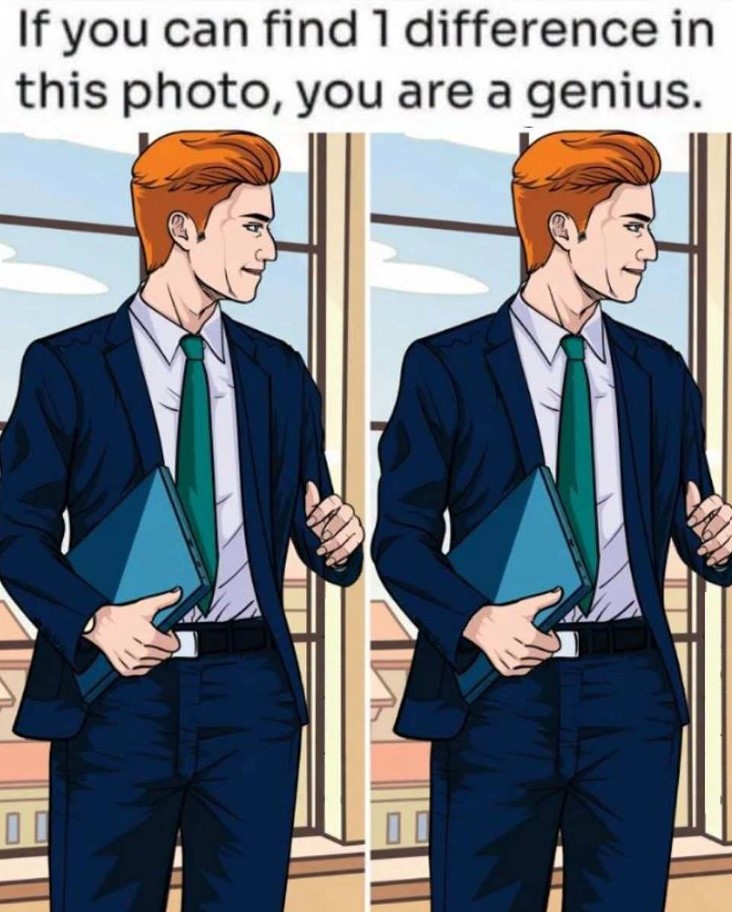
Are you ready for another quick visual challenge?
At first glance, the two pictures in this puzzle appear to be exact copies. The same businessman is standing confidently beside a large office window, wearing a smart suit and holding a folder. Everything seems perfectly normal.
But there is one small difference hiding somewhere between the two images.
Your challenge is simple: Can you spot it?
The difference may be tiny enough to escape your attention during your first few attempts, so don’t rush. Take a careful look at the man’s appearance, clothing, hands, folder, and the office background. The original puzzle confirms that there is exactly one difference between the two pictures.
Meet the Office Guy
The main character in the picture is a confident-looking businessman standing near a large window.
He has bright orange hair that is neatly styled and is dressed in a professional navy-blue suit with a crisp white shirt.
A green tie completes his formal appearance.
In one hand, he is holding a blue folder, making it look as though he is about to attend an important meeting or presentation.
At first, there doesn’t seem to be anything unusual about him.
That’s exactly what makes this puzzle interesting.
When two images are almost identical, your brain naturally focuses on the larger picture rather than the tiny details.
Your Mission: Find One Difference
The instructions are simple.
Look at the picture on the left.
Then compare it carefully with the picture on the right.
There is only one hidden change.
It could be located anywhere.
It might be something on the man’s face.
It could be related to his hair.
Perhaps something about his clothing is different.
It could even be a tiny detail in the background.
The original puzzle specifically encourages you to inspect the man’s hair, face, clothing, tie, belt, folder, hands, fingers, window frame, and the scenery outside.
So don’t limit your search to the most obvious areas.
Start With His Hair
A good way to solve a spot-the-difference puzzle is to work systematically.
Start at the top.
Look closely at the man’s orange hair.
Compare its shape in both pictures.
Check the outline.
Look for missing or additional details.
Does the hairstyle appear exactly the same?
Sometimes a difference can be as subtle as one small section of hair being changed.
Because the hair is such a distinctive feature, it can be tempting to assume that you would notice any change immediately.
But when two images are nearly identical, your brain can easily overlook a tiny alteration.
Examine His Face
Next, move down to the man’s face.
Compare his eyes.
Look at his eyebrows.
Check his nose and mouth.
Even small changes can be surprisingly difficult to spot when you’re switching your attention between two similar images.
Don’t simply glance at both faces.
Instead, choose one feature at a time.
For example, look at the eyes in the first picture, then immediately compare them with the eyes in the second.
Repeat the process with the eyebrows, nose, and mouth.
This method can help you notice something your brain might otherwise ignore.
Check the Green Tie
The green tie is another important area to inspect.
Look carefully at its shape and position.
Compare the knot.
Check the length.
Look at the pattern or small details.
Does it hang exactly the same way in both pictures?
The original puzzle specifically tells readers to pay attention to the green tie, along with other parts of the man’s outfit.
Even if the tie looks identical at first, don’t move on too quickly.
Give yourself a few seconds to compare it properly.
Look at the Navy Suit
Now inspect the man’s suit.
Compare the jacket.
Look at the lapels.
Check the buttons.
Examine the sleeves.
Look at the areas around his shoulders and chest.
It’s easy to concentrate on the bright green tie and completely overlook the dark blue suit surrounding it.
Remember that the difference could involve a small detail rather than an obvious change in color.
Don’t Forget the Belt
The belt is another area specifically worth checking.
Because it’s located lower on the man’s body, many people won’t naturally look at it during their first scan.
Compare the belt carefully.
Look at the buckle.
Check its position.
See whether the shape appears identical in both images.
This is a good example of why a systematic search is more effective than simply staring at the picture.
Inspect the Blue Folder
The blue folder in the man’s hand is another obvious object that deserves attention.
Compare its size and shape.
Look at the edges.
Check whether anything appears to be missing.
Pay attention to how he is holding it.
The folder may look like a simple background prop, but small objects like this are common places for visual puzzles to hide their changes.
Examine His Hands and Fingers
This is one of the areas many people forget to inspect.
Look closely at the man’s hands.
Compare the fingers.
Check their positions.
Look at the way his hand grips the folder.
A tiny change involving a finger can be extremely difficult to notice because your brain tends to recognize the overall shape of a hand rather than individually analyzing every finger.
So slow down here.
Compare one finger at a time if necessary.
Look at the Window
If you haven’t found the answer yet, stop looking only at the businessman.
Move your attention to the large window behind him.
Compare the window frame.
Look at the vertical and horizontal lines.
Check the edges.
Is there anything different?
The original puzzle specifically suggests inspecting the window frame and the background outside.
This is important because the difference doesn’t necessarily have to be on the main character.
Scan the Background
Now look outside the window.
Examine everything visible in the background.
Look for differences in:
- Buildings
- Shapes
- Lines
- Objects
- Colors
- Windows
- Shadows
- Small background details
Because the businessman is the central focus of the picture, your eyes may automatically ignore what’s happening behind him.
That’s exactly why the background can be a tricky place to search.
Why Spot-the-Difference Puzzles Are So Difficult
These puzzles aren’t difficult because there are hundreds of differences.
They’re difficult because there is only one.
Your brain quickly recognizes that the two images are essentially the same.
Once it reaches that conclusion, it stops carefully analyzing every detail.
That’s why you might stare at both pictures and think:
“Everything looks identical.”
Then, suddenly, you spot the difference.
And once you see it, you can’t understand how you missed it in the first place.
Try a Systematic Search
If you’re struggling, don’t keep looking randomly.
Use a specific pattern.
Start at the top-left corner.
Slowly scan across the image.
Move downward.
Continue until you’ve checked the entire picture.
Then repeat the same process on the second image.
You can also divide the picture into sections:
Section 1: Head
Check the hair, forehead, eyes, eyebrows, nose, and mouth.
Section 2: Upper Body
Compare the shirt, tie, jacket, and collar.
Section 3: Hands
Inspect the fingers and the way the folder is being held.
Section 4: Lower Body
Check the belt and anything else visible below the jacket.
Section 5: Background
Compare the window frame and everything visible outside.
This method makes it much harder to accidentally skip an area.
Give Yourself a Time Limit
Want to make the puzzle more challenging?
Set yourself a timer.
Try to find the difference in 10 seconds.
If you don’t succeed, give yourself another 20 or 30 seconds.
You can even challenge a friend or family member and see who finds the answer first.
The original puzzle encourages readers to take their time, zoom in when necessary, and carefully inspect the image from top to bottom.
Don’t Zoom In Too Quickly
Zooming in can certainly help if the difference is extremely small.
But before you do that, try solving the puzzle using your normal eyesight.
There’s something satisfying about finding the hidden detail without assistance.
If you genuinely can’t locate it, however, enlarging the image can help you examine tiny features more carefully.
What Makes a Good Visual Puzzle?
A good spot-the-difference puzzle should make the images look almost identical.
If the difference were huge, you would find it immediately.
If there were dozens of changes, the challenge would disappear.
The best puzzles hide one small detail in a way that makes you question what you’re seeing.
This office scene does exactly that.
The businessman, his clothes, the folder, and the office environment create enough visual information to keep your eyes busy while one tiny change remains hidden.
Challenge Your Friends
Once you’ve found the answer, don’t reveal it immediately.
Send the puzzle to a friend.
Ask them how quickly they can solve it.
You can even turn it into a little competition.
Who can find the difference first?
Who notices the smallest details?
Who needs the longest time?
These simple puzzles are perfect for sharing because everyone can participate without needing any special knowledge.
Did You Find It?
If you’ve already found the hidden difference, congratulations!
You managed to identify something that many people miss during their first glance.
If you haven’t found it yet, don’t give up.
Take another look at:
- The orange hair
- The face
- The navy suit
- The white shirt
- The green tie
- The belt
- The blue folder
- The hands and fingers
- The window frame
- The background
The original puzzle specifically directs attention to these areas because the hidden difference can be surprisingly easy to overlook.
The Fun Is in the Search
Remember, there’s no need to feel frustrated if you can’t find the answer immediately.
The purpose of a visual puzzle isn’t simply to prove that you’re fast.
It’s about slowing down, concentrating, and looking at something from a different perspective.
Sometimes the best strategy is to stop staring at the entire image and focus on one tiny section.
Other times, taking a short break and looking again can make the difference suddenly obvious.
Conclusion :
The “Spot 1 Difference in the Office Guy Picture!” challenge may seem easy when you first see the two images, but finding one tiny change among so many matching details can be surprisingly difficult.
The businessman appears almost identical in both pictures, from his bright orange hair and navy-blue suit to his green tie and blue folder. The surrounding office window and background make the scene even more convincing.
The key to solving the puzzle is patience.
Don’t just look at the picture as a whole. Break it into sections and carefully compare the man’s hair, face, clothing, tie, belt, folder, hands, and fingers. Then move your attention to the window and the background.
And remember: there is only one difference.
So, take another look, slow down, and trust your eyes.
Did you spot the hidden difference in the office guy picture? If you did, you definitely have a sharp eye!