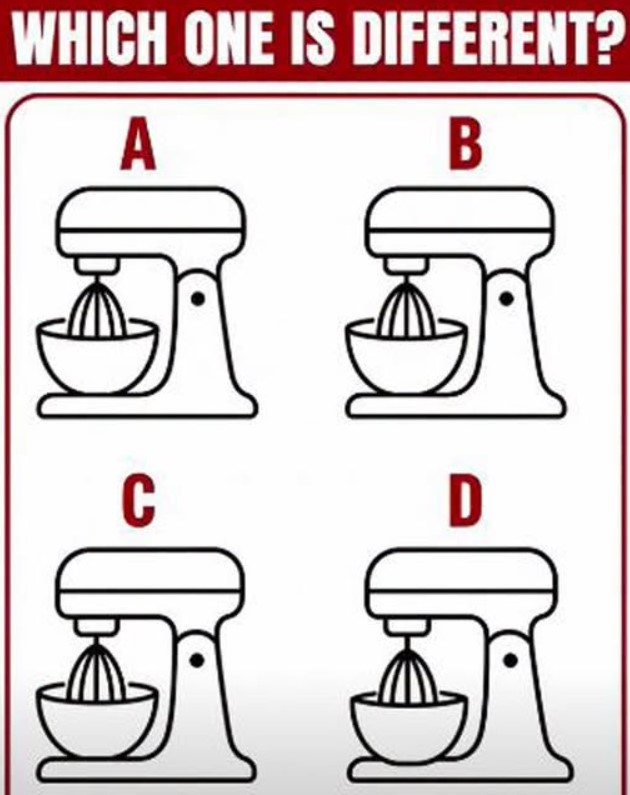
Do you consider yourself someone with excellent attention to detail? If so, this quick visual puzzle is a fun way to put your observation skills to the test.
At first glance, the image appears to show four nearly identical kitchen stand mixers, labeled A, B, C, and D. Each one has the familiar motor housing, mixing bowl, whisk attachment, and sturdy base. Everything looks almost perfectly matched.
But there is a catch.
One stand mixer is different from the other three. The difference is small enough to be easy to overlook, especially if you simply glance at the image instead of examining each mixer carefully.
Your challenge is simple: Can you identify the odd stand mixer before checking the answer?
Don’t rush. Take a moment to study all four options and compare their details carefully.
Can You Find the Odd One?
Look at the four stand mixers labeled A, B, C, and D.
At first, they appear to be exact copies. They have similar shapes, matching bowls, and seemingly identical whisk attachments. This is precisely what makes the puzzle challenging.
Your brain naturally recognizes the overall pattern and assumes that everything is the same. Once it notices that the four objects look alike, it may stop paying attention to tiny differences.
That’s why this puzzle requires you to slow down.
Instead of looking at the image as one large picture, examine each mixer individually. Compare one component at a time and see whether anything looks slightly different.
Start With Mixer A
Begin with Mixer A.
Look carefully at the top section of the mixer. Examine the outline of the motor housing and pay attention to the curves and small connecting points.
Then move your attention down toward the bowl.
Look at the shape of the bowl, its position relative to the mixer, and the whisk attachment inside it.
Don’t stop after finding one feature that looks unusual. Compare that same feature with the other three mixers.
The goal isn’t to find something that looks different by itself. You need to determine whether it is genuinely different from all three other options.
Compare Mixer B
Now move to Mixer B.
Rather than starting over from scratch, compare B directly with A.
Look at the same areas you just examined:
- The upper motor housing
- The connecting hinge
- The mixing bowl
- The whisk attachment
- The base
- Small curves and lines around the body
This side-by-side comparison makes subtle differences easier to recognize.
If A and B appear identical, move on to C.
Examine Mixer C
Mixer C may look just as familiar as the others, but don’t let the overall similarity fool you.
Pay close attention to the small details.
Look at the attachment inside the bowl. Compare its shape and position with the corresponding feature on A and B.
Then inspect the bowl and the base.
Sometimes a visual puzzle hides its answer in an area that seems completely unimportant. A tiny change in a line, curve, connection, or shape can be enough to make one object the odd one out.
Finally, Study Mixer D
Now examine Mixer D.
At this point, you have already studied the first three options, so your eyes may be better prepared to notice a discrepancy.
Compare D with the others feature by feature.
Don’t rely on your first impression. If something looks different, go back and verify it.
A good puzzle-solving technique is to ask yourself: “Can I identify exactly what is different?”
If you can point to a specific feature that doesn’t match the other three, you may have found the answer.
Why Is This Puzzle So Difficult?
The challenge isn’t necessarily that the difference is extremely complicated.
Instead, the difficulty comes from the way our brains process familiar visual patterns.
When four objects look almost identical, our brains tend to group them together. We recognize the common shape and assume that the details are also the same.
This can cause us to overlook tiny inconsistencies.
It’s similar to reading a familiar sentence. You can sometimes read an incorrectly spelled word without noticing because your brain understands what the sentence is supposed to say.
Visual puzzles take advantage of the same tendency.
They encourage you to look beyond the obvious and examine what your brain initially dismisses as unimportant.
A Simple Strategy for Solving It
If you’re having trouble finding the odd mixer, don’t simply stare at the picture.
Use a systematic approach.
Step 1: Compare the Overall Shape
Start with the largest features.
Are all four mixers shaped the same way? Do the upper bodies have identical outlines?
Step 2: Examine the Bowls
Compare the mixing bowls carefully.
Look at their size, position, curves, and relationship to the mixer body.
Step 3: Inspect the Attachments
The whisk is another useful reference point.
Compare its shape and connection to the upper part of each mixer.
Step 4: Check the Base
Look closely at the bottom of each stand mixer.
Small differences in curves, lines, or proportions can be easier to spot when you compare the bases directly.
Step 5: Compare in Pairs
Instead of looking at A, B, C, and D simultaneously, compare them in pairs.
Start with A versus B.
Then compare C versus D.
Finally, compare the two pairs against each other.
This can make a subtle difference much easier to identify.
Don’t Let Your First Guess Fool You
One of the biggest mistakes people make with visual puzzles is deciding too quickly.
You may immediately think you’ve found the odd one, only to discover that your choice was based on a tiny visual illusion.
Once you think you’ve identified the answer, take another look.
Ask yourself:
What exactly makes this mixer different?
If you cannot identify the specific feature, continue looking.
Being confident isn’t the same as being correct.
Challenge Your Friends and Family
These puzzles become even more entertaining when you turn them into a friendly competition.
Show the image to someone else without revealing the answer and ask them to choose A, B, C, or D.
You might be surprised by how differently people approach the same puzzle.
Some people immediately notice tiny visual details, while others are better at recognizing larger patterns.
You can even time yourselves and see who can find the odd mixer first.
Just remember that speed isn’t everything. The real challenge is identifying the difference accurately.
What Does Your Result Say About Your Observation Skills?
If you found the odd mixer quickly, you may have strong visual attention and an ability to notice small inconsistencies.
But don’t worry if it took you longer.
Visual puzzles depend on many factors, including concentration, familiarity with these types of challenges, screen size, image quality, and even how much time you have available to focus.
Taking longer doesn’t mean you have poor observation skills.
In fact, carefully analyzing an image can be more valuable than simply making a fast guess.
Ready for the Answer?
Before revealing the solution, take one final look at the four stand mixers.
A, B, C, or D?
Which one do you believe doesn’t belong?
Don’t scroll ahead until you’ve made your choice.
Look at the image one more time and compare the four mixers carefully.
Once you’ve settled on an answer, you can check the solution and see whether your eyes caught the hidden difference.
The Answer
The original puzzle provides an answer image after the challenge section.
If you identified the correct mixer, congratulations! Your attention to detail paid off.
If you chose incorrectly, don’t worry. These puzzles are deliberately designed to make your brain assume that repeated objects are identical.
The important part is the process of slowing down, comparing details, and questioning your first impression.
Conclusion :
The “Spot the Odd Stand Mixer Out!” puzzle may look simple, but it is a surprisingly effective test of concentration and visual observation.
With four almost identical kitchen mixers in front of you, your brain naturally focuses on their similarities. The real challenge is breaking that pattern and searching for the tiny detail that separates one mixer from the other three.
Whether you spotted the difference in a few seconds or needed several minutes, the puzzle offers a fun reminder that careful observation can reveal things that a quick glance misses.
So, how did you do?
Did you spot the odd stand mixer—A, B, C, or D? Share the puzzle with your friends and family and see who has the sharpest eyes!