Math puzzles have a special way of capturing people’s attention. At first glance, they often look incredibly simple, but once you try to solve them, you may discover that the answer is not as obvious as you expected.
One expression that has sparked plenty of discussion online is:
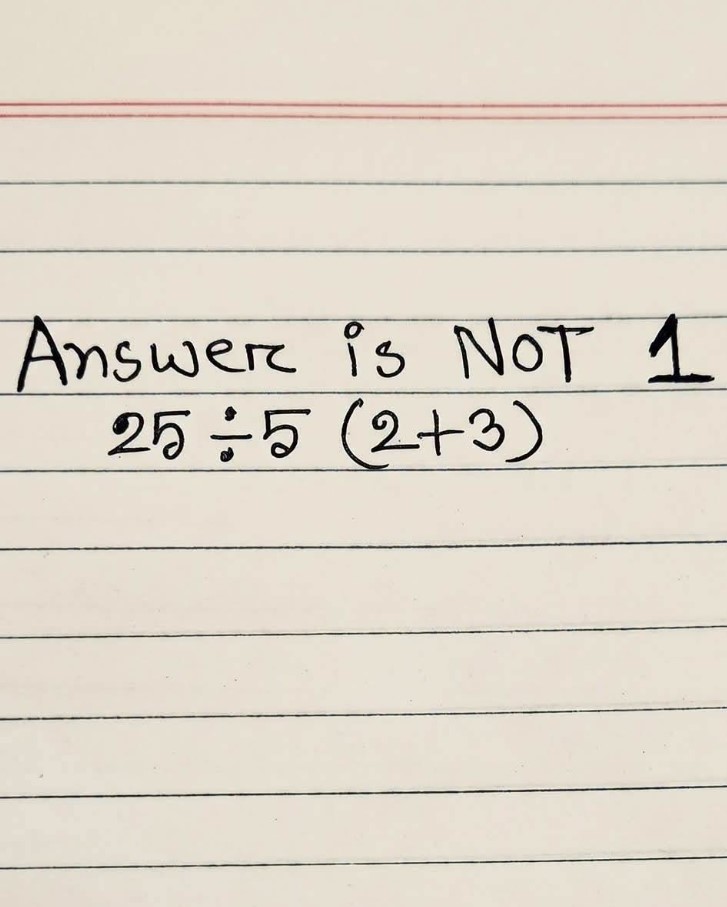
25 ÷ 5(2+3)
The puzzle becomes even more interesting because the image accompanying it includes a short message: “Answer is NOT 1.”
That statement immediately makes people curious. Some believe the answer is 1, while others insist that it is 25. Both sides often feel confident that their calculation is correct.
So, what is the correct answer?
Let’s examine the expression carefully, apply the standard order of operations, and understand why this seemingly simple problem creates so much confusion.
The Math Puzzle: Can You Solve It?
Before looking at the explanation, take a moment to solve the expression yourself:
25 ÷ 5(2+3) = ?
Try not to look at the answer immediately. Follow the usual mathematical rules and see what result you get.
Some people begin by multiplying 5 by the expression inside the parentheses. Others first calculate the division after removing the parentheses.
The difference between these approaches is exactly what makes the puzzle so controversial.
Step 1: Start With the Parentheses
According to the standard order of operations, calculations inside parentheses must be completed first.
Our original expression is:
25 ÷ 5(2+3)
First, calculate:
2 + 3 = 5
Now replace the parentheses with their result:
25 ÷ 5 × 5
The expression is shorter, but we still have two operations to perform: division and multiplication.
This is where many people become confused.
Step 2: Remember the PEMDAS and BODMAS Rules
To solve mathematical expressions correctly, students are often taught the PEMDAS or BODMAS rules.
PEMDAS stands for:
- P – Parentheses
- E – Exponents
- M – Multiplication
- D – Division
- A – Addition
- S – Subtraction
BODMAS follows the same general principle:
- B – Brackets
- O – Orders
- D – Division
- M – Multiplication
- A – Addition
- S – Subtraction
However, there is an important detail that many people misunderstand.
Multiplication and division have equal priority. Likewise, addition and subtraction have equal priority.
This means multiplication does not automatically come before division, even though the letter M appears before D in PEMDAS.
When multiplication and division appear together, they are normally performed from left to right.
The same left-to-right rule applies to addition and subtraction.
Step 3: Solve the Expression From Left to Right
After calculating the parentheses, we have:
25 ÷ 5 × 5
Now work from left to right.
The first operation is:
25 ÷ 5 = 5
Our expression becomes:
5 × 5
Finally:
5 × 5 = 25
The answer is 25.
Following the standard left-to-right convention for multiplication and division, the result is 25.
Why Do So Many People Think the Answer Is 1?
This is the most interesting part of the puzzle.
People who get 1 usually approach the expression differently. Instead of performing the division first, they treat the multiplication immediately following the number 5 as a single grouped expression.
Their calculation looks like this:
25 ÷ 5(2+3)
First, calculate the parentheses:
2 + 3 = 5
Then multiply:
5 × 5 = 25
Finally, divide:
25 ÷ 25 = 1
This explains where the answer 1 comes from.
The disagreement is partly caused by how people interpret the notation. Some readers assume that multiplication written directly beside parentheses should be treated as more tightly connected than division.
However, under the standard convention that multiplication and division have equal precedence and are evaluated from left to right, the answer is 25.
Is the Puzzle Written Clearly?
There is another important detail worth understanding: the original expression is not written in the clearest possible mathematical form.
Different calculators, textbooks, and mathematical conventions may treat implied multiplication, such as 5(2+3), differently.
To avoid confusion, mathematicians can use additional parentheses to make the intended calculation clear.
For example:
If the intended answer is 25:
(25 ÷ 5) × (2+3) = 25
If the intended answer is 1:
25 ÷ [5 × (2+3)] = 1
Both expressions are mathematically clear because the grouping is explicitly shown.
That is why this viral puzzle is such a good reminder that mathematical notation needs to be precise, especially when several operations appear together.
The Final Answer: 25
So, did you get the correct result?
Using the standard rule that multiplication and division are performed from left to right, the expression:
25 ÷ 5(2+3)
gives us:
25 ÷ 5 × 5
5 × 5 = 25
Final answer: 25.
The reason some people arrive at 1 is that they interpret the implied multiplication as a grouped operation. The missing grouping symbols are what make the expression controversial.
Conclusion:
A Simple Math Problem That Started a Big Debate
The viral expression 25 ÷ 5(2+3) proves that even a short mathematical problem can generate a surprising amount of discussion.
At first, the calculation seems straightforward. You only need to solve the parentheses, divide, and multiply. Yet the way the expression is written encourages different interpretations, making people question which mathematical convention should be followed.
The important lesson is not simply to memorize PEMDAS or BODMAS. It is to understand how the rules work. Multiplication and division share the same priority, just as addition and subtraction do. When they appear together, the standard convention is to calculate from left to right.
Under that convention, the answer is 25, not 1.
But what did you get when you first saw the puzzle? Did you immediately calculate 25, or did you initially think the answer was 1?
Share your answer and challenge your friends to solve it too. You might discover that a simple math expression can lead to a much bigger debate than anyone expected!