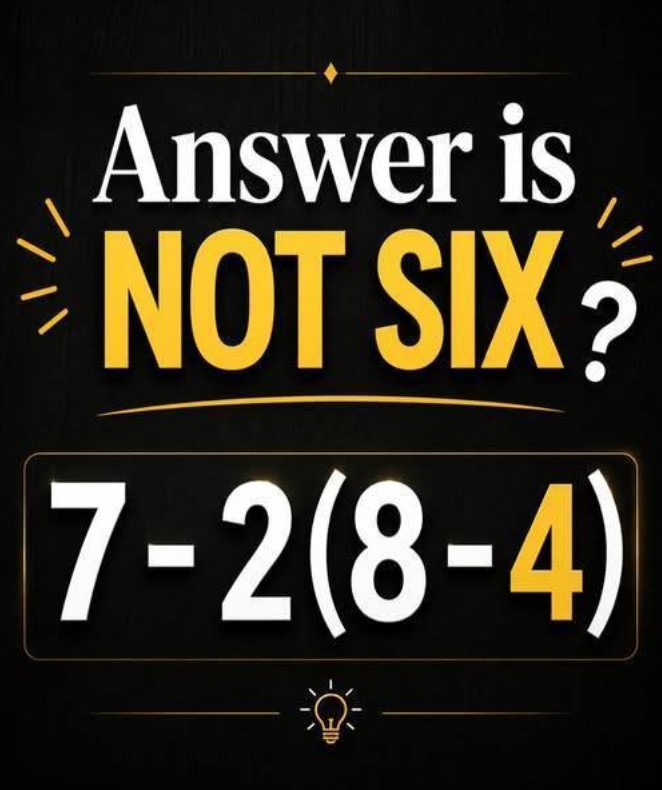
Math puzzles have become one of the internet’s favorite forms of entertainment. Simple-looking equations are constantly shared across social media, often creating massive debates as people argue over different answers.
What makes these puzzles so fascinating is that they usually appear easy at first glance. However, hidden inside the equation is a small detail designed to confuse people and test their understanding of mathematical rules.
These “viral math traps” spread quickly because they challenge not only calculation skills but also attention to detail and logical thinking. In many cases, the disagreement comes from misunderstandings about the order of operations and how mathematical expressions should be interpreted.
WHY VIRAL MATH PUZZLES CONFUSE SO MANY PEOPLE
1. The order of operations creates confusion
Most viral math problems rely on confusion around the order of operations, commonly remembered through acronyms like PEMDAS or BODMAS.
These rules determine the correct sequence for solving equations:
- Parentheses
- Exponents
- Multiplication and Division
- Addition and Subtraction
Many people either forget these rules or apply them inconsistently, which leads to different answers and online debates.
2. The formatting is often intentionally misleading
A major reason these puzzles go viral is because the equations are written in a way that encourages misinterpretation.
For example, missing multiplication symbols or unclear spacing can make people read the equation differently. Experts have explained that these formatting tricks are often the real source of confusion rather than the math itself.
3. People rush instead of analyzing carefully
Many internet users try to solve the puzzle quickly instead of slowing down and checking each step carefully. Because the equation looks simple, the brain assumes the answer should also be simple.
This overconfidence often leads to mistakes.
COMMON TYPES OF VIRAL MATH TRAPS
1. Hidden multiplication problems
Some puzzles place numbers beside parentheses without clear multiplication signs. This creates arguments about whether multiplication should happen before division or after it.
One famous example involved equations like:
8÷2(2+2)8\div 2(2+2)8÷2(2+2)
This type of expression caused years of debate online because people interpreted the notation differently.
2. Visual equation puzzles
Another popular format replaces numbers with pictures or symbols. Users must figure out the hidden value of each object before solving the final equation.
These puzzles are tricky because small visual differences are easy to miss.
3. Timing pressure challenges
Some math traps encourage people to answer quickly by claiming only “geniuses” can solve them in a few seconds. This pressure causes many users to skip careful reasoning.
The challenge becomes more about reaction speed than mathematical understanding.
WHY THESE PUZZLES SPREAD SO FAST ONLINE
1. They create arguments and engagement
People enjoy debating answers, especially when they feel confident they are correct. Comment sections quickly fill with competing explanations, making the post spread even further online.
2. They challenge intelligence in a playful way
Many users enjoy testing themselves against others. Solving a difficult-looking puzzle creates a feeling of achievement and encourages sharing.
3. The internet loves simple but controversial questions
The most viral content is often something simple that divides opinions. Math traps are perfect for this because they appear straightforward while still generating disagreement.
HOW TO AVOID FALLING INTO THE “MATH TRAP”
1. Slow down and read carefully
The best way to solve these puzzles is to avoid rushing. Carefully analyzing each symbol and operation reduces mistakes.
2. Follow mathematical rules step by step
Instead of relying on instinct, apply the order of operations consistently from beginning to end.
3. Ignore misleading presentation tricks
Spacing, fonts, and unusual formatting are often designed to distract you. Focus on the actual mathematical structure instead.
Conclusion :
Viral math traps have become a major part of internet culture because they combine simplicity, confusion, and competition into one entertaining challenge. Even basic-looking equations can generate huge debates when formatting tricks and order-of-operation misunderstandings are involved.
What makes these puzzles so effective is that they test more than just math skills. They also challenge attention, patience, and logical thinking. Many people answer incorrectly not because they cannot do math, but because they rush or rely too heavily on instinct.
These challenges also reveal something interesting about human psychology. People naturally trust their first impression, especially when a problem looks easy. Viral math puzzles take advantage of this tendency by hiding confusion inside seemingly simple equations.
At the same time, these puzzles can actually be beneficial when approached correctly. They encourage people to think critically, review mathematical rules, and pay closer attention to details. In a way, they turn learning into entertainment.
In the end, the “viral math trap” is not really about proving intelligence—it is about understanding how easily the brain can be misled when speed replaces careful thinking.