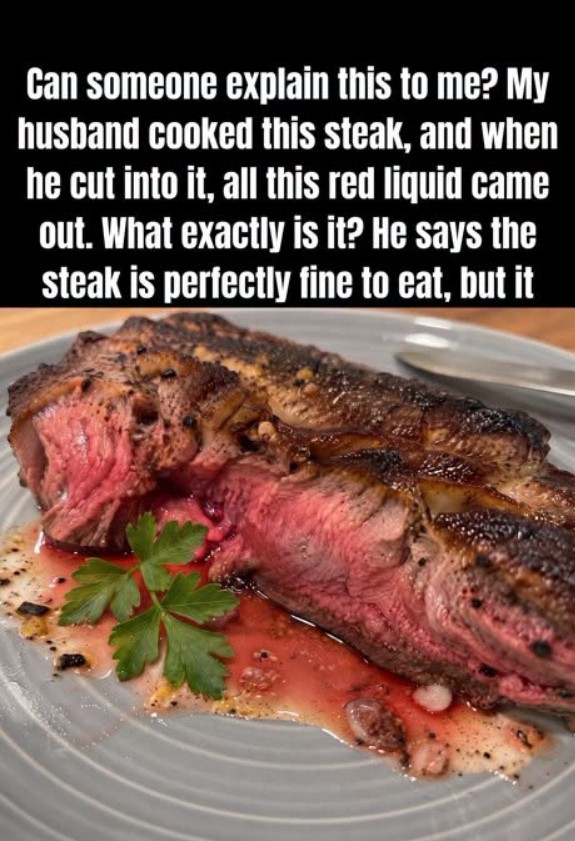
Have you ever brought home a package of steak, ground beef, or another cut of red meat, opened the plastic wrapping, and noticed a small pool of reddish liquid sitting at the bottom?
For many people, that sight immediately raises the same question: Is that blood?
It can certainly look like blood. The deep red color, especially when it collects underneath a steak or around a package of ground beef, can be enough to make someone hesitate before cooking the meat.
Some people even throw meat away because they assume the red liquid means something is wrong with it.
Fortunately, the explanation is much less alarming.
The reddish liquid found in packages of fresh red meat is generally not blood. It is primarily water naturally present in muscle tissue mixed with myoglobin, a protein responsible for much of the characteristic red color of meat. The USDA explains that most blood is removed during slaughter, while the remaining liquid comes largely from natural moisture and proteins in the muscle.
Once you understand what myoglobin is and why moisture comes out of meat during storage, that mysterious red puddle becomes much easier to understand.
So, Is the Red Liquid Blood?
In most cases, no.
There can be very small amounts of residual blood in meat, but commercially processed meat has had most of its blood removed before it reaches the grocery store.
The liquid you see in the package is mainly associated with the natural moisture inside the muscle and proteins such as myoglobin.
The USDA notes that beef is roughly three-quarters water, and that water combined with protein is responsible for much of the liquid that collects inside a package of fresh beef.
This is why calling it “blood” isn’t really accurate.
A better way to think about it is as meat juice or purge: moisture that naturally leaves the muscle tissue during processing, cooling, transportation, and storage.
The red color makes the liquid look much more dramatic than it actually is.
What Exactly Is Myoglobin?
Myoglobin is a naturally occurring protein found inside muscle cells.
Its job in living muscle is connected to oxygen. It helps store and make oxygen available to muscle tissue when it is needed.
But myoglobin has another characteristic that matters when you’re looking at a package of steak.
It contains a pigment that contributes significantly to the color of meat.
That is why beef can appear deep red, bright red, purplish-red, or brownish depending on how much oxygen the meat has been exposed to and how long it has been stored.
The USDA explains that myoglobin is responsible for much of the red color in meat. In its oxygen-free state, myoglobin has a purplish appearance. When exposed to oxygen, it forms oxymyoglobin, which gives fresh beef the familiar bright cherry-red color shoppers often associate with freshness.
So when water escapes from muscle tissue and carries some of these pigments with it, the resulting liquid can look remarkably similar to blood.
That is where the confusion comes from.
Why Does the Liquid Look So Red?
The answer comes down largely to myoglobin and oxygen.
When a fresh piece of beef is protected from oxygen, it can have a darker, purplish-red appearance. This is especially noticeable with vacuum-sealed meat.
Once the surface is exposed to oxygen, the myoglobin reacts with it and produces oxymyoglobin, creating the brighter cherry-red color that shoppers commonly see at the grocery store.
The liquid inside the package can contain some of these same pigments.
As a result, a small amount of water mixed with myoglobin can appear surprisingly red.
The color does not mean that blood is pooling inside the package.
It is simply a visual consequence of the natural chemistry of muscle tissue.
Why Is There Liquid in the Package?
Meat naturally contains a large amount of water.
According to the USDA, muscle is approximately 75 percent water, although the exact amount can vary depending on the cut, type of meat, muscle, and other factors.
During processing and refrigeration, some of that moisture gradually moves out of the muscle.
This can happen while meat is being transported, displayed in refrigerated cases, or stored at home.
The industry may refer to this visible moisture as purge or weep.
Packaging can make the liquid particularly noticeable because it has nowhere else to go. In a sealed or tightly wrapped package, the moisture collects at the bottom rather than simply evaporating.
Vacuum packaging can make this especially obvious because the packaging remains tightly against the meat while the natural juices accumulate inside the package.
That little puddle is therefore not necessarily a sign that anything unusual has happened to the meat.
It can simply be part of the normal storage process.
Why Does Some Meat Have More Liquid Than Other Meat?
You may notice that one package contains almost no visible liquid while another seems to have quite a bit.
That doesn’t necessarily mean one package is better or worse.
The amount of moisture released can vary depending on the type and cut of meat, how it was processed, how it was packaged, how long it has been stored, and other conditions.
Different cuts contain different amounts of fat, connective tissue, and muscle.
The way the meat is handled and cooled can also affect how much moisture eventually appears in the package.
Temperature and packaging methods matter as well.
The USDA explains that meat can release natural moisture during refrigerated storage, and that the visible liquid is a normal result of moisture moving out of the product.
So seeing more juice in one package than another isn’t automatically a reason to reject the meat.
Does Red Liquid Mean the Meat Is Fresh?
Not necessarily.
This is an important distinction.
People often associate bright red meat with freshness, but color alone cannot tell you whether meat is safe to eat.
Oxygen can make fresh beef appear bright cherry red, while meat protected from oxygen can look darker or purplish.
The USDA also notes that color changes can occur naturally during storage and that a change in color alone does not necessarily mean the meat has spoiled.
That means shoppers shouldn’t judge meat entirely by whether it looks bright red.
Instead, consider the package condition, storage temperature, use-by or sell-by information where applicable, and the meat’s smell and texture.
What If the Meat Looks Brown or Gray?
This is another common source of confusion.
Fresh meat does not always have one uniform color.
For example, the outside of ground beef can look bright red while the inside looks grayish-brown.
That can happen because oxygen reaches the surface more easily than the interior.
The USDA explains that oxygen reacts with the pigments on the surface of meat, producing the bright red color shoppers commonly see. The interior may remain grayish-brown because it has less exposure to oxygen.
A color change by itself does not automatically mean the meat is spoiled.
However, if the entire product has developed an unusual gray or brown appearance along with other signs of spoilage, it deserves closer attention.
The USDA advises that spoiled meat may also develop an unpleasant odor or become sticky, tacky, or slimy.
Those characteristics are much more concerning than color alone.
Does the Red Liquid Mean the Meat Is Unsafe?
The presence of reddish liquid by itself does not mean the meat is unsafe.
It is a normal consequence of moisture and myoglobin leaving the muscle tissue.
However, that does not mean every package of meat should automatically be considered safe simply because the liquid looks normal.
Food safety depends on several factors, including proper refrigeration, handling, storage time, packaging condition, and thorough cooking.
Raw meat should always be handled carefully to prevent cross-contamination.
Keep it refrigerated, wash your hands after handling it, clean surfaces and utensils that come into contact with raw meat, and prevent raw juices from coming into contact with ready-to-eat foods.
Most importantly, don’t use the color of the meat or its juices as your only method for deciding whether it is properly cooked.
Why You Shouldn’t Judge Doneness by Color Alone
Another important point about myoglobin is that its color changes during cooking.
Because of this, the appearance of meat isn’t always a reliable indicator of whether it has reached a safe internal temperature.
The USDA explains that meat pigments can behave differently depending on factors such as pH, pigment concentration, and cooking conditions. Ground beef can sometimes remain pink even after reaching temperatures associated with safe cooking.
That is why using a food thermometer is more reliable than simply cutting into the meat and looking at its color.
A steak may look done on the outside while remaining undercooked inside.
Conversely, some meat can retain a pinkish appearance even after reaching an appropriate temperature.
A thermometer removes much of that guesswork.
What Is the Absorbent Pad Under the Meat?
If you’ve ever purchased packaged steaks or ground beef, you may also have noticed a small absorbent pad underneath the meat.
It is there to collect moisture released from the product.
Instead of allowing the liquid to move freely around the package, the pad helps contain it.
This is one reason you may see a red or pink-colored pad when you lift the meat from the tray.
The presence of liquid around or inside the absorbent material is therefore not unusual.
However, the pad itself should never be eaten.
When preparing meat, remove it from the packaging carefully and dispose of the packaging and absorbent material appropriately.
Why Does Vacuum-Packed Meat Look Purple?
If you’ve ever opened vacuum-sealed beef and thought it looked strangely dark or purple, don’t panic immediately.
This appearance can be related to oxygen exposure.
When meat is protected from air, the myoglobin inside it is not in the same oxygenated state responsible for the bright cherry-red color.
Once the package is opened and the meat is exposed to air, the surface can become noticeably redder.
The USDA specifically notes that beef protected from oxygen, such as beef in vacuum packaging, can have a burgundy or purplish color and then become brighter red after exposure to air.
So the color you see immediately after opening a vacuum package isn’t necessarily a sign that the meat is old.
It can simply be a normal response to oxygen.
Does More Red Juice Mean More Water Was Added?
Not necessarily.
It is important to distinguish naturally occurring moisture from products that have had a solution added.
Meat naturally contains a significant amount of water, and some of that moisture can escape during storage.
However, some meat products are also sold with added solutions containing ingredients such as water, salt, or other substances.
When a solution has been added, labeling requirements apply. The USDA explains that products containing added solutions must identify that information on the product label.
So if you are concerned about added water or marinade, check the package label rather than assuming that every puddle of liquid means the meat was injected with water.
Should You Rinse the Meat to Remove the Red Liquid?
There is generally no need to rinse raw meat simply because you see red liquid in the package.
The liquid is not something that needs to be washed away for the meat to become safe.
More importantly, rinsing raw meat can spread contaminated droplets around your sink, counters, utensils, and nearby foods.
Instead, remove the meat from its packaging carefully.
If you want the surface to be drier before searing, you can pat it dry with disposable paper towels and then discard them immediately.
After handling raw meat, wash your hands and clean any surfaces that may have come into contact with the raw product.
Why Does the Liquid Sometimes Seem to Disappear During Cooking?
Once the meat goes into a hot pan, much of the visible liquid disappears.
There are several reasons.
Water naturally evaporates as the meat heats.
At the same time, the proteins and pigments responsible for the meat’s color undergo chemical changes.
The familiar red color therefore begins to change as cooking progresses.
This is one reason the red liquid you saw in the package doesn’t remain as a pool of red fluid on your plate.
The water is being driven off as steam or retained within the cooking process, while the meat’s proteins and pigments change with heat.
What Should You Look for When Buying Meat?
When you’re standing in front of the meat counter, don’t let a little red liquid automatically scare you away.
Instead, pay attention to several factors.
First, check that the package is properly sealed and isn’t leaking.
Second, make sure the meat has been kept properly refrigerated.
Third, check the package date and follow the storage instructions.
Fourth, look at the overall condition of the meat rather than focusing on one color or one small pool of liquid.
And finally, if the meat has an unpleasant odor or feels unusually sticky, tacky, or slimy, don’t ignore those warning signs. The USDA identifies these characteristics as potential signs of spoilage.
The Big Difference Between Blood and Myoglobin
The easiest way to remember all of this is to think about where the two substances are found.
Hemoglobin is the protein associated primarily with blood.
Myoglobin is a protein found in muscle.
Both contain iron, and both can contribute to red coloration, which helps explain why they can be confused visually.
But the reddish liquid in a package of steak is not simply blood leaking from the meat.
Most blood is removed during slaughter, while the liquid you see later is largely natural moisture from the muscle combined with myoglobin and other dissolved components.
Once you know that distinction, the mystery becomes much less unsettling.
The Next Time You Open a Package of Steak
The next time you open a package of steak and notice a red puddle underneath it, you don’t need to assume you’ve discovered something unusual.
That liquid is usually a combination of water naturally present in the muscle and myoglobin, the protein that contributes to the red color of meat.
The meat industry and food-safety authorities have long recognized this as a normal part of storing and packaging fresh meat.
The USDA specifically confirms that the liquid in fresh beef packages is not blood but natural moisture combined with protein from the muscle.
The bright red color can also change depending on how much oxygen reaches the meat.
Fresh beef may appear purplish when protected from oxygen and become bright cherry red when exposed to air. Later, it can become brownish as the pigments change during storage.
None of these observations should be considered a substitute for proper food-safety practices.
Conclusion :
That mysterious red liquid at the bottom of a grocery-store meat package is one of those everyday things that looks much more alarming than it really is.
Although it may resemble blood, the liquid is generally water and myoglobin released from the muscle tissue, along with other naturally occurring components. Most blood is removed during processing, which is why the liquid found in packaged beef should not be thought of as blood pooling inside the package.
Myoglobin is especially important because it explains both the red liquid and many of the color changes you see in fresh meat. When exposed to oxygen, it contributes to the bright red color commonly associated with fresh beef. When oxygen is limited, meat can look darker or purplish. During storage and cooking, additional chemical changes can alter its appearance.
So the next time you open a package and see that familiar reddish puddle, there is no reason to immediately assume something is wrong.
Instead, remember what you’re actually seeing: natural moisture from the muscle carrying some of the pigments that give red meat its characteristic color.
What matters much more for food safety is how the meat has been stored and handled, whether the package is in good condition, whether there are signs of spoilage such as an unpleasant odor or slimy texture, and whether the meat is cooked to an appropriate internal temperature.
Once you understand the science behind that little red puddle, one of the grocery store’s most common food mysteries becomes surprisingly simple.