At first glance, it may seem easy to tell whether someone is a real doctor. A white coat, a stethoscope, and a confident attitude can make a person look like a trained medical professional. However, appearances can sometimes be misleading, and even the smallest detail can reveal something important.
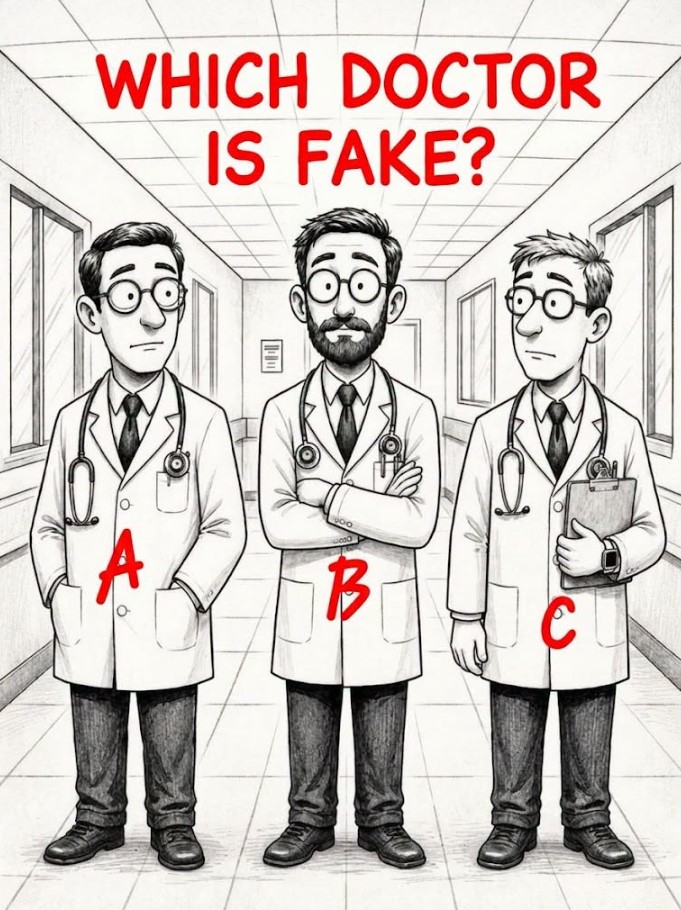
Today’s visual puzzle challenges your observation skills and attention to detail. Three men are standing in what appears to be a hospital hallway. All three are dressed like doctors, and each seems to have the equipment associated with medical work. Yet one small mistake gives away the person who does not belong.
Can you identify the fake doctor without looking at the answer? Take a moment to study the three figures carefully before continuing.
Look Carefully at the Three Doctors
The puzzle presents three men, labeled A, B, and C. At first, they all appear equally convincing, so the solution is not immediately obvious.
Doctor A: The Man With His Hands in His Pockets
Doctor A is wearing a white coat with a stethoscope around his neck. His hands are inside his coat pockets, and he appears relaxed.
Nothing about his posture immediately suggests that something is wrong. His clothing and medical equipment make him look like someone who could work in a hospital or clinic.
However, the challenge is not about who looks the most professional. Instead, it asks you to examine the details of the equipment each person is carrying.
Doctor B: The Man Standing in the Center
Doctor B stands confidently in the middle, with his arms crossed and a stethoscope hanging around his neck. His appearance may seem perfectly normal at first.
Because he is standing confidently and wearing a white coat, many people might not think twice about him. The stethoscope also makes him appear to be a medical professional.
But there is a subtle problem with his equipment. To find it, you need to look closely at the stethoscope rather than concentrating on his clothing or posture.
Doctor C: The Man Holding a Clipboard
Doctor C is holding a clipboard and wearing a stethoscope. Like the other two men, he appears to be dressed appropriately for a medical environment.
A clipboard is commonly used by healthcare professionals to review patient information, write notes, and keep track of important details. His equipment therefore does not immediately raise suspicion.
Still, the key to solving this puzzle is to compare the three stethoscopes and look for something that one of the men is missing.
Can You Find the Fake Doctor?
Before revealing the answer, take another look at the three figures.
Ask yourself these questions:
- Do all three men have complete medical equipment?
- Is there a missing part that would prevent one of them from using his stethoscope?
- Are you paying attention to the small details, or are you judging the men by their appearance?
The trick is that the suspicious detail is not especially obvious when you look at the figures quickly. All three men wear similar clothing, and their general appearance gives the impression that they belong in a hospital.
However, carefully comparing their equipment reveals the important difference.
The Answer: Doctor B Is the Fake Doctor
The correct answer is Doctor B.
The clue is his stethoscope, which is missing its earpieces. Unlike the complete stethoscopes shown on Doctors A and C, his equipment appears to be missing the parts that allow a person to listen through the instrument.
A conventional stethoscope has earpieces that fit into the user’s ears, tubing that carries sound, and a chestpiece placed against the patient’s body. These components work together to help a healthcare professional listen to internal body sounds, including the heartbeat and breathing.
Without the earpieces, the stethoscope shown in the puzzle would not function as intended. This missing detail is the clue that identifies Doctor B as the person the puzzle describes as fake.
The other two men have stethoscopes that appear complete, making Doctor B the intended answer.
Why Is This Puzzle So Easy to Miss?
One reason this puzzle can fool people is that we often make quick judgments based on appearance. When someone wears a white coat and carries medical equipment, we may automatically assume that the person is a doctor.
This is a common shortcut our brains use to process visual information quickly. In everyday life, it can be useful, but it can also cause us to overlook small inconsistencies.
The puzzle encourages you to slow down and examine what is actually visible instead of accepting the first impression.
1. We Often Notice Clothing Before Details
White coats and stethoscopes are strongly associated with doctors. Because these items immediately suggest a medical profession, they can distract us from noticing whether the equipment is complete.
The solution becomes easier when you stop looking at the overall appearance and focus on individual objects.
2. Small Mistakes Can Reveal Important Clues
The missing earpieces are a small detail, but they make a difference to how the stethoscope works.
Many visual puzzles use the same technique. The answer may depend on an incorrect object, an unusual shadow, an impossible position, or something that does not match the rest of the picture.
Training yourself to notice these details can make similar challenges easier to solve.
3. Confidence Does Not Always Mean Knowledge
Doctor B looks confident, just like someone who belongs in a hospital. But confidence alone cannot prove that someone has the qualifications or knowledge needed for a particular profession.
The puzzle uses this idea to remind us that appearances can be deceiving. It is better to examine the available evidence than to make assumptions based only on how someone looks.
What Can You Learn From This Visual Challenge?
Although the puzzle is designed primarily for entertainment, it offers a simple lesson about observation and critical thinking.
When you face a visual challenge, try comparing similar objects instead of examining each one separately. Differences often become more noticeable when you look at several items side by side.
You can also make a habit of asking yourself what information supports your conclusion. Rather than choosing the person who looks suspicious, identify a specific detail that explains why your answer makes sense.
These techniques can be useful when solving picture puzzles, finding errors in illustrations, or completing activities that require concentration.
However, it is important to remember that this is only a visual brain teaser. In real life, a missing or incorrectly positioned piece of equipment would not, by itself, prove that someone was impersonating a doctor. A person’s professional credentials and authorization must be verified through appropriate official sources.
How to Improve Your Observation Skills
If you enjoy challenges like this one, you can practice with a few simple habits.
Look at the whole picture first. Notice how many people or objects appear and how they relate to one another.
Compare similar items. If several people are carrying the same type of equipment, look for differences in shape, position, or missing components.
Avoid rushing. Give yourself a few seconds to examine the details before deciding.
Explain your answer. Try to identify the exact clue that supports your choice. This makes your reasoning clearer and helps you avoid random guesses.
Try different types of puzzles. Picture riddles, spot-the-difference games, and visual logic challenges can all provide opportunities to practice careful observation.
You do not need to solve every puzzle immediately. The goal is to enjoy the challenge, think carefully, and learn to notice things that might otherwise escape your attention.
Conclusion :
The answer to “Which Doctor Is Fake?” is Doctor B, whose stethoscope is missing its earpieces. At first glance, all three men look like they belong in a hospital. They wear white coats, carry medical equipment, and appear confident in their roles. However, when you take a closer look, one small detail changes everything. Doctor B’s incomplete stethoscope is the clue that helps solve the mystery.
This visual challenge reminds us that sometimes the smallest details are the most important. We often make quick judgments based on what we see first, especially when something looks familiar. A white coat and a stethoscope may immediately make us think of a doctor, but looking professional is not the same as proving that someone has the knowledge, training, and qualifications required for the job. By comparing the equipment carefully, you can move beyond first impressions and discover the detail you might otherwise have missed.
The fun of this puzzle is that the answer is hidden in plain sight. You do not need special medical knowledge to solve it; you simply need patience, concentration, and a willingness to look a little closer. That is what makes visual riddles so enjoyable. They encourage us to slow down, examine the evidence, and think before making a decision. Even if you did not identify Doctor B immediately, there is no reason to feel disappointed. Sometimes, knowing what to look for makes the solution much clearer the second time around.
You can also use this kind of challenge as a fun way to test your observation skills with friends and family. Show them the picture without revealing the answer and give them a few seconds to study all three doctors. Some may focus on their clothing, while others may examine their posture or medical equipment. It can be interesting to see who spots the missing earpieces first and how each person explains their choice.
Of course, in real life, a missing piece of equipment would not be enough to prove that someone is pretending to be a doctor. The puzzle offers a simplified clue for entertainment, while real medical credentials must be verified through reliable official sources.
So, did you spot the fake doctor before reading the explanation, or did Doctor B fool you at first? Share the puzzle with someone who enjoys brain teasers and see whether they can find the answer on their own. Remember to let them examine the picture before giving away the clue!
Sometimes, the difference between a wrong guess and the right answer comes down to one small detail. Look carefully, question your first impression, and never underestimate the power of observation. After all, the most obvious answer is not always the correct one, and the truth may be hiding right in front of you.