
Have you ever wondered what happens to the human body after death? Although the heart stops beating and breathing comes to an end, the cells and tissues inside the body do not all stop functioning at exactly the same moment.
Some tissues are much more sensitive to the loss of oxygen and blood circulation than others. This raises an interesting question: Which organ can remain suitable for medical donation for the longest time after a person dies?
Let’s test your knowledge with a quick challenge!
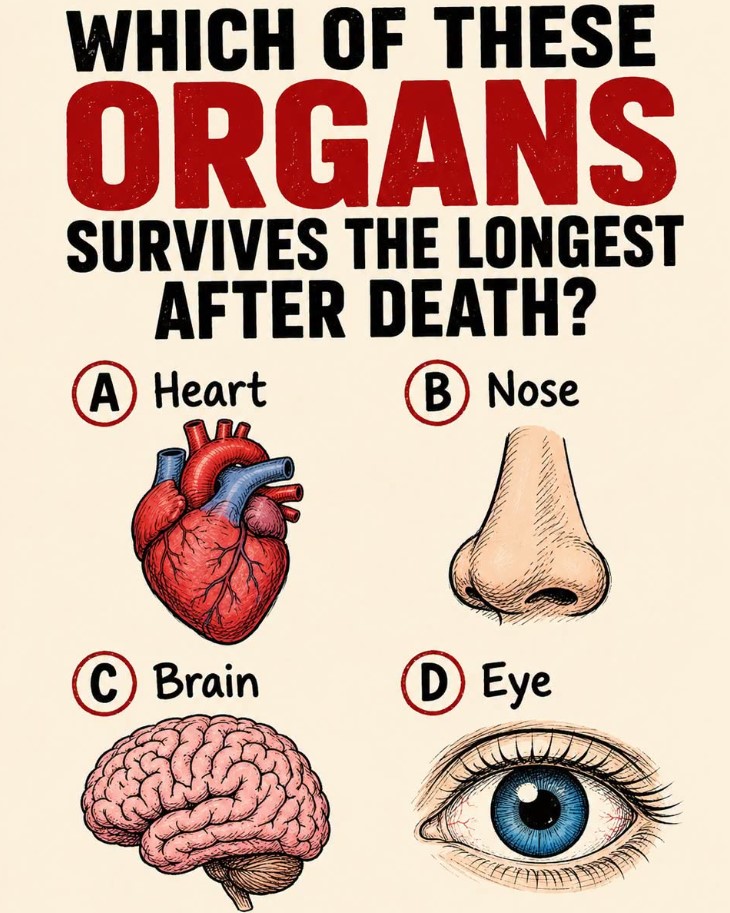
The Question: Which Organ Survives the Longest After Death?
Take a look at the four possible answers below:
A. Heart
B. Nose
C. Brain
D. Eye
Which one would you choose?
Many people immediately think of the heart because it is responsible for pumping blood throughout the body. Others might select the brain because it controls essential functions, memories, thoughts, and movements.
The nose may seem like an unusual possibility, while the eye might not be the first organ that comes to mind.
Before continuing, take a few seconds to make your choice. You might be surprised by the correct answer!
Why Doesn’t Every Organ Stop Functioning at the Same Time?
When a person dies, blood circulation and the delivery of oxygen to the body’s tissues stop. Without a fresh supply of oxygen and nutrients, cells begin to experience damage.
However, different cells respond differently to these conditions.
Some are extremely sensitive to oxygen deprivation, while others can remain suitable for medical use for a longer period under carefully controlled conditions.
This is why doctors and medical specialists must act quickly when recovering organs and tissues for transplantation. The timing depends on the type of tissue, the circumstances of death, and how it is preserved.
What Happens to the Brain After Death?
The brain is one of the body’s most important and oxygen-dependent organs. It requires a continuous supply of oxygen and nutrients to support its many functions.
When blood flow to the brain stops, its normal activity is quickly disrupted. Brain function can cease within seconds after cardiac arrest, and some brain cells begin to suffer serious damage within minutes.
However, it is important to understand that all brain cells do not necessarily die at the same moment. The process of cellular damage and death can continue over a longer period.
This is one reason why restoring circulation quickly during a medical emergency is so important.
Although the brain is remarkably complex, it is not the correct answer to this particular challenge.
What About the Heart?
The heart is another strong candidate because it is made of specialized muscle tissue that keeps working continuously throughout life.
Even after circulation stops, some heart cells do not immediately lose all their biological activity. Under appropriate medical conditions, a donor heart can sometimes be recovered and transplanted within a limited period after death.
However, the heart still depends on oxygen, nutrients, and proper preservation to remain suitable for transplantation.
It is an extraordinary organ, but it is not the answer expected in this puzzle.
Could the Nose Be the Answer?
The nose is made up of several different tissues, including skin, cartilage, blood vessels, nerves, and connective tissue.
Cartilage has a different structure from many other tissues in the body. It does not contain its own blood vessels and receives nutrients through surrounding tissues.
This can make cartilage behave differently when blood circulation stops.
Nevertheless, the nose is not generally considered the correct answer when comparing the four options in terms of tissue donation and transplantation.
Its external shape may remain recognizable long after death, but that is not the same as saying its tissues remain alive or suitable for transplantation.
The Surprising Role of the Eye
Here is where the question becomes especially interesting.
The correct answer is D. Eye, but there is an important detail worth understanding: the main reason is the cornea.
The cornea is the clear, curved layer at the front of the eye. It allows light to enter and helps focus it so that we can see clearly.
Unlike many other tissues, the cornea does not have its own blood vessels. Instead, it receives oxygen and nutrients from tears and surrounding fluids.
This special structure helps explain why corneal tissue can remain suitable for donation after a person has died.
Eye banks carefully recover, examine, and preserve donated corneas so they can be used in transplant procedures. These procedures can restore or improve vision for people whose corneas have been damaged by disease, injury, or other conditions.
How Long Can a Donated Cornea Be Preserved?
Corneal donation is time-sensitive, but the tissue does not necessarily need to be transplanted immediately after recovery.
The recovery process usually takes place within hours after death, although the exact time allowed depends on local medical guidelines and circumstances.
Once recovered, corneas can be placed in special preservation solutions. In the United States, commonly used preservation media can maintain corneal cells for up to 14 days, allowing medical teams to examine the tissue and prepare it for surgery.
This does not mean that the entire eye remains alive for two weeks. It means that properly recovered and preserved corneal tissue can remain suitable for transplantation during that period.
That distinction is important because the eye is a complex organ, and different parts of it respond differently after death.
Why Is Cornea Donation So Important?
Cornea donation gives people with serious vision problems an opportunity to see more clearly again.
When the cornea becomes cloudy, scarred, or damaged, light may no longer pass through it properly. In suitable cases, surgeons can replace the damaged corneal tissue with healthy donor tissue.
The procedure is known as a corneal transplant.
For many recipients, this donation can make a meaningful difference in everyday life. It may help them read, recognize faces, work, and enjoy activities that have become difficult because of poor vision.
It is also a remarkable example of how one person’s generosity can help another person long after their death.
So, What Is the Correct Answer?
If you selected D. Eye, congratulations! You found the answer to the challenge.
More precisely, it is the cornea, the transparent tissue at the front of the eye, that can remain suitable for transplantation after death when it is recovered and preserved properly.
The heart, brain, and nose all have their own biological characteristics, but the cornea is the surprising answer among the four choices.
Final Thoughts
The human body is full of fascinating details that many of us never think about. We usually associate life after death with the immediate stopping of the heart and brain, but the biological processes inside the body are more complicated than that.
Different cells and tissues respond to the loss of oxygen in different ways. Some become damaged very quickly, while others can remain useful for medical purposes under the right conditions.
The cornea is a wonderful example. Although it is only a small part of the eye, it plays an essential role in vision and can help restore sight through donation and transplantation.
Did you choose the eye before reading the explanation, or did another option seem more convincing? Share your answer and challenge your friends and family to see whether they can solve this interesting science question!