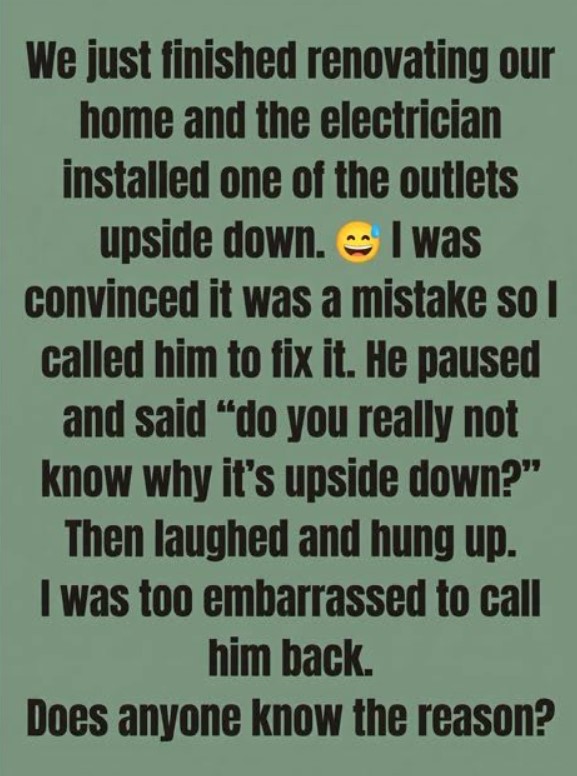
Have you ever walked into a room, looked at an electrical outlet, and suddenly noticed that it appears to be installed upside down?
You may have seen the familiar arrangement countless times without ever thinking about it: two narrow vertical slots near the top and a small round grounding opening underneath. But occasionally, you will come across an outlet that seems to be reversed, with the round grounding hole positioned above the two vertical slots.
At first glance, it can look like someone simply made a mistake during installation. After all, if most of the outlets in a home face one direction, why would one be installed differently?
Interestingly, an upside-down wall outlet is not necessarily a sign of poor workmanship. There are several reasons an electrician or homeowner might choose that orientation. Sometimes it can relate to safety preferences, sometimes it can be used as a visual clue for a particular circuit, and sometimes there may be no special reason at all.
Understanding the difference can help you look at the electrical outlets around your home a little differently.
What Does “Upside Down” Mean?
When people describe an electrical outlet as being “upside down,” they are usually referring to the orientation of a standard North American-style receptacle.
In the more familiar position, you will generally see:
- Two narrow vertical slots positioned toward the top
- A round grounding opening underneath them
When the receptacle is rotated 180 degrees, the arrangement is reversed:
- The round grounding opening is at the top
- The two vertical slots are underneath
The important point is that rotating a standard receptacle does not automatically change the way the receptacle functions. An outlet does not suddenly become a different type of outlet simply because it has been turned around.
The interesting question is therefore not whether an upside-down outlet works differently, but rather why someone chose to install it that way.
And there can be more than one answer.
1. It Can Be Related to a Safety Preference
One commonly discussed reason for installing an outlet with the grounding hole on top involves plugs that have a grounding pin.
Imagine that a plug is not completely inserted into the receptacle. The plug is partially pulled out, leaving part of its metal connection exposed. In certain situations, a conductive object could potentially fall against the exposed portion of the plug.
With the grounding opening positioned above the other contacts, the grounding pin may engage before the other plug contacts in some circumstances.
This is one reason some electricians and homeowners prefer to install receptacles with the grounding hole facing upward.
However, there is an important distinction to keep in mind: the orientation of an outlet should not be treated as a substitute for proper electrical protection.
A safe electrical installation depends on many factors, including correctly installed wiring, appropriate grounding, circuit breakers, and required protective devices such as GFCI protection.
In other words, simply turning an outlet upside down does not automatically make an electrical system safer.
It is better understood as a particular installation preference that some people use for an additional consideration rather than as a complete safety solution.
2. It May Be Used to Identify a Special Circuit
Another possible reason you might find one upside-down receptacle in a room full of normally oriented outlets is identification.
Electricians sometimes use the physical orientation of a receptacle as a visual clue. An outlet facing the opposite direction may indicate that it is connected to a particular type of circuit or has a special function.
For example, an electrician may use the unusual orientation to make it easier to recognize a receptacle that differs from the others.
This can be useful when several outlets are located close together and someone needs to know that one of them is wired or controlled differently.
But there is an important limitation.
There is no universal rule saying that every upside-down outlet represents a special circuit.
One electrician might use orientation as an identifier, while another might use labels, different receptacle types, colors, or another method entirely. Some electricians may not use orientation as an identifier at all.
Therefore, seeing an upside-down receptacle should not automatically lead you to assume that it has a special electrical function.
The orientation can provide a clue, but it cannot tell you exactly how the circuit is wired.
3. The Outlet May Be Controlled by a Wall Switch
Another common situation involves switched receptacles.
In some homes, a wall outlet is connected to a wall switch. This means that turning the wall switch on or off can control the electricity supplied to the receptacle, or to one portion of a receptacle.
This arrangement can be particularly useful in rooms where there is no ceiling light or where homeowners want to control a lamp from a convenient wall switch.
For example, instead of walking over to a lamp every evening to turn it on, you can plug the lamp into a switched receptacle and control it using the wall switch.
Some electricians or homeowners may choose to install such a receptacle in a different orientation as a visual reminder that it is associated with a switched circuit.
However, once again, this is not a universal standard.
A switched receptacle does not have to be installed upside down, and an upside-down receptacle does not necessarily mean that it is controlled by a switch.
The physical orientation by itself cannot tell you what is happening electrically.
If you want to know whether a receptacle is switched, you need to test it or determine how the circuit is wired.
4. The Electrician May Have Simply Installed It That Way
Sometimes the explanation is much less complicated.
The electrician may simply have installed the receptacle in that orientation.
Not every difference you see in a home has a hidden meaning.
Electrical receptacles can be installed with the grounding opening facing either direction depending on local practices, installer preference, the design of the installation, or the circumstances of the particular project.
If you notice one upside-down outlet in your home, it does not automatically mean that something is wrong.
It is also possible that a previous homeowner, electrician, or contractor replaced the receptacle and chose a different orientation from the one that was there previously.
This is one reason you should avoid making assumptions based solely on how an outlet looks.
Why Do Most Outlets Look the Same?
If an outlet can be installed either way, you may wonder why most outlets in a home tend to have the same orientation.
Part of the answer is simply consistency.
When electricians install multiple receptacles in the same room, keeping them oriented in the same direction creates a uniform appearance. It also makes the electrical installation look organized.
A homeowner walking into a room may never give outlet orientation a second thought because all of the receptacles look identical.
That consistency can also make an unusual outlet stand out.
If nearly every receptacle has the grounding opening underneath the vertical slots and one suddenly has the grounding opening on top, it naturally catches your attention.
But that difference does not necessarily indicate a problem.
Does an Upside-Down Outlet Work Differently?
Generally, simply rotating a standard receptacle does not change its basic function.
The receptacle still provides the electrical connection it was designed to provide. What matters much more is how the circuit has been wired, whether the receptacle is properly grounded, and whether the appropriate electrical protection has been installed.
This is an important distinction because the visual appearance of an electrical outlet can sometimes be misleading.
Two outlets can look identical while being connected to different circuits, and two outlets facing different directions can perform essentially the same basic function.
The orientation alone is therefore not enough to determine how an outlet is wired.
What About Safety?
Electrical safety involves much more than deciding whether the grounding hole should face upward or downward.
Proper wiring, grounding, circuit protection, and correctly installed protective devices are fundamental parts of a safe electrical system.
For example, GFCI protection is important in locations where it is required because it can help protect people from certain types of electrical shock hazards.
Circuit breakers also play a critical role by helping protect electrical circuits from excessive current.
These protections matter far more than the simple visual orientation of a receptacle.
So, if you discover an upside-down outlet in your home, there is usually no reason to panic simply because it looks different from the others.
The orientation itself does not prove that the outlet is dangerous or incorrectly installed.
Should You Turn It Around Yourself?
If an upside-down outlet bothers you because you prefer all the receptacles in your home to face the same direction, it may be tempting to remove the cover plate and rotate it yourself.
However, electrical work should be approached carefully.
Even a seemingly simple receptacle can be connected to energized wiring. Turning or replacing an outlet incorrectly can create a shock hazard, damage the wiring, or result in an improperly grounded connection.
If you are not experienced with electrical work, it is safer to have a qualified electrician inspect or modify the receptacle.
This is especially important if you notice additional warning signs such as:
- Sparks coming from the outlet
- A burning smell
- Discoloration or scorch marks
- Loose receptacles
- Buzzing or crackling sounds
- A receptacle that feels unusually warm
- Plugs that fall out easily
- Frequently tripped breakers
Those signs are more important than whether the grounding opening is on the top or bottom.
What If Only One Outlet Is Upside Down?
If you have several normal-looking outlets and notice one that is installed upside down, don’t immediately assume it was installed incorrectly.
It could have been intentionally oriented that way to identify a switched receptacle or another type of circuit. It could reflect an electrician’s preferred installation method. It could also simply be the way that particular receptacle was installed.
If you are curious, you can look for other clues.
For example, see whether the outlet is controlled by a nearby wall switch. You can also check whether it is located in an area where a particular electrical function might be expected.
But remember that appearance alone cannot confirm how the circuit works.
When there is uncertainty, an electrician can determine how the receptacle is actually wired.
The Small Detail You Probably Never Noticed
Wall outlets are so common that most of us rarely pay attention to them.
We plug in our phones, lamps, televisions, computers, kitchen appliances, and countless other devices without thinking about the orientation of the receptacle.
That is why discovering an upside-down outlet can suddenly seem strange.
Once you notice one, however, you may start seeing them everywhere.
The important thing to remember is that an upside-down receptacle is not automatically evidence of an installation mistake. There are several legitimate reasons why someone might choose that orientation, and in many situations it has no effect on the basic operation of the outlet.
At the same time, you should not assume that every upside-down receptacle has a hidden purpose. Orientation is sometimes used as a visual clue, but it is not a universal electrical code or a guaranteed indicator of a particular circuit.
Final Thoughts :
So, why are some wall outlets installed upside down?
The answer is that there isn’t one universal explanation.
An upside-down receptacle may reflect a safety-related preference involving the grounding pin. It may have been used by an electrician as a visual identifier for a switched or special circuit. It may be associated with a wall switch. Or, in some cases, the electrician may simply have installed the receptacle that way.
The most important point is that the orientation itself does not determine whether an outlet is safe or unsafe.
Proper wiring, grounding, circuit protection, and appropriate electrical safety devices are much more significant factors.
So the next time you notice an outlet with the round grounding opening on top, you don’t necessarily need to assume that somebody made a mistake. It may simply be an intentional choice—or it may have a perfectly ordinary explanation that has nothing to do with a special function.
Sometimes the smallest details in a home have a story behind them, and an upside-down wall outlet is a perfect example.