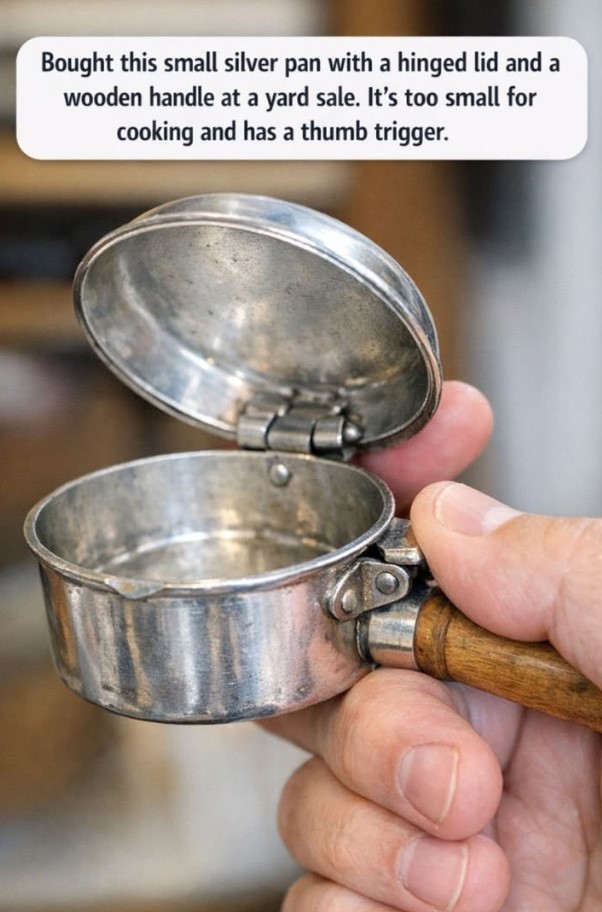
Finding unusual items at yard sales or flea markets can be exciting—but also confusing. Sometimes you come across objects that look familiar at first glance, yet something feels off. A small silver pan with a hinged lid and a wooden handle might seem like cookware, but if it’s too small to cook with and has a strange thumb mechanism, it raises questions.
Is it decorative? Is it part of a larger tool? Or does it serve a completely different purpose?
Items like this often turn out to be clever tools from the past—objects designed for very specific uses that aren’t common today. And once you know what it is, it suddenly makes perfect sense.
What this object actually is
This item is most likely a vintage crumb catcher (crumb pan).
These were commonly used in the past—especially in homes with tablecloths or formal dining setups.
Its purpose was simple:
- To collect crumbs from tables, counters, or laps
- Often used alongside a small brush
Some versions include:
- A hinged lid to trap crumbs inside
- A wooden handle for comfort
- A thumb trigger to open and close the lid easily
Vintage listings show very similar items described as crumb pans with hinged lids and wooden handles.
Why it looks like a tiny pan
It’s easy to mistake it for cookware because:
- It’s made of metal (often silver or silver-plated)
- It has a pan-like shape
- It includes a lid and handle
But it was never meant for cooking.
Instead, the design was chosen because:
- The shallow shape makes it easy to scoop crumbs
- The lid helps keep everything contained
- The handle keeps hands clean while using it
What is the thumb trigger for?
The thumb trigger is one of the most distinctive features.
It allows you to:
- Open the lid with one hand
- Close it quickly after collecting crumbs
This made it practical for cleaning tables during or after meals without making a mess.
How it was used
Here’s how people typically used it:
- Hold the pan in one hand
- Use a small brush (or even a napkin) in the other
- Sweep crumbs into the pan
- Close the lid using the thumb trigger
This was especially common in:
- Formal dining settings
- Restaurants
- Homes with tablecloths
Why you don’t see them anymore
Crumb catchers were more popular in the past because:
- Table settings were more formal
- Tablecloths were used daily
- Cleaning methods were different
Today, people usually:
- Wipe tables with cloths
- Use vacuum cleaners
- Skip formal table service
So these tools gradually disappeared from everyday use.
Could it be something else?
There are a few similar-looking items, but they’re less likely:
- Small decorative pans (usually lack the trigger)
- Antique cookware (larger and functional)
- Even novelty items
For example, some antique pans with lids exist, but they are designed for cooking and are much larger or lack the trigger mechanism.
The thumb trigger + small size + lid combo strongly points to a crumb pan.
Is it valuable?
It depends on a few factors:
- Material (silver-plated vs solid silver)
- Condition
- Age and design
Some vintage crumb pans sell for:
- Around $20–$40 for common pieces
- More if they are antique or high-quality
So while it may not be extremely valuable, it can still be a nice collectible.
Conclusion :
What looks like a mysterious tiny pan is actually a clever and practical tool from the past. This small silver item with a hinged lid and thumb trigger is most likely a crumb catcher—a once-common household accessory designed to keep dining areas clean and tidy.
Its unusual design makes much more sense once you understand its purpose. The shallow pan shape helps collect crumbs, the lid keeps them contained, and the trigger allows for easy one-handed use. It’s a simple but thoughtful solution from a time when table presentation and cleanliness were taken very seriously.
Today, these items have become rare not because they weren’t useful, but because modern habits and tools replaced them. That’s what makes finding one so interesting—it’s a small glimpse into everyday life from another era.
So instead of a strange or useless object, you’ve actually found a piece of practical history—something that once played a quiet but important role at the dining table.