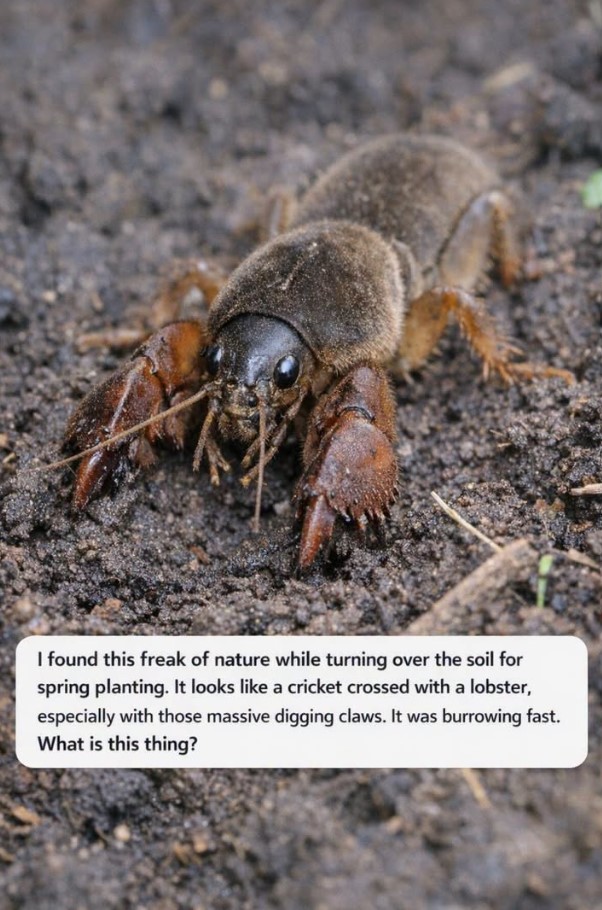
There’s nothing quite like the surprise of uncovering an unusual creature while working in the garden. One moment you’re preparing the soil for flowers or vegetables, and the next you’re staring at something that looks like it came straight out of a science fiction movie. With oversized front claws, a velvety body, and lightning-fast burrowing skills, this strange insect has left countless gardeners scratching their heads. Is it dangerous? Is it rare? Or is it simply one of nature’s misunderstood little engineers?
If you’ve ever spotted a bug that resembles a cross between a cricket and a tiny lobster, you’re not alone. The good news is that this mysterious creature has a name—and its story is far more fascinating than its appearance suggests.
Meet the Mole Cricket: Nature’s Underground Specialist
The unusual insect in question is known as the mole cricket. Despite its intimidating claws, it isn’t part lobster or crab. Instead, it’s a fascinating type of cricket that has evolved to spend most of its life underground.
Its enlarged front legs work like miniature shovels, allowing it to tunnel through loose soil with incredible speed. These specialized limbs make the mole cricket one of the best diggers in the insect world, perfectly adapted for life beneath the surface.
Unlike common crickets that hop around lawns at night, mole crickets prefer to stay hidden, creating underground tunnels where they search for food and protection.
Why Does It Have Those Huge Claws?
The mole cricket’s front legs often surprise first-time observers because they resemble tiny lobster pincers. However, they aren’t used for grabbing prey.
Instead, they function as powerful digging tools that help the insect:
- Build complex underground tunnel systems.
- Escape predators quickly.
- Search for roots, insects, and organic material.
- Create safe nesting areas.
Its entire body is designed for burrowing, with a rounded shape that allows it to move easily through the soil.
Where Are Mole Crickets Commonly Found?
Mole crickets thrive in areas with soft, moist soil. They’re commonly found in:
- Vegetable gardens
- Flower beds
- Lawns
- Golf courses
- Agricultural fields
- Meadows and grassy landscapes
Because they spend most of their time underground, many people never realize they’re living nearby until they accidentally uncover one while digging.
Should You Be Worried?
For people, the answer is generally no.
Mole crickets are not poisonous, and they don’t actively seek out humans. They rarely bite, and even if they do, it’s usually only when handled roughly. Their digging claws may look fierce, but they’re designed for soil—not for attacking people.
They’re more interested in disappearing back underground than confronting anything larger than themselves.
Can They Damage Gardens?
This depends on the species and the size of the population.
Some mole cricket species feed on:
- Grass roots
- Young seedlings
- Plant roots
- Small insects
- Organic matter
Large infestations can damage lawns by loosening the soil beneath the grass, creating brown patches and weakening root systems. Young vegetable plants may also suffer if their roots are disturbed.
However, finding a single mole cricket in your garden isn’t necessarily a reason for concern.
Are They Helpful in Any Way?
Like many insects, mole crickets play both positive and negative roles in the ecosystem.
Their tunneling helps:
- Improve soil aeration.
- Increase water movement through the ground.
- Mix organic material into the soil.
- Create habitats for beneficial microorganisms.
Some species also consume other small insects, contributing to the natural balance of garden ecosystems.
Why Do They Burrow So Quickly?
If you’ve ever tried catching one, you’ve probably noticed how fast it disappears.
Mole crickets can dig remarkably quickly using synchronized movements of their powerful front legs. Within seconds, they can vanish beneath loose soil, making them surprisingly difficult to observe for long.
This rapid escape helps protect them from birds, reptiles, and other predators.
What Should You Do If You Find One?
If you discover a mole cricket while gardening:
- Observe it for a moment if you’re curious.
- Avoid handling it unless necessary.
- If it isn’t causing visible plant damage, consider leaving it alone.
- Monitor your garden for signs of widespread root damage before deciding on any control measures.
Most home gardeners encounter only an occasional mole cricket, which rarely requires intervention.
Fun Facts About Mole Crickets
Here are a few interesting facts that make these insects even more remarkable:
- They can spend most of their lives underground.
- Male mole crickets build special chambers that amplify their mating calls.
- Some species are capable of short flights.
- They have existed for millions of years with very little evolutionary change.
- Their digging legs are considered one of the most specialized limb adaptations among insects.
Final Thoughts
At first glance, a mole cricket may seem like something from another planet—a bizarre blend of cricket, lobster, and tiny digging machine. Its oversized claws, unusual body shape, and rapid burrowing behavior can certainly startle anyone turning over garden soil for the first time. Fortunately, this strange-looking insect is a natural part of many ecosystems and is far less frightening than its appearance suggests.
While large populations can occasionally become a nuisance in lawns or gardens, an isolated encounter is usually nothing more than an opportunity to appreciate one of nature’s most unique creations. Understanding what a mole cricket is—and why it looks the way it does—helps replace surprise with curiosity. The next time you uncover one while planting flowers or vegetables, you’ll know you’re looking at an incredible underground specialist that has mastered life beneath the soil. Nature is full of remarkable creatures, and the mole cricket is a perfect reminder that some of the most fascinating ones are hiding just beneath our feet.