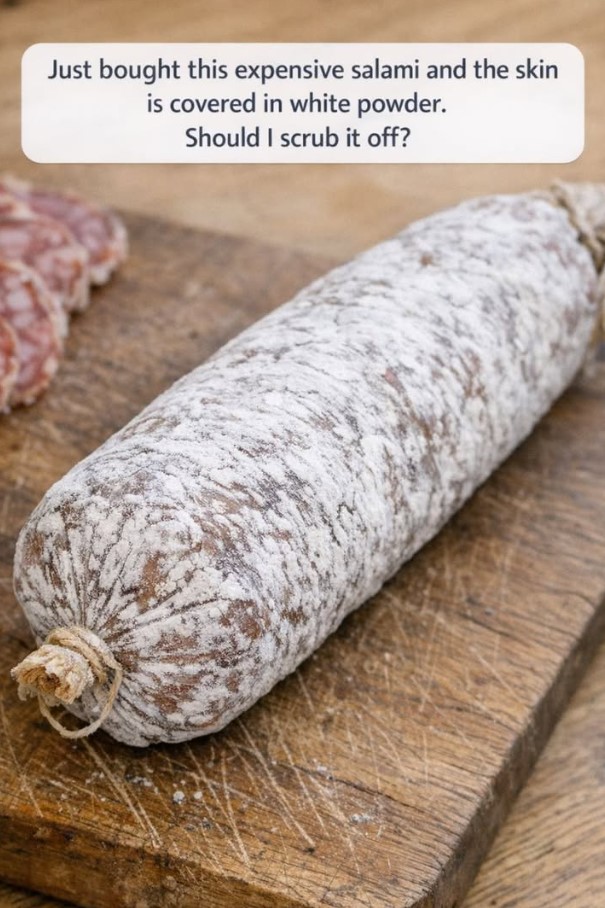
You open a beautifully packaged, expensive salami expecting a rich, savory treat, only to notice that the outside is covered with what looks like a layer of white dust. Your first thought may be that the meat has gone bad. Should you wash it? Scrub it? Peel the casing away? Or, perhaps, throw the entire salami in the trash?
Fortunately, a white coating on a dry-cured salami is not automatically a sign of spoilage. In fact, a pale, dry, powdery surface can be a normal and intentional part of traditional salami production. Certain molds are deliberately encouraged during fermentation and aging because they can help protect the surface and contribute to the development of the product’s characteristic flavor. USDA guidance notes that dry-white mold is commonly seen on fermented and dried sausages and is generally considered beneficial, although not every type of mold is desirable.
Still, it is important not to assume that every white substance—or every mold-covered sausage—is safe. The appearance, texture, smell, packaging instructions, and type of salami all matter. Here’s what you should know before reaching for the scrub brush.
What Is the White Powder on Salami?
That white coating is often a surface mold associated with the curing process. In traditionally made dry-cured sausages, beneficial molds can grow on the casing while the salami ferments and dries.
One commonly used species is Penicillium nalgiovense, a mold that can be intentionally introduced during production. It forms a pale coating over the casing and can help create an environment that discourages some undesirable microorganisms while contributing to the flavor and appearance of aged sausage.
USDA materials specifically explain that molds may be deliberately added to dry and semi-dry products for quality and flavor-development purposes. Dry-white mold is frequently seen on fermented and dried sausages and is generally considered a desirable type of mold.
So, if you bought a properly produced dry salami and found an even, dry, white coating over the outside, there may be nothing wrong with it at all.
Why Would Anyone Want Mold on Salami?
It sounds strange at first. Most people associate mold with food that belongs in the garbage. But food production is more complicated than that.
Certain molds are useful in controlled fermentation and aging processes. On dry-cured meats, the surface culture can become part of the environment that develops as the sausage ages. It may help influence the aroma, texture, and flavor of the finished product.
The mold also forms part of the characteristic appearance of many traditional cured sausages. In other words, that dusty-looking exterior can actually be evidence that the product has gone through a deliberate aging process rather than an indication that someone forgot about it in the refrigerator.
However, the important word here is controlled. A commercial salami is produced under specific conditions, and you should not assume that any mold growing on meat at home is automatically beneficial.
Does the White Coating Mean the Salami Is Safe?
Not necessarily.
A normal-looking white coating is reassuring when it appears on a commercially produced dry-cured salami, but appearance alone cannot guarantee food safety.
Pay attention to the product’s packaging and storage instructions. USDA guidance says whole, unopened hard or dry sausages such as pepperoni and Genoa salami can have substantially longer storage lives than fresh sausage; once opened, USDA recommends refrigeration and gives about three weeks as a general storage period for these products.
The exact recommendation can vary by product, so the manufacturer’s instructions should take priority.
Also examine the salami carefully before eating it.
How to Tell Normal White Mold From a Problem
The color of the surface is only one clue. You should consider the overall appearance and condition of the salami.
A normal curing-related coating is generally:
- White or pale in appearance
- Dry and powdery
- Relatively even across the surface
- Associated with a normal cured-meat aroma
- Found on an appropriately packaged dry-cured product
Be more cautious if you see unusual growth that is spreading in a way that doesn’t match the expected appearance of the product, particularly if it is accompanied by other signs of deterioration.
Green, black, pink, or unusually colored growth deserves particular caution. However, color alone is not a perfect way to identify a dangerous mold. USDA guidance notes that most molds found on dry-cured products may be harmless, while some undesirable molds can cause problems, and color isn’t necessarily a reliable indicator by itself.
If the salami has an obviously unpleasant odor, a slimy or unusually sticky surface, damaged packaging, or other signs of spoilage, don’t try to rescue it simply by wiping the outside.
What About a Sour or Ammonia-Like Smell?
Aged salami naturally has a strong aroma, so a powerful smell isn’t automatically evidence of spoilage. But there’s a difference between the characteristic smell of cured meat and an unmistakably unpleasant odor.
If the product smells rotten, unusually sour, chemical-like, or otherwise wrong to you, don’t rely on scrubbing the casing to make it safe.
USDA notes that spoilage can involve changes in odor and texture, including unpleasant odors and a sticky or slimy surface.
When you’re dealing with meat, uncertainty is a good reason to be conservative.
Should You Scrub the White Powder Off?
If the coating is an intentional curing mold and the salami is otherwise in good condition, there is usually no need to aggressively scrub it away.
Whether you want to remove the casing is largely a matter of the particular product and your preference. Some salami casings are intended to be removed before eating, while others may be edible.
The safest approach is to follow the producer’s instructions rather than automatically washing or scrubbing the sausage.
USDA’s guidance for commercial processing is also important here: when mold is managed during production, establishments may package products with the mold remaining on or remove it with appropriate brushing procedures. The agency specifically warns that washing mold off with hoses can create cross-contamination concerns.
That means the idea of putting a cured sausage under running water and aggressively scrubbing it isn’t necessarily the best solution.
What If I Don’t Like the Idea of Eating the Mold?
That’s completely understandable.
Even when a surface mold is part of the traditional curing process, you don’t have to eat it if the product’s instructions allow for removal of the casing.
Many people simply remove the outer casing before slicing the salami. If the casing is meant to be discarded, peeling it away can also give you a cleaner texture and a milder flavor.
The important distinction is that removing a normal casing is not the same as trying to save spoiled meat. If the salami has clear signs of deterioration, don’t assume that removing the outside will make the interior safe.
What About Rice Flour or Other White Coatings?
Not every white substance on salami is necessarily mold.
Some products can have a light coating of flour or another ingredient used during production. Depending on the product and manufacturing method, these coatings may help with handling, moisture management, or the surface appearance.
That’s another reason why judging the substance from a photograph alone can be difficult.
If you’re unsure whether you’re looking at mold, flour, or another coating, check the ingredient label and product description. You can also contact the manufacturer or butcher and ask whether the particular salami was intentionally surface-cultured.
Don’t Treat Every Salami the Same
This is one of the most important points.
A dry-cured salami is not the same thing as fresh sausage, cooked sausage, or deli meat.
USDA states that most sausages other than dry sausage are perishable and require refrigeration. Hard or dry sausages have different storage characteristics because their production involves curing and drying.
So before deciding that a moldy-looking sausage is perfectly fine, identify what you actually purchased.
Look at the label for terms such as:
- Dry-cured
- Fermented
- Aged
- Hard salami
- Genoa salami
- Pepperoni
- Keep refrigerated
- Use-by date
- Best-by date
- Casing instructions
The label can tell you much more than the appearance of the white coating alone.
How Should You Store Dry Salami?
Storage matters just as much as appearance.
If the package says the salami should be refrigerated, keep it refrigerated. Don’t assume that because some traditional dry sausages can be stored without refrigeration, every salami can be treated that way.
For whole, unopened hard or dry sausage, USDA says products such as pepperoni and Genoa salami can be stored indefinitely in the refrigerator and for up to six weeks in the pantry; after opening, refrigeration is recommended, with about three weeks given as a general guideline.
Those are general recommendations, however, and individual products can have different requirements. Always follow the package directions when they are more specific.
After opening, protect the salami from unnecessary moisture and contamination, and keep it according to the manufacturer’s storage instructions.
Should You Wash Salami Before Eating It?
Generally, don’t make washing your first response to a mysterious coating.
If the manufacturer says the casing should be removed, remove it. If the surface is a normal curing mold and the product is otherwise sound, aggressive washing isn’t necessary.
More importantly, washing cannot turn spoiled meat into safe meat.
If you notice a combination of questionable mold, unpleasant odor, sliminess, damaged packaging, or improper storage, the better choice is to discard the product rather than trying to clean it.
What If the Salami Looks Completely Normal Inside?
Cutting into the salami and seeing a normal-looking interior is reassuring, but it doesn’t override other warning signs.
Food safety isn’t determined by appearance alone. A product can look acceptable while still being improperly stored or otherwise unsafe.
For that reason, consider the complete history of the product:
Was it kept at the correct temperature? Was the packaging intact? Is it within the recommended date? Is it the type of salami that develops a white surface mold? Does it smell and feel normal?
Taken together, these details provide a much better basis for a decision than the white powder by itself.
When You Should Throw It Away
There are times when the answer should be simple: don’t eat it.
Consider discarding the salami if:
- It has an unmistakably foul or rotten odor.
- The surface has become slimy or unusually sticky.
- The package is damaged or leaking.
- It was stored outside the conditions specified on the package.
- You see unusual or suspicious mold growth and cannot establish that it is an intentional curing culture.
- You’re unsure whether the product is a dry-cured sausage or a perishable sausage that was improperly stored.
- The manufacturer advises disposal because of the appearance or condition.
When it comes to meat products, attempting to save a questionable item isn’t worth the risk.
What Should You Do If You’re Still Unsure?
If you just purchased an expensive salami and the white coating has you worried, don’t feel embarrassed about asking.
Take a clear photograph of the product and its label, including the brand, product name, lot information, and storage instructions. Then contact the butcher, store, or manufacturer.
Ask whether the white coating is an intentional mold culture, whether the casing is edible, and how the product should be stored after opening.
The producer is often in the best position to identify the expected appearance of that specific salami.
The Bottom Line
That mysterious white powder covering an expensive salami may look alarming, but it isn’t necessarily a sign that you’ve wasted your money. On many fermented and dry-cured sausages, a dry white mold is a normal part of the aging process and can contribute to the product’s characteristic flavor and protection. USDA guidance specifically recognizes dry-white mold as commonly associated with fermented and dried sausages and generally considered beneficial.
The key is not to panic—but also not to assume every mold is harmless.
Don’t automatically scrub the salami under running water, and don’t try to disguise questionable meat by removing the outer coating. Instead, identify the type of salami, check the manufacturer’s instructions, examine the product for unusual odors or textures, and make sure it has been stored correctly. If everything looks and smells normal and the white coating is the expected surface culture, it may simply be one of the characteristics that makes traditionally cured salami so distinctive.
And if you are still uncertain, asking the producer or butcher is far better than taking a chance. A little caution can help you enjoy the salami with confidence—and keep an interesting-looking rind from turning into a food-safety gamble.
Conclusion
Finding a layer of white powder on an expensive salami can be surprising, especially when you’re expecting the outside of the meat to look perfectly clean. However, in many dry-cured and fermented salamis, a fine white coating is actually a normal part of the traditional aging process. Certain beneficial molds are intentionally used to help develop the sausage’s flavor, aroma, texture, and protective outer environment.
Still, it’s important to look at the whole picture rather than assuming every white coating is harmless. Check the label, storage instructions, smell, texture, and overall appearance of the salami. A dry, even white coating on a properly stored dry-cured product can be perfectly normal, while unusual colors, sliminess, foul odors, damaged packaging, or uncertain storage conditions are reasons to be more cautious.
Most importantly, don’t try to rescue questionable meat simply by scrubbing the outside. If you’re unsure whether the coating is an intentional curing mold, contact the manufacturer or butcher and ask about the specific product. When everything checks out, that mysterious white layer may not be something to fear at all—it may simply be one of the signs that your salami has been properly aged and is ready to enjoy.