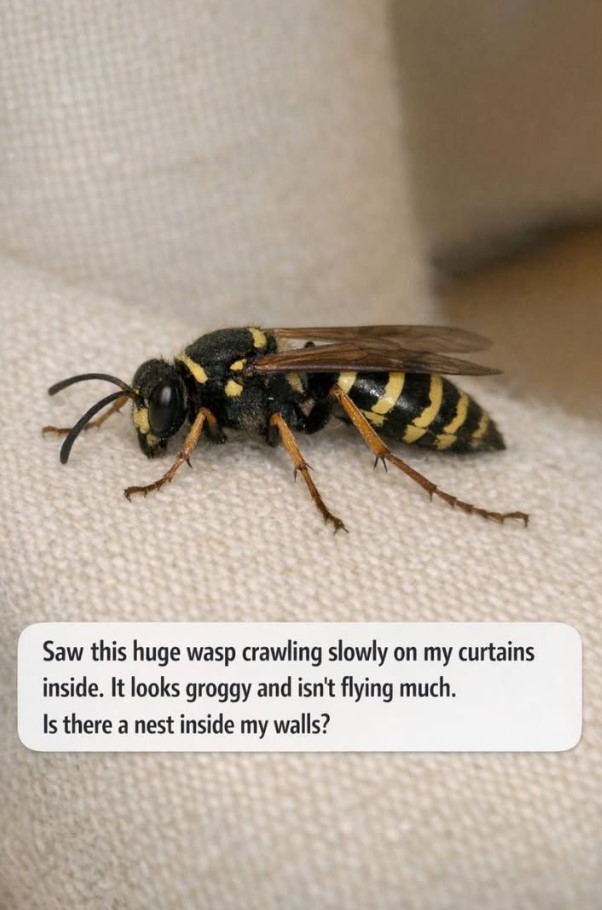
Finding a huge wasp crawling slowly across your curtains can be alarming, especially when it looks unusually sluggish and barely attempts to fly. The first thought many homeowners have is understandably worrying: Could there be a hidden nest inside the walls?
Fortunately, seeing one slow-moving wasp indoors does not automatically mean there is a nest inside your home. A wasp can enter through an open window, damaged screen, door, vent, or tiny gap around the structure. Once indoors, it may become disoriented, exhausted, or less active because the indoor environment is different from what it normally experiences outdoors.
However, repeated sightings should not be ignored. If you begin finding several wasps indoors, particularly around the same room or wall, there may be an entry point or potentially a nest nearby.
Why Is the Wasp Moving So Slowly?
Wasps are generally active, fast-flying insects, so seeing one crawling slowly can look strange.
Temperature is one possible explanation. Wasps are cold-blooded, meaning their activity is affected by environmental temperature. When conditions are cool, they may become much less active and have difficulty flying.
An individual that has been trapped indoors may also become tired or disoriented. It may spend time crawling across curtains, walls, or windows while trying to find a route back outside.
If the wasp is near a window, the curtain may simply be part of its attempt to reach the light.
Does One Wasp Mean There Is a Nest in the Wall?
No. One wasp alone is not enough evidence to conclude that you have a nest.
A single wasp can accidentally enter through:
- An open window or door
- A damaged window screen
- Gaps around windows
- Cracks in exterior walls
- Roof or attic openings
- Vents
- Gaps around pipes or cables
- Small openings around siding
If you only saw one wasp and never see another, it may have simply been an isolated visitor.
The situation becomes more concerning when wasps repeatedly appear indoors or seem to be coming from one particular area.
Signs You May Have a Hidden Wasp Nest
If you’re worried about a nest inside your walls, look for patterns rather than focusing on one insect.
Repeated Wasp Activity
Seeing several wasps over a period of days is more significant than finding one.
If you consistently discover wasps indoors, particularly during the same part of the day, there may be an entry point nearby.
Wasps Entering One Specific Gap
Pay attention to the outside of your home.
If you see wasps repeatedly flying into or out of a particular crack, vent, gap, or opening, that could indicate nesting activity.
Buzzing Inside the Wall
In some cases, an active colony may produce a faint buzzing sound inside a wall or ceiling.
If you repeatedly hear unusual buzzing coming from one particular location, avoid hitting or drilling into the wall to investigate.
Wasps Appearing Near the Same Room
If wasps keep showing up around one window, wall, ceiling, or vent, that location may deserve closer inspection.
One isolated insect is easy to explain. A consistent pattern is much more meaningful.
Why Did It End Up on the Curtain?
Curtains are often located directly beside windows, which makes them a surprisingly logical place for an indoor wasp to end up.
The insect may be attracted toward natural light and attempting to locate an exit.
If it is tired or affected by cooler temperatures, it may not be capable of flying normally. Instead, it may crawl across the curtain or remain motionless for long periods.
So the location of the wasp doesn’t necessarily mean it came from inside the wall. It may simply be trying to get back outdoors.
What Should You Do If You Find One?
If you are comfortable doing so and there is no immediate risk, give the wasp an opportunity to leave.
Opening a nearby exterior window can provide an obvious escape route. If there is a screen, make sure the opening actually gives the insect access to the outdoors.
You can also use a container-and-paper method to capture and release a single insect, but only if you feel confident doing so.
Never take unnecessary risks if you have a serious insect-sting allergy or are uncomfortable approaching the wasp.
In that situation, keeping your distance and contacting someone who can safely remove it is the better choice.
What If You Find Several Wasps?
This is when you should become more cautious.
If multiple wasps are appearing inside your home, especially if they seem to be concentrated in one area, don’t assume they are all random visitors.
There could be a nest in an attic, wall cavity, roof space, or another protected location.
Avoid disturbing the suspected nesting area. Don’t start drilling into walls or tearing away trim to find the colony.
A disturbed colony can become defensive, creating a much more dangerous situation.
Don’t Immediately Seal the Hole
It may seem logical to simply find a hole where wasps are entering and seal it shut.
But if there is an active nest inside the structure, sealing the entrance without addressing the colony can make matters worse.
The insects may search for another way out, potentially leading them toward the interior of your home.
If you suspect an active nest inside a wall, it’s better to have the situation assessed before permanently closing an opening.
How to Prevent Wasps From Getting Inside
Once you’ve dealt with the immediate problem, prevention can help reduce future encounters.
Inspect Window Screens
Look for holes, loose edges, or gaps around screens. Even a small opening can allow insects to enter.
Check Doors
Make sure exterior doors close properly and don’t have large gaps underneath or around their frames.
Door sweeps and weather stripping can help reduce potential entry points.
Seal Appropriate Exterior Gaps
Inspect areas around windows, vents, siding, pipes, and utility lines for cracks or openings.
Addressing suitable gaps can make it more difficult for insects to enter the structure.
Keep Outdoor Food Sources Covered
Wasps can be attracted to sugary drinks, food scraps, garbage, and fallen fruit.
Keep outdoor trash containers closed and clean up food spills promptly.
When Should You Call a Professional?
Professional help is particularly sensible if:
- You repeatedly find wasps indoors.
- Several wasps appear within a short period.
- Wasps repeatedly enter or leave one opening.
- You hear buzzing inside a wall or ceiling.
- You can see a nest but cannot safely reach it.
- The suspected nest is inside a wall cavity, attic, roof space, or chimney.
- Someone in the household has a serious allergy to insect stings.
A professional can determine whether you’re dealing with an isolated visitor or an active colony without unnecessarily disturbing the structure.
The Bottom Line
Seeing one huge, groggy wasp crawling slowly across your curtains doesn’t necessarily mean there’s a nest inside your walls. It may simply have wandered indoors, become disoriented, or slowed down because of temperature or exhaustion.
The real warning sign is repeated activity. If wasps keep appearing, particularly around the same window, wall, ceiling, vent, or exterior opening, then it’s worth investigating further.
For now, don’t panic and don’t start opening your walls. Give a lone wasp a safe opportunity to leave if you can do so without putting yourself at risk, and keep an eye on whether any more appear.
Sometimes that frightening-looking visitor really is just one lost insect that took a wrong turn. But if the wasps keep coming back, that’s when the mystery deserves a closer—and preferably professional—look.