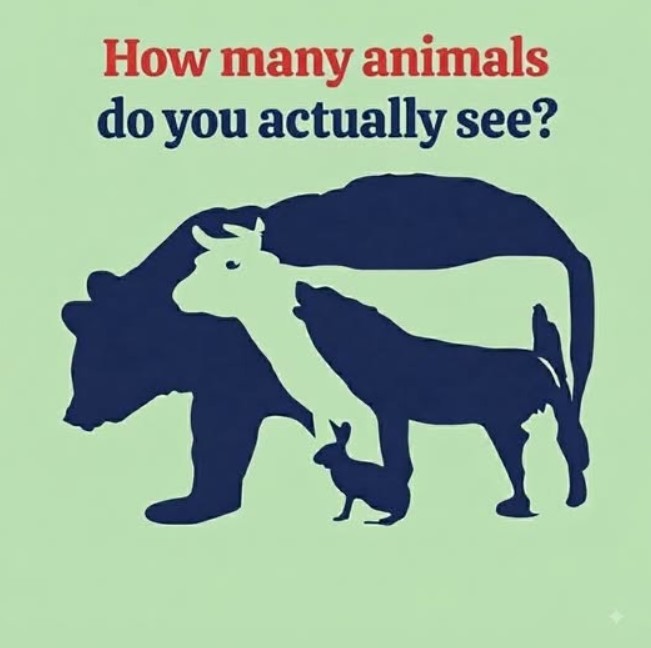
At first glance, this image may seem like a simple collection of animal shapes. You look at it for a few seconds and probably feel confident that you’ve spotted everything hiding within the picture.
But that’s exactly what makes this type of optical illusion so entertaining.
The image is designed to make your brain recognize large, obvious shapes first while smaller figures remain hidden within overlapping outlines, negative spaces, and cleverly arranged silhouettes. What appears to be one animal may actually contain another, and a shape that initially looks like background can suddenly transform into something recognizable once you know what you’re looking for.
So, how many animals can you actually find?
Before reading further, take another look at the image and give yourself a few moments to search. Don’t worry about finding the answer immediately. The challenge is as much about how you look as it is about what you see.
The First Animal Is Usually the Easiest to Spot
Most viewers naturally begin with the largest and darkest figure in the composition.
The bear is one of the most prominent animals in the puzzle, positioned toward the left side. Its larger silhouette provides an obvious visual anchor, so your brain tends to recognize it before concentrating on the smaller details.
This is a common feature of visual illusions.
Our brains are extremely good at identifying large, familiar patterns quickly. We don’t consciously analyze every line and curve before deciding what we’re seeing. Instead, the brain processes the overall shape and makes a rapid interpretation.
That’s useful in everyday life—but in an optical illusion, it can work against you.
Can You Find the Cow?
Once you’ve identified the largest shape, shift your attention toward the center of the image.
There’s another prominent figure representing a cow. Depending on the way the surrounding shapes are arranged, the animal may initially appear less obvious than the bear. It can be defined partly by the surrounding space rather than by a simple, clearly outlined silhouette.
This is where the puzzle becomes more interesting.
You aren’t necessarily looking for a conventional drawing with a complete outline.
Instead, you’re trying to recognize an animal from a combination of contours, spaces, and shapes.
The Tiny Mouse Is Easy to Miss
One of the more cleverly concealed figures is the mouse.
It’s located toward the lower central area of the composition and can easily be overlooked because of its smaller size. At first, it may appear to be nothing more than part of a larger silhouette.
Once you’ve been told that a mouse is there, however, your perception can change dramatically.
This is one of the most enjoyable parts of hidden-image puzzles.
A shape that seemed meaningless a moment earlier suddenly becomes recognizable.
Look Carefully on the Right Side
The cat is another animal hidden within the overall arrangement.
It’s positioned on the right side and can be identified by features such as its upright form and pointed ears beneath the larger shapes.
The cat demonstrates another trick commonly used in optical illusions: partial information.
Your brain doesn’t need to see an entire animal perfectly outlined.
A couple of distinctive characteristics—such as pointed ears, a familiar body shape, or a recognizable posture—can be enough for the brain to complete the picture.
Are There More Animals Hidden in the Picture?
This is where the puzzle gets especially intriguing.
The composition may contain additional shapes that become visible depending on how you separate the foreground from the background.
The spaces surrounding the cat and larger silhouettes can potentially form new shapes. Overlapping contours can also create interpretations that aren’t immediately apparent.
That’s why people can look at the same optical illusion and report different numbers.
One person may confidently see four animals.
Another may insist there are additional figures.
Neither person is necessarily looking at the image incorrectly. Their brains may simply be organizing the same visual information differently.
Why Does Your Brain See Different Things?
The answer has a lot to do with visual perception.
Your eyes collect information from the image, but your brain is responsible for interpreting that information.
It looks for patterns, familiar objects, boundaries, symmetry, and relationships between shapes.
When an image is ambiguous, the brain has to make decisions about what belongs to the object and what belongs to the background.
This is known as figure-ground perception.
In an ordinary photograph, the distinction is usually obvious.
In an optical illusion, the artist deliberately makes that distinction confusing.
Negative Space Can Become Part of the Picture
One of the cleverest techniques in hidden-image artwork is the use of negative space.
Negative space is the area surrounding or between objects.
We tend to think of it as empty space, but artists can manipulate those areas so they form recognizable shapes.
That means the background isn’t necessarily just background.
It can become part of the puzzle.
A curve surrounding one animal might simultaneously create the outline of another.
Once you begin looking for negative-space figures, these illusions become much easier to understand.
Why Do We Notice the Big Shapes First?
Human vision tends to prioritize prominent information.
A large, dark silhouette naturally attracts attention before a small figure tucked into a corner.
This is one reason the bear is likely to be spotted quickly while the mouse takes more effort.
The effect is similar to walking into a crowded room.
You notice the biggest or most obvious things first.
Only after you’ve taken in the overall scene do you begin noticing smaller details.
The optical illusion simply uses that natural tendency against you.
Try Looking at the Image Backward
If you’re having trouble finding the hidden animals, change your approach.
Instead of asking:
“What animal is this?”
ask:
“What shapes do I see?”
Look for:
- Curves
- Triangles
- Small circles
- Pointed shapes
- Gaps between silhouettes
- Unusual outlines
- Areas where two shapes overlap
- Objects that seem to have no obvious purpose
Then allow those shapes to become animals.
This can make hidden figures much easier to recognize.
Don’t Trust Your First Impression
The first answer that comes to mind isn’t necessarily the complete answer.
Optical illusions are specifically designed to exploit the brain’s tendency to make quick assumptions.
You see a large shape and immediately label it.
Once you’ve labeled it, your brain may stop searching that area.
That’s called perceptual set—your expectations influence what you’re likely to notice.
If you’re told that the image contains animals, you’ll begin searching for animal-like features.
If someone instead told you the same image contained faces, you might start seeing faces.
The image hasn’t changed.
Your interpretation has.
Why Hidden-Image Puzzles Are So Addictive
There’s something deeply satisfying about discovering something that was right in front of you the entire time.
The moment a hidden figure becomes visible, you often wonder how you could possibly have missed it.
That sudden shift in perception is what makes these puzzles so enjoyable.
It’s not simply about getting the correct number.
It’s about experiencing that moment when your brain suddenly reorganizes the information.
A Fun Challenge for Friends and Family
This type of puzzle makes an excellent little challenge to share with other people.
Show someone the image without giving them any clues.
Ask them:
“How many animals do you see?”
Give them a minute or two to search.
Then compare answers.
You may be surprised by how differently people interpret the same shapes.
Some people immediately notice the larger animals.
Others are exceptionally good at spotting small details and hidden figures.
Children can be particularly enthusiastic about this kind of visual puzzle because they often approach ambiguous images with fewer assumptions.
The Four Main Animals to Look For
Based on the description of the composition, four clearly identified animals are:
1. Bear
The large, dark figure on the left side.
2. Cow
The prominent central figure, partly defined by surrounding space.
3. Mouse
The much smaller figure toward the lower center.
4. Cat
The upright figure on the right, recognizable by its pointed ears and silhouette.
But don’t necessarily stop there.
The surrounding shapes and overlapping contours may create additional interpretations, which is part of what makes the puzzle so challenging.
The Real Trick Is Learning to Look Differently
Perhaps the most interesting lesson from this illusion isn’t the final number of animals.
It’s the realization that seeing isn’t exactly the same as understanding.
Your eyes can receive the same visual information while your brain interprets it differently depending on what you’re expecting to find.
That’s why someone can point to a shape and say, “How did you not see that?” while you genuinely can’t understand what they’re talking about.
Then suddenly you see it.
And once you do, you can’t unsee it.
Final Thoughts
Optical illusions like this are a fascinating reminder of how much work our brains perform every second. We rarely stop to think about how we identify objects, separate foreground from background, recognize familiar silhouettes, and fill in missing information. Yet all of those processes are happening automatically while we look at a simple picture.
In this particular puzzle, the obvious figures include a bear, cow, mouse, and cat, with the smaller animals requiring considerably more attention than the dominant shapes.
The real challenge, however, is that overlapping outlines and negative spaces can create additional interpretations. That means the puzzle isn’t simply testing whether you can count. It’s testing whether you can change your perspective.
So the next time you encounter an optical illusion, don’t rush to announce your answer after the first glance.
Look again.
Move your attention from the large shapes to the tiny details. Examine the spaces between objects. Follow unusual curves and outlines. Turn your attention toward areas that initially seem empty.
You may discover that what looked like an ordinary image contains an entire little world hiding in plain sight.
And once your brain finally reveals one of those hidden animals, you’ll probably find yourself staring at the picture again, wondering how many more you’ve been missing.