
Some puzzles look so simple that you expect to solve them within seconds. However, a few carefully chosen words can make even the easiest question surprisingly difficult. The viral “There’s a Woman in a Boat” riddle is a perfect example of how a short sentence can confuse people who are used to searching for complicated answers.
This popular brain teaser does not require mathematical calculations, special knowledge, or advanced logical skills. Instead, it challenges you to pay attention to the wording of a question and recognize information that may be hiding in plain sight.
At first, the riddle sounds like a tiny story about a woman sitting in a boat on a lake while wearing a coat. You might immediately begin wondering where she is going, what she is doing, or whether the surrounding details contain a secret clue. Yet the real challenge is much simpler than that.
Before looking at the answer, take a moment to read the riddle carefully and see whether you can solve it yourself. You may discover that the most important clue was right in front of you from the beginning.
The Viral Woman in a Boat Riddle
Here is the complete riddle:
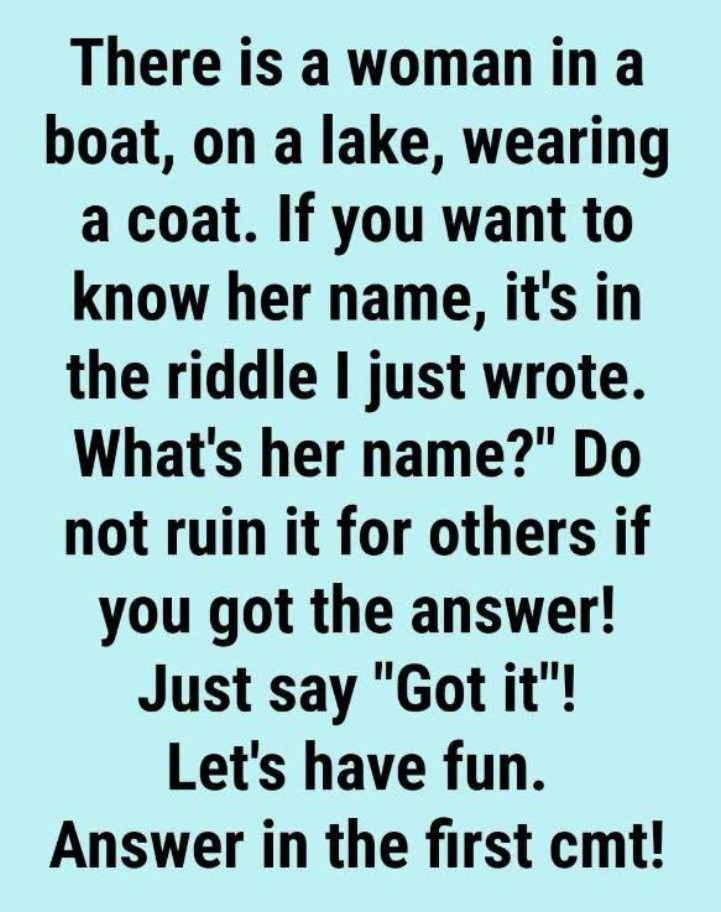
“There’s a woman in a boat on a lake wearing a coat. If you want to know her name, it’s in the riddle I just wrote. What is the woman’s name?”
Take a few seconds to think about your answer before continuing.
Did you guess a traditional name? Perhaps you tried to find a hidden name among the words or wondered whether the boat, lake, or coat had something to do with the solution.
Many people approach the puzzle this way because they expect a riddle to hide its answer behind a complicated clue. They examine every detail, rearrange words in their minds, and search for a clever explanation.
However, this particular brain teaser works differently. The sentence itself contains the information needed to solve it. The trick is recognizing which part deserves your attention.
Why Is This Riddle So Tricky?
The main reason this puzzle confuses readers is that the opening words sound completely ordinary.
When someone begins a story with “There’s a woman in a boat,” your brain naturally understands the sentence as an introduction to a person and a situation. You imagine the woman, the water, and perhaps the coat she is wearing.
You do not usually stop to consider whether the first word could also be interpreted as a name.
That automatic reaction is precisely what makes the riddle entertaining. Your mind assigns meaning to the sentence before you have fully examined the possibility that the wording contains a different kind of clue.
The extra details also make the puzzle more distracting. The boat, lake, and coat create a small mental picture, encouraging you to focus on the imaginary scene rather than the language used to describe it.
Another reason the riddle works so well is that it tells you where to look without making the instruction feel obvious. The line explaining that the woman’s name is inside the riddle is the most important clue, but readers often interpret it as a hint about a hidden word rather than a direct instruction.
The solution becomes much easier when you stop searching for a complicated pattern and begin reading the sentence literally.
Hints to Help You Solve the Puzzle
If you would like to solve the riddle without immediately seeing the answer, the following hints can help you approach it from a different perspective.
Hint 1: Read the First Sentence Again
Start by reading the opening words slowly. Do not concentrate on the boat or the lake. Instead, look at the very beginning of the sentence.
Could the first word be more important than it initially appears?
Sometimes, a word that seems to serve only a grammatical purpose can become the key to a wordplay puzzle.
Hint 2: Take the Instructions Literally
The riddle specifically says that the woman’s name is in the riddle that has just been written.
This is not necessarily a suggestion that you must rearrange letters, decode a secret message, or discover a hidden pattern. The name could simply be one of the words already present in the sentence.
Try to avoid adding rules that the riddle never mentions.
Hint 3: Do Not Search for a Familiar Name
Many people immediately think of common names such as Sarah, Emily, Jennifer, or Jessica. Others look for names concealed in longer words.
For this puzzle, you may need to reconsider that assumption. The answer is not a conventional name that most people would expect to hear in an everyday conversation.
Hint 4: Pay Attention to the Very First Word
Here is one final clue: look at the word that begins the riddle.
It is the same word that tells you a woman exists in the scene. Could that word also be the answer to the question?
If you have figured it out, congratulations! If not, keep reading to discover the solution.
The Answer to the Woman in a Boat Riddle
The answer is There.
Yes, the woman’s name is “There,” according to the intended wordplay of the riddle.
At first, this answer might sound unusual. After all, “there” is normally used as an adverb to indicate a place or introduce the existence of something. It is not a common personal name.
However, the trick lies in the opening words:
“There’s a woman in a boat…”
The word “There” appears immediately at the beginning of the riddle. When the puzzle tells you that the woman’s name is contained in the text, it directs you toward that word.
The answer is therefore not hidden in the description of the boat, the lake, or the coat. It is sitting right at the beginning of the sentence.
The riddle plays with your expectations by encouraging you to treat the opening word as an ordinary part of a sentence instead of considering it as the unusual name you are trying to identify.
A Simple Explanation of the Answer
To understand why the solution is so easy to miss, imagine that the sentence began with a familiar name instead.
For example:
“Sarah is a woman in a boat on a lake wearing a coat.”
In this version, you would immediately recognize Sarah as the woman’s name. You would not need to investigate the boat, the lake, or the coat to identify her.
The original riddle creates a similar effect, except that the word at the beginning is “There.” Because it is such a familiar English word, readers automatically interpret it according to its usual grammatical function.
The puzzle invites you to reconsider that automatic interpretation.
There is also an important distinction between solving the riddle and deciding whether the answer represents a realistic personal name. “There” is not a conventional name in this context. The solution works as a playful interpretation of the wording, rather than as a claim that this is a common name in real life.
That unusual answer is part of the joke. It challenges the expectation that every name puzzle must lead to a familiar person’s name.
What Makes This Brain Teaser Worth Sharing?
The woman in a boat riddle is an entertaining example of how language can influence the way we think.
Unlike puzzles that depend on complicated calculations or extensive background knowledge, this one can be presented to almost anyone who understands the English wording. It takes only a few seconds to read, yet the answer may not come immediately.
That makes it suitable for sharing with friends, family members, and colleagues. You can ask someone to solve it, let them think for a moment, and offer a hint if they become stuck.
It is also a reminder that people can approach the same problem in very different ways. One person may immediately notice the first word, while another may spend several minutes looking for a more complicated explanation.
Neither reaction is unusual. We often rely on familiar patterns when reading, and those patterns can sometimes prevent us from noticing an unexpected interpretation.
The important part is to remain curious, question your assumptions, and remember that not every puzzle requires an elaborate solution.
Conclusion :
The “There’s a Woman in a Boat” riddle is a short but clever brain teaser that demonstrates how easily ordinary language can mislead us. By describing a woman in a boat on a lake wearing a coat, the puzzle encourages readers to imagine a scene and search for clues in the wrong places.
The intended answer, “There,” is hidden in the very first word of the riddle. Once you recognize the wordplay, the solution becomes much easier to understand.
If you did not solve it on your first attempt, there is no reason to feel disappointed. The fun of a riddle comes from exploring different possibilities and experiencing that satisfying moment when the answer finally makes sense.
Now that you know the trick, try sharing the puzzle with someone else before revealing the solution. Ask them to read it carefully and give them a little time to think. You might be surprised by how many different guesses you hear before someone discovers the answer.
Sometimes, the best way to solve a tricky question is not to think harder, but to look at the words in front of you from a completely different perspective.