Can You Find the One Tiny Difference?
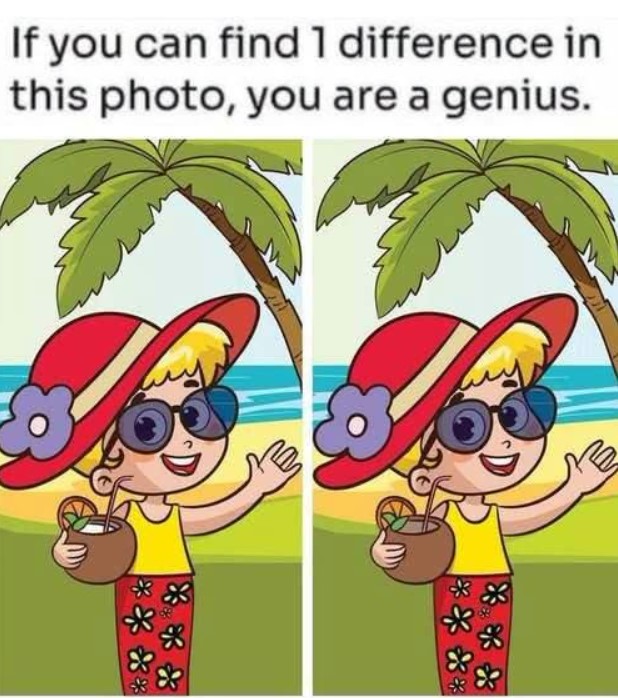
Picture yourself on a bright summer beach, surrounded by blue water, palm trees, warm sunshine, and the relaxed atmosphere of a perfect vacation. Now imagine that everything in front of you looks almost identical in two pictures.
That is exactly what makes this visual puzzle so entertaining.
In the Happy Beach Girl: Spot 1 Difference challenge, you are presented with two cheerful beach scenes featuring a cartoon girl enjoying a sunny day by the ocean. At first glance, the two images appear to be complete copies of one another. The character, her clothing, accessories, drink, and tropical surroundings all seem to match.
But there is a catch.
One small detail has been changed.
Your challenge is to find it.
The difference is deliberately subtle, so simply glancing from one image to the other probably won’t be enough. You need to slow down and compare the pictures carefully, paying attention to small shapes, colors, and details that your eyes might normally ignore.
Take a Good Look at the Beach Scene
Before searching for the difference, it helps to examine the entire scene.
The cheerful beach girl is dressed for a relaxing day in the sun. One of the first things that catches your attention is her large red sun hat. The hat features a decorative purple flower and a yellow stripe, making it one of the most noticeable objects in the picture.
She is also wearing round blue sunglasses, adding another colorful detail to her summer look.
The girl is happily waving with one hand while holding a refreshing coconut drink in the other. The drink includes a straw and an orange slice, giving the illustration an unmistakable tropical feel.
Behind her, palm trees and the bright blue ocean complete the scene.
With so many colorful details competing for your attention, it’s easy for a tiny change to disappear into the larger picture.
Why This Puzzle Is More Difficult Than It Looks
Spot-the-difference puzzles are designed to take advantage of the way we normally look at pictures.
When two images appear almost identical, your brain tends to recognize the overall scene rather than inspect every individual feature. Once you identify the picture as “the same,” you may automatically stop looking for small variations.
That’s exactly what happens here.
You might quickly check the girl’s hat, dress, drink, and background and decide that everything matches. But the puzzle doesn’t require you to find a large object that has suddenly disappeared.
Instead, the change is deliberately tiny.
The original article even encourages readers to stop simply scanning the images and instead compare them slowly, checking individual lines, colors, and shapes.
Start at the Top
One useful strategy is to compare the images systematically rather than jumping randomly from one area to another.
Begin with the top of the picture.
Look carefully at the large red sun hat. Compare its outline, the purple flower, and the yellow stripe. Is every part of the decoration identical?
Don’t move on until you’re reasonably certain.
Next, examine the sunglasses.
The blue frames are particularly noticeable, but don’t let their bright color fool you into thinking there can’t be a tiny change there. Look at the shape and details of both lenses and compare them carefully.
Then continue downward.
Check the girl’s hair, face, smile, clothing, arms, and hands.
After that, examine the coconut drink. Compare the straw, the orange slice, and the shape of the drink itself.
Finally, move your attention toward the background, including the palm trees, sky, and ocean.
This method prevents your eyes from repeatedly jumping between random objects.
Don’t Forget the Smallest Details
One of the biggest mistakes people make with these puzzles is focusing only on large objects.
They might ask themselves:
“Is the hat missing?”
“Did the drink disappear?”
“Is one of the palm trees different?”
But a good spot-the-difference puzzle doesn’t need to remove an entire object.
A tiny change to a line, shape, accessory, or facial feature can be enough.
That’s why you should pay attention to details that seem almost insignificant.
A small mark can be easy to overlook when it is surrounded by bright colors and larger shapes. Your brain may automatically fill in what it expects to see, making the two pictures appear identical even when they aren’t.
Give Yourself a Time Limit
If you want to turn this into a real challenge, don’t immediately search for the answer.
Give yourself a minute or two.
During that time, compare the two pictures methodically.
You can start with the hat and work downward, as suggested by the original puzzle, rather than moving your eyes randomly around the scene.
Try looking at one small section at a time.
For example:
Hat → sunglasses → face → clothing → hands → drink → background
Once you’ve checked each section, compare the entire image again.
Sometimes your eyes will notice the difference only after you’ve already examined the area once.
Why Our Eyes Can Be Fooled
The interesting thing about these puzzles is that they aren’t really testing how good your eyesight is.
They are testing your attention.
You can have excellent vision and still miss a tiny difference because your brain is concentrating on the overall meaning of the image rather than every individual detail.
When two pictures are nearly identical, your brain expects them to match. This expectation makes subtle differences harder to notice.
That’s why slowing down is so useful.
Instead of asking, “Do these pictures look the same?” ask yourself:
“What exactly is different between these two pictures?”
That small change in wording can encourage you to look more critically.
The Beach Setting Makes It More Challenging
The tropical setting is another reason this puzzle can hold your attention.
There are many different elements in the scene: the girl’s red hat, purple flower, yellow stripe, blue sunglasses, clothing, coconut drink, orange garnish, palm trees, and ocean.
All those details create visual distractions.
Your eyes naturally move toward the most colorful or recognizable objects, while a small difference may be sitting somewhere you wouldn’t normally focus on.
This is why checking every element individually is much more effective than simply staring at the whole picture.
Still Can’t Find It?
Don’t worry.
That’s part of the fun.
If you’ve been looking for a while and still haven’t found the difference, take a short break and then look again.
Sometimes stepping away for a few seconds makes the change much easier to recognize.
You can also try comparing corresponding areas rather than looking at both pictures as complete scenes.
For example, compare the left side of the first image with the same area of the second image. Then move across the picture section by section.
You may be surprised by how quickly the difference becomes visible once you change your approach.
The Real Trick Is Patience
The biggest lesson from a puzzle like this is simple: don’t rush.
The image is designed to look almost identical, so speed isn’t necessarily an advantage.
A person who carefully examines every detail may solve it faster than someone who simply stares at the two pictures and hopes the answer suddenly appears.
Observation requires patience.
You need to resist the temptation to say, “They’re exactly the same,” after only a few seconds.
Instead, keep comparing.
Look at the shapes.
Look at the colors.
Look at the accessories.
Look at the facial details.
Look at the drink.
Look at the background.
According to the original puzzle, there is only one changed detail, making the challenge especially sneaky.
How Did You Do?
If you spotted the difference without help, congratulations!
That means you managed to notice a detail that was deliberately designed to blend into the rest of the illustration.
If you didn’t find it, don’t worry. These puzzles are meant to be challenging, and missing a tiny difference doesn’t mean you have poor observation skills.
In fact, the most enjoyable part is often the moment when someone finally reveals the answer and you suddenly realize how easy it was to overlook.
You may find yourself thinking:
“How did I not see that before?”
That’s exactly what makes spot-the-difference puzzles so satisfying.
Final Thoughts
The Happy Beach Girl: Spot 1 Difference puzzle may look simple, but its nearly identical images make it surprisingly challenging. The colorful beach setting, cheerful character, tropical drink, sun hat, sunglasses, palm trees, and ocean create plenty of visual information for your eyes to process.
The challenge isn’t about counting objects or solving a complicated mathematical problem. Instead, it asks you to slow down and pay attention to something that your brain might otherwise ignore.
There is only one difference, and it is intentionally difficult to notice at first. That makes the puzzle a great little test of concentration and visual observation.
So before looking at the answer, take one last careful look.
Start at the top of the girl’s hat. Move slowly down through her sunglasses, face, clothing, and drink. Then compare the background. Check every small shape and detail rather than relying on your first impression.
And remember: don’t just scan the picture—really look at it.
If you find the hidden difference on your own, you’ve earned bragging rights as a sharp-eyed puzzle solver. If you need the answer, there’s no shame in that either. The important thing is that you took the time to challenge your observation skills and have a little fun along the way.
Sometimes the smallest detail can hide in the most obvious place.