How good is your attention to detail?
Sometimes the simplest-looking puzzles are the ones that manage to fool us the most. When we see a picture filled with similar objects, our brains naturally try to recognize the overall pattern instead of carefully examining every individual item.
That is exactly what makes today’s visual challenge so entertaining.
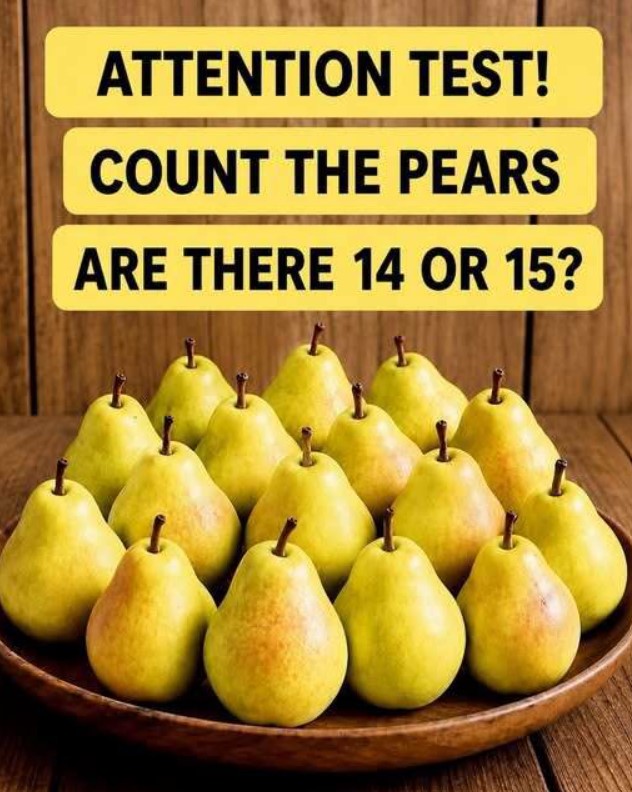
In this puzzle, you are shown a large bowl filled with bright yellow pears. At first glance, the task appears incredibly straightforward: count the pears and decide whether there are 14 or 15. Those are the two numbers presented as possible answers in the image.
But there is a clever twist.
If you count too quickly, you may easily settle on one of the two choices without noticing that the puzzle is deliberately designed to make you overlook several pears.
So before reading the solution, take a close look at the image and count the fruit yourself. Try not to rely on a quick glance. Instead, examine the pears systematically and see whether you can discover the actual total.
The Challenge: 14 or 15?
At first, the puzzle gives you a very simple question:
Are there 14 pears or 15 pears?
That immediately creates a small trap for your brain.
Once you are given two possible answers, you naturally begin searching for evidence that supports one of them. You may count quickly and decide there are 14. Another person might carefully count the visible fruit and arrive at 15.
But the puzzle isn’t really asking you to choose between those two numbers.
The real challenge is to question the choices themselves.
Could the answer actually be something else?
That’s where careful observation becomes important.
Take Your Time Before Looking at the Answer
Before continuing, give yourself a few seconds to examine the picture.
Instead of trying to count every pear randomly, use a method.
Start at the front of the bowl and work backward. Look for the individual stems and visible fruit. When several pears overlap, it can be difficult to see their entire bodies, so the stems can provide a useful clue.
Try counting the pears in separate layers rather than attempting to count the entire bowl at once.
How many do you see in the front?
How many are behind them?
What about the pears near the top?
Write down your numbers if necessary and add them together.
Why Counting the Stems Helps
When objects overlap, counting their visible bodies can sometimes be confusing.
A pear toward the back may be partially hidden behind another pear, making it easy to miss. However, its stem can still be visible above or between the surrounding fruit.
That’s why one of the easiest ways to solve this particular puzzle is to pay attention to the stems.
Instead of asking yourself, “How many complete pears can I see?” ask:
“How many individual pear stems can I identify?”
This approach helps separate the fruit from one another and reduces the chance of accidentally counting the same pear twice.
Let’s Count the Front Row
Begin with the pears closest to you.
In the front section of the bowl, there are 4 pears.
These are among the easiest to identify because they are positioned prominently at the front of the arrangement.
So our count begins with:
4 pears
Don’t move too quickly. The key to this puzzle is keeping track of every layer.
Move to the Second Row
Now look behind the four pears in the front.
Between the spaces and around the sides, you’ll find another group of pears arranged in the next layer.
There are 5 pears in this second row.
Now add them to the four pears from the front:
4 + 5 = 9
So, at this point, we have identified 9 pears.
This is already more than you might expect if you simply counted the most obvious fruit at first glance.
Examine the Third Layer
Next, move your attention toward the back of the bowl.
There is another row of pears sitting behind the second group.
This layer contains 4 more pears.
Add those to the 9 we’ve already counted:
9 + 4 = 13
We now have 13 pears.
But we’re not finished.
This is exactly where the puzzle can catch people who assume they’ve already counted everything.
Don’t Forget the Top
Now look carefully at the very back and upper portion of the arrangement.
Some pears are partially hidden behind the others. Their bodies may not immediately stand out, but their stems provide an important clue.
There are 3 additional pears in this final layer.
Add those to the previous total:
13 + 3 = 16
And there is the answer.
The Correct Answer Is 16!
The puzzle is deliberately misleading because the image suggests that the answer should be either 14 or 15.
But after carefully counting each layer, the actual number is:
16 PEARS
The complete breakdown is:
- 4 pears in the front row
- 5 pears in the second row
- 4 pears in the third row
- 3 pears in the back row
That gives us:
4 + 5 + 4 + 3 = 16
The original puzzle confirms that the real total is 16 and that both 14 and 15 are incorrect choices.
Why Did So Many People Get It Wrong?
The trick works because the puzzle gives you a limited choice before you have even finished counting.
When you see 14 or 15, your brain tends to assume that one of those numbers must be correct.
This is a common feature of visual puzzles. Instead of simply asking you to find the answer, the puzzle creates an expectation that influences the way you search for it.
Once you begin looking for either 14 or 15, you may stop counting carefully as soon as your total reaches one of those numbers.
The hidden pears are therefore easy to overlook.
The Importance of Counting in Groups
This puzzle also demonstrates why organizing information can make a difficult task easier.
Trying to count all the pears simultaneously can be confusing because many of them overlap.
Breaking the image into rows gives you a much clearer strategy.
Instead of thinking:
“How many pears are there?”
you can ask:
“How many are in this row?”
Then repeat the process for each layer.
This reduces the chance of skipping an object and makes it easier to check your answer.
What This Puzzle Says About Attention
Although this is primarily a fun brain teaser, it highlights an interesting aspect of visual attention.
We don’t always process every detail in front of us. Our brains constantly filter information and focus on what appears most important.
When several objects look similar, the brain can quickly group them together rather than individually analyzing each one.
That is useful in everyday life because it allows us to process complicated surroundings efficiently. But in an attention puzzle, that same shortcut can work against us.
The puzzle rewards people who deliberately slow down and inspect the details.
A Better Way to Solve Similar Puzzles
If you enjoy visual challenges like this one, there are several techniques that can help.
1. Ignore the Suggested Answers
If a puzzle gives you two or three possible answers, don’t automatically assume one of them is correct.
Treat them as possibilities rather than facts.
2. Divide the Image Into Sections
Break a crowded image into rows, columns, corners, or other sections.
3. Look for Distinguishing Features
When objects overlap, look for stems, edges, shadows, handles, or other details that can identify individual objects.
4. Count Slowly
Speed isn’t the goal. Accuracy is.
5. Count a Second Time
After reaching an answer, start again using a different method. If you get the same number twice, you’re much more likely to be correct.
Did You Fall for the Trick?
Now that you know the solution, think about your first answer.
Did you initially choose 14?
Maybe you counted carefully and decided there were 15.
Or perhaps you immediately suspected that the puzzle was trying to trick you and searched for an answer outside the two choices.
If you found 16, congratulations! You successfully ignored the misleading choices and paid attention to every layer of the picture.
If you didn’t, don’t worry. The puzzle was specifically designed to make the obvious choices seem convincing.
Challenge Your Friends
This is also a fun puzzle to share with friends and family.
Show them the picture without revealing the answer and ask:
“How many pears can you count?”
Don’t tell them that 14 and 15 are both wrong. Let them make their own decision.
You may be surprised by how many people immediately choose one of the numbers suggested by the puzzle.
After they give their answer, reveal the actual total of 16 and explain how the pears are arranged in four separate layers.
It makes for a simple but entertaining attention challenge.
Conclusion :
The “Attention Test! Count the Pears” puzzle proves that a seemingly easy counting task can become surprisingly challenging when visual information is arranged to distract you.
The image gives you two tempting choices—14 or 15—but neither is correct. By slowing down, examining the pears row by row, and using their stems as clues, you can uncover the complete arrangement.
There are 4 pears in the front, 5 in the second row, 4 in the third row, and 3 in the back, giving us a final total of 16 pears.
The biggest lesson isn’t simply the number 16. It’s the importance of questioning your first impression. When a puzzle gives you an apparently obvious choice, don’t assume the answer must be hiding among those options. Sometimes the real solution is the one you aren’t expecting.
So, how did you do?
Did you count all 16 pears, or did the 14-versus-15 trick fool you?