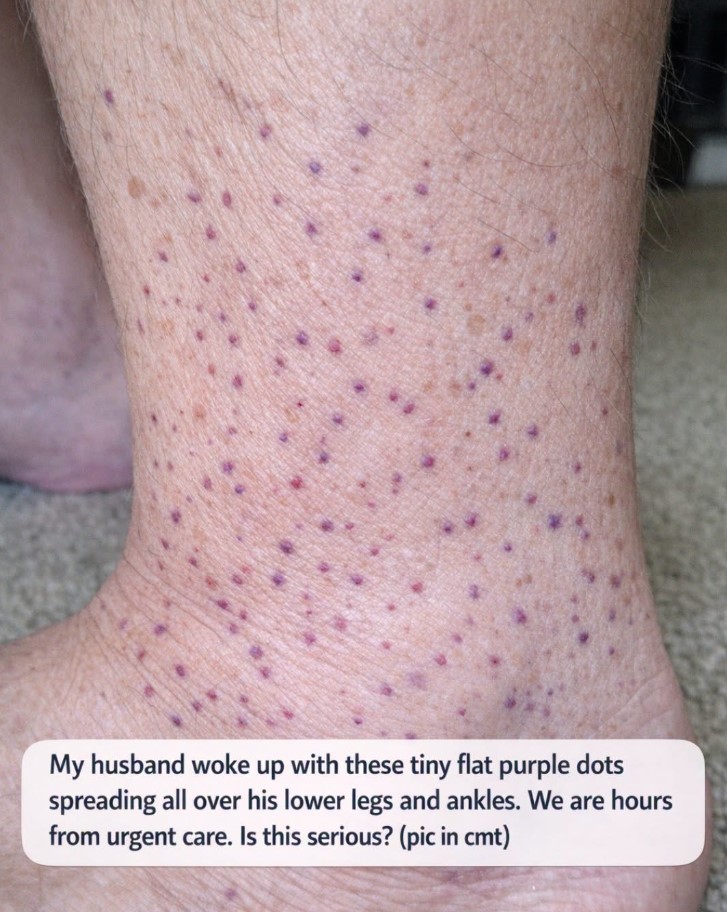
Waking up to find dozens of tiny purple or reddish spots suddenly covering your husband’s lower legs and ankles can be frightening. The situation becomes even more stressful when you’re several hours away from an urgent-care clinic and aren’t sure whether you can safely wait.
At first, these tiny marks might look like a simple rash, irritation from clothing, insect bites, or even small bruises. But if the spots are very small, completely flat, purple or red, and don’t fade when you press on them, they may be something called petechiae.
Petechiae are tiny areas of bleeding underneath the skin caused by leakage from very small blood vessels. They are a symptom rather than a diagnosis, and there are many possible causes. Some are relatively minor, while others need prompt medical attention.
That is why new spots that are spreading should not simply be ignored, particularly when other symptoms are present.
What Are These Tiny Purple Dots?
Petechiae are usually very small, often appearing as pinpoint red, purple, or reddish-brown spots.
Unlike many ordinary rashes, they are generally:
- Flat rather than raised
- Very small
- Red, purple, or dark reddish in color
- Not particularly itchy
- Resistant to fading when pressure is applied
They occur when tiny blood vessels called capillaries leak a small amount of blood into the surrounding tissue.
The result is a tiny spot that can resemble a miniature bruise.
Because petechiae can have many different causes, their appearance alone cannot tell you exactly what is happening.
One Important Question: Do the Spots Fade When Pressed?
One useful observation is whether the spots blanch when pressure is applied.
You can gently press a clear glass against the affected skin and look through the glass.
If the spots remain visible and do not fade, they are considered non-blanching. A non-blanching rash can have several causes and should be taken seriously, particularly if it is new or spreading. NHS guidance specifically advises urgent medical assessment for a non-blanching rash, with emergency care needed when it occurs alongside feeling very unwell or symptoms such as a stiff neck.
However, this simple test cannot determine the cause. It should never be used to reassure yourself that everything is fine when someone has concerning symptoms.
Why Might Petechiae Appear?
There isn’t one single reason that someone develops these tiny purple spots.
Possible causes include physical pressure or strain, certain medications, infections, problems involving platelets or blood clotting, inflammation of blood vessels, and other medical conditions.
Sometimes intense coughing, vomiting, or straining can cause tiny blood vessels to break. Pressure or friction can also contribute in certain circumstances.
But when a person suddenly develops many unexplained spots over both lower legs, it’s important to consider the wider picture rather than assuming the cause is harmless.
Could Medication Be Responsible?
Some medications can increase the likelihood of bleeding or affect how platelets function.
Medications that may be relevant include certain blood thinners, aspirin, anti-inflammatory medicines, antibiotics, and other drugs.
This doesn’t mean someone should stop a prescribed medication simply because purple spots appear.
If your husband takes any medications or supplements, make a list of them and tell the healthcare professional about them. Include anything that was started recently, as well as medications he has been taking for a longer period.
Do not stop prescribed blood thinners or other important medications without medical advice.
When Should You Be Worried?
The number and speed at which the spots appear matter.
A couple of isolated spots may have a very different significance from dozens of new spots appearing over several hours.
You should be especially concerned if the purple spots are:
- Increasing quickly
- Appearing in new areas
- Spreading beyond the ankles and lower legs
- Accompanied by unexplained bruising
- Associated with unusual bleeding
- Appearing with fever or chills
- Occurring with significant weakness or dizziness
These features don’t prove that something dangerous is happening, but they make professional assessment more important.
Red Flags That Should Not Wait
If your husband develops purple or non-blanching spots and also becomes seriously unwell, don’t simply wait several hours for an urgent-care appointment.
Emergency symptoms can include:
- Difficulty breathing
- Confusion or unusual drowsiness
- Fainting or severe dizziness
- Very high or unusually low temperature
- Rapid breathing
- Severe weakness
- Severe headache
- Stiff neck
- Cold, pale, or blotchy skin
- Rapidly worsening symptoms
- Significant unexplained bleeding
A non-blanching rash accompanied by serious illness can occur with severe infections and other emergencies. NHS guidance recommends immediate emergency care in such circumstances.
What If He Feels Completely Fine?
That is reassuring, but it doesn’t completely answer the question.
Someone with new petechiae may otherwise feel normal, especially early in the process.
If the spots are clearly new, numerous, unexplained, and spreading, it is still sensible to seek medical advice rather than simply waiting several days to see what happens.
If you are hours away from urgent care and he remains well, contact an appropriate medical advice service in your area and describe exactly what you are seeing. They can help determine whether he should be assessed sooner.
Take Photographs Now
If the spots are changing, photographs can be very useful.
Take clear pictures in good lighting and include:
- A close-up of the spots
- Both lower legs
- The ankles
- Any areas where new spots appear
If the spots spread, take another photograph later.
This creates a visual record that can help a healthcare professional determine whether the rash is changing.
Look for Other Symptoms
While you’re monitoring him, pay attention to how he feels overall.
Ask whether he has developed:
- Fever
- Chills
- Headache
- Dizziness
- Weakness
- Joint pain
- Abdominal pain
- Nausea or vomiting
- Unusual bruising
- Nosebleeds
- Bleeding gums
- Blood in urine
- Dark or bloody stools
- Shortness of breath
These details can be important when a doctor is trying to determine the possible cause.
Could It Be Something Less Serious?
Yes.
Not every purple spot represents a dangerous condition.
Minor trauma, pressure, physical strain, certain medications, and other relatively benign causes can sometimes produce small areas of bleeding beneath the skin.
The difficulty is that you cannot reliably determine the cause simply by looking at the spots.
That is why the combination of new + unexplained + spreading + non-blanching deserves attention.
Why the Lower Legs and Ankles?
Petechiae and other purpuric spots can appear on the lower legs for a variety of reasons.
The legs are exposed to pressure, friction, gravity, and physical activity throughout the day. Certain inflammatory conditions can also preferentially produce purpuric spots on the lower extremities.
For example, some forms of small-vessel inflammation can produce purple-red, non-blanching spots on the legs and may also involve joint or abdominal symptoms.
But location alone isn’t enough to identify the cause.
What Will a Doctor Check?
A healthcare professional will usually begin by looking closely at the skin and asking questions about when the spots appeared.
They may ask:
- When did you first notice them?
- How quickly are they spreading?
- Do they fade when pressed?
- Are they painful or itchy?
- Has there been a recent infection?
- Has he started any new medications?
- Is there unusual bruising or bleeding?
- Does he have a fever?
- Are there other symptoms?
Depending on the situation, blood tests may also be needed.
A complete blood count can help determine whether platelet levels or other blood-cell measurements are abnormal. Additional tests may be used to investigate clotting, inflammation, infection, or organ function.
Why Platelets Are Important
Platelets play an important role in stopping bleeding.
When a tiny blood vessel is damaged, platelets help form a plug that prevents blood from continuing to escape.
If platelet numbers are unusually low or platelet function is impaired, small blood vessels may leak more easily.
This is one reason unexplained petechiae can sometimes prompt a doctor to order blood tests.
It doesn’t mean that your husband has a platelet disorder. It simply explains why doctors may want to investigate rather than assuming the spots are an ordinary rash.
Don’t Treat It Like a Normal Rash
If you’re unsure whether the spots are petechiae, avoid randomly applying creams or treating them as though they’re simply an allergic rash.
The underlying cause needs to be understood first.
Likewise, don’t make major changes to prescribed medication without professional guidance.
The goal while waiting for medical evaluation is observation, documentation, and getting appropriate advice—not trying to diagnose the condition at home.
When Waiting Is Not Safe
The fact that you’re hours away from urgent care doesn’t necessarily mean you have to wait.
If your husband develops symptoms suggesting a medical emergency, seek emergency services rather than waiting for the clinic to open or for the drive to become convenient.
For example, NHS guidance identifies a non-blanching rash alongside serious symptoms such as confusion, abnormal breathing, high or low temperature, or feeling extremely unwell as a reason for immediate emergency assessment.
Similarly, rapidly worsening purple skin changes accompanied by severe pain, swelling, fever, confusion, or other signs of serious infection require urgent attention.
What to Do While You’re Waiting
If he is otherwise stable and you’re waiting for medical advice or an appointment:
- Keep track of when the spots appeared.
- Take clear photographs.
- Check whether new areas are appearing.
- Note his temperature if you have a thermometer.
- Make a list of his medications and supplements.
- Watch for unusual bleeding or bruising.
- Pay attention to changes in his overall condition.
- Contact a medical advice service if you’re uncertain about how urgently he needs to be seen.
Don’t spend hours repeatedly pressing the spots or trying different home remedies.
The goal is to recognize whether the situation is changing and communicate those changes to a healthcare professional.
Final Thoughts
Finding tiny, flat purple dots suddenly spreading across your husband’s lower legs and ankles can understandably be alarming.
These spots may represent petechiae, which are tiny areas of bleeding beneath the skin. They can have many possible causes, ranging from physical strain and medication effects to platelet problems, infections, and other medical conditions.
The most important thing is not to assume that the spots are harmless simply because they don’t hurt.
If they are new, numerous, spreading, or don’t fade when pressed, medical advice is appropriate. A non-blanching rash becomes particularly concerning when it occurs with fever, confusion, breathing difficulties, severe weakness, stiff neck, fainting, or other signs that the person is seriously unwell. In that situation, emergency care should not be delayed.
If your husband feels well while you’re waiting, document the spots carefully, watch for changes, gather information about his medications and recent illnesses, and contact an appropriate medical service for guidance.
The key takeaway is simple: don’t panic, but don’t dismiss a new spreading purple rash either. When the cause isn’t obvious, getting it properly evaluated is the safest way to find out whether it’s something minor or something that needs treatment.