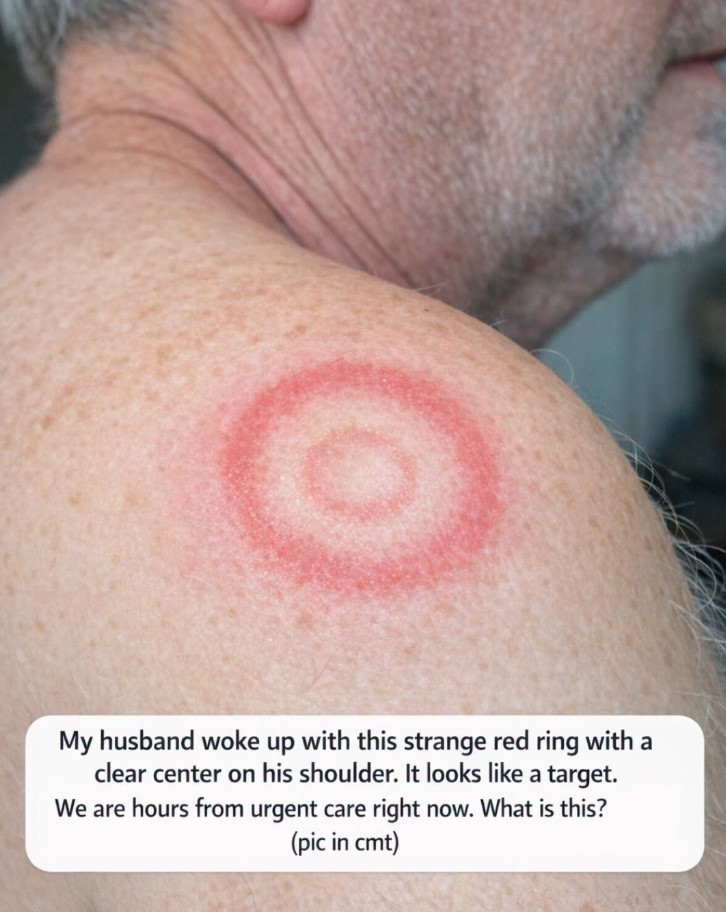
Waking up and discovering a strange red ring on someone’s skin can be unsettling, especially when the mark has a pale or clear center and looks almost like a target.
That’s exactly what happened when a husband woke up with an unusual circular rash on his shoulder. Because the nearest urgent-care facility was hours away, the first question was naturally whether it was something that could safely wait or something that required medical attention right away.
A ring-shaped rash can have several possible causes. However, when a red patch resembles a bull’s-eye or target and appears to be getting larger, one important possibility is Lyme disease, particularly if the person has recently spent time outdoors in areas where ticks are common.
The characteristic Lyme rash is known medically as erythema migrans. It often begins where an infected tick has bitten and can gradually expand over several days. It may have a clearer center, although it does not always look like the perfectly defined bull’s-eye that is commonly shown in pictures.
A rash alone cannot confirm Lyme disease. Other skin conditions, insect reactions, and infections can sometimes produce circular or ring-shaped marks as well.
Still, an expanding target-like rash deserves attention rather than being dismissed as an ordinary insect bite.
This guide explains what this type of rash can mean, what details are useful to document, what to do if a tick is still attached, which symptoms make the situation more urgent, and why getting medical advice promptly can matter.
What Could a Red Ring With a Clear Center Mean?
One of the most important possibilities to consider is Lyme disease.
Lyme disease is caused by bacteria transmitted through the bites of infected blacklegged ticks, sometimes called deer ticks. These ticks can be surprisingly small, particularly when they are in their nymph stage, which means a person may never notice the bite itself.
The rash associated with early Lyme disease is called erythema migrans.
It often begins as a red area around the location of the bite and gradually expands outward. Some people describe it as looking like:
- A bull’s-eye
- A target
- A red ring
- A circular patch
- A red area with a lighter center
- An expanding oval-shaped rash
Importantly, the rash does not have to look perfectly symmetrical.
Some Lyme rashes are almost completely red. Others are oval rather than circular. Some have a more obvious central clearing.
What matters is the overall pattern and history, particularly whether the rash is expanding over time and whether there may have been exposure to ticks.
Why an Expanding Rash Matters
A small red spot immediately after an insect bite can simply be a local reaction.
For example, if a person notices a small itchy area after being bitten by an insect and the redness gradually settles, that is different from a mark that continues spreading outward over the next day or several days.
An erythema migrans rash can become considerably larger as it expands.
The original article notes that Lyme rashes are often larger than about two inches and may continue expanding substantially over several days.
That doesn’t mean every large circular rash is Lyme disease.
It means that an enlarging target-like rash should be evaluated rather than automatically assuming it is harmless.
If you’re watching the rash at home while arranging medical advice, documenting its size can be extremely useful.
Could He Have Been Bitten by a Tick Without Knowing It?
Yes.
Not seeing a tick does not rule out Lyme disease.
Ticks can be extremely small, especially immature ticks. They may attach to areas that are difficult to see, remain unnoticed for a period of time, and eventually fall away before a person realizes they were ever there.
A tick can also be hidden underneath clothing or in areas such as:
- The shoulder or upper back
- Scalp
- Behind the ears
- Under the arms
- Waistline
- Groin
- Behind the knees
- Ankles
For that reason, it can be useful to carefully inspect the rest of the body if a suspicious rash appears.
Think about recent outdoor activities as well.
Has he recently:
- Walked through tall grass?
- Hiked through wooded areas?
- Worked around brush?
- Spent time near deer?
- Worked around fences or overgrown vegetation?
- Mowed or maintained areas with tall vegetation?
- Camped or spent time outdoors?
Those details can help a healthcare professional assess the likelihood of tick exposure.
What to Do Right Now
If you’re several hours from urgent care, there are still useful things you can do while arranging medical advice.
1. Take a Clear Photograph
Take a well-lit picture of the rash as soon as possible.
Try to photograph the entire area rather than only taking a close-up.
A second photograph can be taken with a ruler or measuring tape beside the rash. If you don’t have either available, another object of known size can provide some perspective.
The goal is to document how large the rash is now.
2. Record the Time
Write down when you first noticed the mark.
For example:
8:00 a.m. — approximately 3 inches across.
If it becomes larger later, record the new measurement.
This creates a simple timeline that can be useful when speaking with a clinician.
3. Watch for Expansion
Pay attention to whether the redness is staying the same size, fading, or spreading outward.
An expanding rash is more concerning than a small mark that is already improving.
Don’t repeatedly scrub or irritate the area simply to see whether the redness changes.
4. Check the Rest of the Skin
Carefully inspect areas where ticks can hide.
Look especially around the scalp, behind the ears, under the arms, around the waist, behind the knees, the groin, and ankles.
If another suspicious mark is found, photograph that as well.
What If a Tick Is Still Attached?
If you actually find an attached tick, remove it carefully.
The preferred method is to use fine-tipped tweezers.
Grip the tick as close to the skin as possible and pull upward with steady, even pressure.
Try not to twist or jerk it.
After removing the tick, wash the bite area and your hands with soap and water.
There are many old home remedies involving petroleum jelly, nail polish, heat, alcohol, or other substances. These methods are not recommended as a way to make an attached tick release and may cause unnecessary irritation.
If possible, keep the tick in a sealed container or bag until you have spoken with a healthcare professional. It may not be necessary for diagnosis, but having information about the tick can sometimes be useful.
Symptoms That Can Accompany Lyme Disease
The rash may be the first noticeable sign, but some people also develop symptoms that resemble a mild flu.
These can include:
- Fever
- Chills
- Headache
- Fatigue
- Muscle aches
- Joint aches
- Swollen lymph nodes
- A general feeling of being unwell
The timing can vary.
Early Lyme symptoms can appear days to weeks after a tick bite, and the rash may occur before or around the time of other symptoms.
If a suspicious expanding rash is accompanied by several of these symptoms, same-day medical advice becomes particularly important.
When Should You Seek More Urgent Help?
A target-like rash should be evaluated, but certain additional symptoms make the situation more urgent.
Seek urgent medical attention if there is:
- Difficulty breathing
- Chest pain
- Fainting
- Confusion
- Severe weakness
- A new facial droop
- Severe headache, especially with vomiting
- Rapid deterioration
- Significant neurological symptoms
These symptoms should not be treated as something to simply monitor at home.
If they occur, don’t wait for a routine appointment just because the rash itself doesn’t seem severe.
Not Every Ring-Shaped Rash Is Lyme Disease
It’s important not to jump from “target-shaped rash” directly to “definitely Lyme disease.”
Several other conditions can create circular or ring-like skin changes.
Ringworm
Ringworm is a fungal skin infection and can produce a circular rash with a more noticeable edge.
It is often itchy and may have a scaly border.
Despite its name, ringworm is not caused by a worm.
Insect Bite Reaction
A bite from an insect can cause localized redness and swelling.
These reactions are often smaller and may gradually improve rather than continuing to expand outward.
Cellulitis
Cellulitis is a bacterial infection of the skin and deeper tissues. It can cause redness, warmth, swelling, tenderness, and sometimes fever.
Because it can worsen and requires appropriate treatment, suspected cellulitis should also be medically evaluated.
Allergic or Irritant Reactions
Contact with a new product, plant, medication, adhesive, or other substance can produce unusual patterns of redness.
The appearance alone isn’t always enough to distinguish one cause from another.
That is why the history and progression of the rash are so important.
Why Early Medical Evaluation Matters
If the rash is caused by Lyme disease, recognizing it early is helpful because early Lyme disease is generally treatable.
A clinician may consider the appearance of the rash, possible exposure to ticks, symptoms, geographic location, and other medical information when deciding what to do.
One important point is that blood testing isn’t always immediately positive during the earliest stages of Lyme disease.
When a characteristic erythema migrans rash is present, a clinician may be able to make the diagnosis clinically rather than waiting for an early blood test to become positive.
That’s another reason not to dismiss a suspicious expanding rash simply because an initial test might not provide an immediate answer.
How Lyme Disease Is Commonly Treated
When a clinician determines that a person has early Lyme disease, antibiotics are commonly used.
The exact medication and duration depend on factors such as the person’s age, allergies, medical history, pregnancy status when applicable, the clinical presentation, and the healthcare professional’s judgment.
Doxycycline is one antibiotic commonly used in adults, but it is not appropriate for everyone and should not be started using leftover medication from a previous illness.
The encouraging part is that early Lyme disease is generally very treatable when appropriately diagnosed and managed.
What Can Happen If Lyme Disease Is Ignored?
This doesn’t mean that everyone with a suspicious rash will develop complications.
However, untreated Lyme disease can sometimes progress beyond the initial skin manifestation.
Possible later problems can include:
- Swollen or painful joints
- Nerve-related symptoms
- Facial nerve weakness or paralysis
- Shooting pains
- Numbness or tingling
- Heart rhythm problems
These complications are one reason an expanding target-like rash shouldn’t simply be ignored.
The goal isn’t to panic.
The goal is to recognize a potentially important early warning sign while treatment is usually simpler.
What Information Should You Tell the Clinician?
Before calling a medical office, telehealth service, nurse line, or urgent-care provider, gather as much information as possible.
Write down:
- When the rash was first noticed
- Its current size
- Whether it is expanding
- Whether it is painful
- Whether it is itchy
- Whether it feels warm
- Whether a tick was seen
- Whether a tick was attached
- Recent outdoor activities
- Possible exposure to wooded or grassy areas
- Recent travel
- Fever or chills
- Headache
- Fatigue
- Muscle aches
- Joint pain
- Any other unusual symptoms
A simple timeline can make the conversation much easier.
Instead of saying, “He has a weird rash,” you can tell the clinician:
“The rash was first noticed at 8 a.m. It was approximately three inches across, and by the afternoon it measured five inches. He was hiking in a wooded area four days ago and now has fatigue.”
That gives the healthcare professional much more useful information.
What Not to Do While Waiting
There are several things you should avoid.
Don’t use leftover antibiotics from an old prescription.
Don’t cut, squeeze, or scrape the skin.
Don’t aggressively scrub the rash.
Don’t assume that because the redness temporarily looks lighter, the underlying problem has disappeared.
Don’t cover it with heavy products simply to hide the appearance.
And don’t let the absence of a known tick bite convince you that Lyme disease is impossible.
At the same time, don’t panic based solely on a photograph or internet comparison. A target-like rash has several possible explanations, and a healthcare professional needs to consider the complete picture.
If You’re Hours Away From Urgent Care
Being far from medical care can make an uncertain situation much more stressful.
If your husband is otherwise stable and does not have emergency symptoms, consider calling a medical professional before beginning a long drive.
Depending on what services are available in your area, this could include:
- A primary-care office
- An after-hours nurse line
- A telehealth service
- An on-call clinician
- A local medical center
Explain exactly what the rash looks like and mention whether it is expanding.
If the clinician recommends same-day evaluation, follow that advice.
If severe symptoms such as chest pain, difficulty breathing, fainting, confusion, severe weakness, or a new facial droop appear, seek emergency care rather than waiting for a routine appointment.
A Simple Checklist for Today
If you are trying to figure out what to do over the next few hours, keep it simple.
Take pictures.
Document the rash in good lighting.
Measure it.
Record its approximate size.
Look for a tick.
Check the skin carefully without irritating the rash.
Write down recent outdoor exposure.
Think about hiking, gardening, yard work, tall grass, woods, or contact with areas where ticks may live.
Monitor symptoms.
Pay attention to fever, fatigue, headache, body aches, joint symptoms, or neurological changes.
Get medical advice.
Call a healthcare professional or appropriate medical service today rather than simply waiting several days.
Escalate if symptoms become severe.
Emergency symptoms should be treated as urgent regardless of how far away the nearest clinic is.
The Bottom Line
A red, ring-shaped rash with a clearer center can have many causes, but an expanding target-like rash is an important pattern to have evaluated for possible Lyme disease, particularly after potential tick exposure. The classic Lyme rash is known as erythema migrans, and it does not always form a perfect bull’s-eye.
The safest approach is not to diagnose the rash from its appearance alone.
Instead, document it carefully, measure whether it is changing, check for possible tick exposure, record any accompanying symptoms, and seek same-day medical guidance.
If the person develops serious symptoms such as trouble breathing, chest pain, fainting, confusion, severe weakness, a new facial droop, or a rapidly worsening condition, emergency evaluation is appropriate.
The reassuring part is that when Lyme disease is recognized and treated early, outcomes are generally good. What matters most is paying attention to the warning sign and getting appropriate medical advice rather than waiting for the problem to become more complicated.
A strange rash doesn’t automatically mean something serious.
But when it looks like a target and keeps getting bigger, it is worth taking seriously.
Conclusion :
A strange red ring with a clear center can be alarming, especially when it has the distinctive appearance of a target. While not every circular rash is caused by Lyme disease, an expanding, target-like rash—particularly after possible tick exposure—is something that deserves prompt medical attention. Erythema migrans, the rash associated with early Lyme disease, can vary considerably in appearance and does not always form a perfect bull’s-eye.
If you notice a rash like this, don’t simply wait and hope it disappears. Take clear photographs, measure its size, keep track of whether it is expanding, and write down any symptoms such as fever, headache, fatigue, muscle aches, or joint pain. Contact a healthcare professional as soon as possible and explain the appearance and progression of the rash.
The reassuring news is that Lyme disease is generally very treatable when recognized early. A clinician may sometimes diagnose early Lyme disease based on the characteristic rash and exposure history, even when an early blood test does not yet show a positive result.
At the same time, remember that other conditions—including insect reactions, ringworm, allergic reactions, and skin infections—can produce similar-looking marks. The appearance alone cannot establish a diagnosis.
Most importantly, don’t ignore a rash simply because you never saw a tick. Ticks can be extremely small and may go unnoticed. If the rash is rapidly expanding or is accompanied by serious symptoms such as facial weakness, chest pain, difficulty breathing, fainting, confusion, or severe headache, seek urgent medical care.
When something unusual appears on the skin, it’s easy to hope it will simply go away. But sometimes the safest decision is to pay attention early, document what you’re seeing, and let a healthcare professional determine what it means.