The judge looked directly at my husband.
Then she asked Dustin one question that made the entire room go silent.
“Mr. Harper, if your daughter was sitting in this courtroom today because she was afraid of your mother, why did you choose to sit beside your mother instead of beside your daughter?”
Dustin’s face changed.
For the first time since I had entered that courtroom, he looked uncertain.
He glanced at Meadow.
She was still sitting beside me, her pink hat pulled low over her ears and her purple elephant hidden against her stomach.
Dustin opened his mouth.
“I—”
The judge waited.
He looked at Judith.
She leaned toward him and whispered something.
The judge immediately stopped her.
“Mrs. Harper, I am speaking to your son.”
Judith sat back.
Dustin swallowed.
“I thought my wife was trying to turn Meadow against my mother.”
The judge’s expression remained calm.
“Your daughter is eight years old.”
“I know.”
“She has documented injuries to her scalp.”
“I know.”
“She has exhibited a documented trauma response.”
Dustin lowered his eyes.
“Yes.”
“And you have admitted that you gave your mother permission to handle your daughter’s behavior however she believed appropriate.”
Dustin nodded.
“I didn’t know she would shave her head.”
The judge leaned back.
“Then why, after learning what she had done, did you continue defending her?”
No one moved.
Dustin looked toward Judith again.
This time, his mother didn’t speak.
“I thought discipline was important,” he finally said.
The judge nodded slowly.
“Discipline does not give an adult permission to humiliate or physically restrain a child.”
Judith suddenly leaned forward.
“She wasn’t restrained.”
I turned toward her.
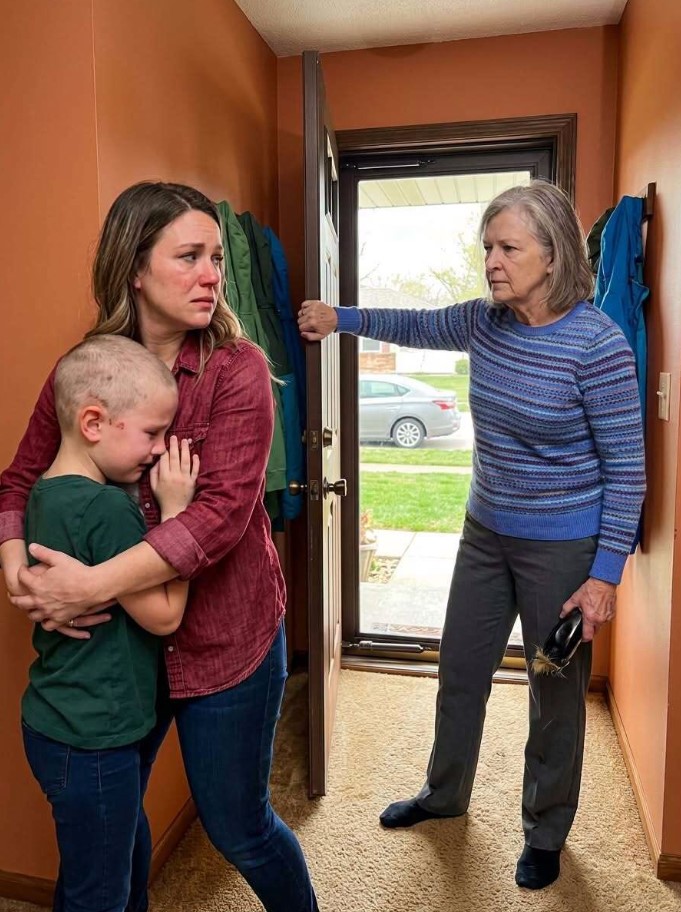
“She blocked the door.”
Judith’s face tightened.
“I was trying to stop you from making an emotional decision.”
The judge looked at her.
“You blocked the child’s mother from leaving with her daughter?”
Judith hesitated.
“Yes.”
“While holding the electric clippers?”
Judith said nothing.
The judge made a note.
Then she looked toward our attorneys.
“I am issuing a temporary order effective immediately.”
My heart began pounding.
The judge continued.
“Meadow is to remain in her mother’s care while the investigation is ongoing. Neither the father nor the paternal grandmother is to remove the child from that care without further court authorization.”
Dustin’s head snapped up.
“Your Honor—”
The judge raised one hand.
“I am not finished.”
He stopped.
“Mr. Harper, you will have no unsupervised contact with Meadow at this time.”
His face went pale.
“And Mrs. Harper,” the judge continued, “you are to have no direct contact with the child unless that contact is specifically authorized through the court.”
Judith stared at her.
“You can’t keep me from my granddaughter.”
The judge’s voice became firm.
“I can, and under the circumstances presented today, I am.”
Judith’s mouth opened.
No words came out.
Then the judge turned toward me.
“You have done the appropriate thing by obtaining medical documentation and bringing this matter before the court rather than attempting to resolve it through confrontation.”
I nodded, barely able to speak.
“Thank you.”
The judge closed the file.
“The temporary order will remain in effect until the next hearing.”
The gavel struck.
It wasn’t loud.
But it sounded like the end of the life I had known.
Outside the courtroom, Dustin caught up with me.
“Wait.”
I kept walking.
“Please.”
I stopped.
Meadow was holding my hand.
Her pink hat covered most of her face.
Dustin stood several feet away.
For the first time, he wasn’t angry.
He looked frightened.
“I didn’t think this would happen.”
I stared at him.
“That is exactly the problem.”
“I thought Mom was trying to teach her something.”
“You told your mother to do whatever she thought was best.”
“I didn’t mean shave her head.”
“You didn’t have to say those exact words.”
He looked down.
“I didn’t understand.”
I almost laughed.
“You didn’t understand when you saw her?”
He said nothing.
“You didn’t understand when you saw the cuts?”
Nothing.
“You didn’t understand when she wouldn’t speak?”
He lowered his head.
“And you still never asked her if she was okay.”
His eyes filled with tears.
“I was wrong.”
I looked at him carefully.
Those were the first words he had said that didn’t defend Judith.
But they came too late.
“I hope you mean that.”
“I do.”
“I don’t know if I can ever trust you again.”
“I know.”
I squeezed Meadow’s hand.
Dustin looked at our daughter.
“Meadow?”
She didn’t answer.
He took one step closer.
She immediately moved behind me.
He stopped.
That tiny movement destroyed whatever remained of the argument inside him.
His daughter was afraid of him.
Not angry.
Not rebellious.
Afraid.
Dustin wiped his face.
“I’ll wait,” he whispered.
Then he walked away.
Meadow remained behind me until he disappeared around the corner.
Only then did she whisper, “Mom?”
“Yes?”
“Can we go home?”
I knelt beside her.
“We’re going somewhere safe.”
She thought about that.
“Is that home?”
I hugged her.
“It is now.”
That night, Meadow slept beside me.
Around two in the morning, I woke to find her sitting upright.
Her pink hat had fallen onto the pillow.
She was touching her head.
I sat up.
“What’s wrong?”
She looked at me.
“Will my hair grow back?”
My heart broke.
“Yes, sweetheart.”
“How long?”
“I don’t know.”
She looked down.
“Will I look normal again?”
I took her hand.
“You’ve always looked normal to me.”
“But Grandma said I looked vain.”
I felt anger rise in my chest, but I kept my voice gentle.
“Your hair was never the problem.”
She looked at me.
“What was?”
“The adults who forgot that you were a person with feelings.”
She was quiet for a long time.
Then she crawled closer.
“I don’t want Grandma to touch my hair again.”
“She won’t.”
“You promise?”
“I promise.”
She rested her head against my shoulder.
After a few minutes, her breathing became slow.
I stayed awake.
I couldn’t stop thinking about how close I had come to accepting Judith’s version of what happened.
For years, I had told myself she was difficult but harmless.
Controlling but loving.
Critical but well-intentioned.
I had made excuses because confronting her would have meant confronting Dustin too.
And confronting Dustin would have meant admitting something painful.
My husband had spent years asking me to tolerate behavior he would never have tolerated if it came from a stranger.
He called it family.
He called it respect.
He called it discipline.
But Meadow had finally shown me what it really was.
Fear.
The following week, the family services investigator visited us.
She spoke to Meadow privately first.
I stayed nearby but out of earshot.
When Meadow came out, she was holding her purple elephant.
The investigator asked me several questions.
Then she asked whether there had been previous incidents involving Judith.
I thought about the little things.
Judith choosing Meadow’s clothes.
Judith criticizing her food.
Judith telling her that girls should sit properly.
Judith brushing her hair too hard because she said Meadow was “too sensitive.”
Judith once cutting a piece of Meadow’s bangs without asking because “they were getting in her eyes.”
I had always dismissed those moments.
Now they looked different.
Not because every mistake meant abuse.
But because there was a pattern.
Judith believed she had authority over my daughter.
And Dustin had repeatedly allowed her to believe it.
The investigator asked for copies of every message.
I gave them to her.
She read the one where Dustin said:
Mom knows what she’s doing.
Then another:
Stop making this bigger than it is.
Then another:
Meadow needs consequences.
The investigator looked up.
“Did he ever ask about her injuries?”
“No.”
“Did he ask whether she was frightened?”
“No.”
“Did he ask whether she wanted her hair shaved?”
“No.”
She nodded and continued taking notes.
A few days later, I received a call from Dustin’s attorney.
He wanted to negotiate.
I agreed to listen.
Not because I was ready to forgive Dustin.
Because I needed to know what he was willing to change.
We met in a conference room.
Dustin arrived alone.
That surprised me.
He sat across from me.
For several seconds, neither of us spoke.
Then he said, “Mom isn’t allowed near Meadow.”
I looked at him.
“That’s not enough.”
“I know.”
“What else?”
“I’ve started counseling.”
I didn’t answer.
“I know that doesn’t fix anything.”
“No.”
“I’ve also told my attorney that I won’t oppose temporary custody.”
That surprised me.
He looked exhausted.
“I keep thinking about the courtroom.”
“So do I.”
“I passed Meadow and sat next to Mom.”
His voice cracked.
“I don’t know why I did that.”
I didn’t tell him.
He already knew.
“You were protecting the person who made you feel loyal,” I said.
He nodded.
“And you forgot the person who needed you.”
He closed his eyes.
“I know.”
Then he said something I never expected.
“I was afraid of my mother.”
I stared at him.
Dustin looked down at his hands.
“She controlled everything when I was growing up. If I disagreed with her, she would stop speaking to me for days. If I defended someone she disliked, she’d make me regret it.”
I listened.
“She always told me that being a good son meant never embarrassing her.”
He looked up.
“So when she called me about Meadow, I thought I was supposed to support her.”
I shook my head.
“You were supposed to protect your daughter.”
“I know.”
For the first time, I believed he understood that.
But understanding wasn’t the same as forgiveness.
And forgiveness wasn’t the same as trust.
“Dustin,” I said, “you have a lot of work to do.”
“I know.”
“And none of it gets to happen at Meadow’s expense.”
“I understand.”
The next court hearing took place six weeks later.
By then, Meadow’s hair had started growing back.
Not enough to cover her head.
But enough that she no longer wore the pink hat every day.
One morning, she stood in front of the mirror and touched the soft new growth.
“Mom?”
“Yes?”
“Can I pick my own haircut when it gets long?”
I smiled.
“You can.”
“Anything?”
“Anything you want.”
She thought for a moment.
“I think I want it really long.”
I smiled.
“Then we’ll grow it.”
At the hearing, the judge reviewed the investigation.
The findings were clear.
Judith had acted without appropriate parental authority.
Dustin had authorized her to handle the situation without limits.
The medical documentation supported Meadow’s physical and emotional distress.
And the messages showed that Dustin’s first priority had been defending his mother rather than checking on his daughter.
The judge extended my temporary custody.
She also ordered that any future contact between Dustin and Meadow occur gradually and under professional supervision until Meadow felt safe.
Judith was prohibited from having unsupervised contact.
Dustin accepted the order.
Judith did not.
She accused me of destroying the family.
She said I was keeping Meadow from her.
She said hair grew back.
The judge listened.
Then she said something Judith never forgot.
“Mrs. Harper, this case has never been about hair.”
Judith became silent.
“It is about consent, safety, boundaries, and the treatment of a child who was placed in your care.”
The judge paused.
“Hair growing back does not erase what happened.”
Judith looked down.
I looked at Meadow.
She was sitting beside me, wearing a blue hat this time.
Her purple elephant rested in her lap.
She wasn’t shaking.
That mattered more to me than anything else.
Months passed.
Meadow’s hair grew.
She started smiling again.
She returned to school without the hat.
Her teacher told me she had begun participating in class again.
She joined an art club.
She started sleeping through the night.
One afternoon, she came home holding a picture.
It was a drawing of three people standing beneath a huge yellow sun.
A woman.
A little girl.
And a smaller purple elephant.
I smiled.
“Who’s this?”
She pointed to the woman.
“That’s you.”
“And this?”
“Me.”
“And the elephant?”
She looked offended.
“Mom, that’s obviously Ellie.”
I laughed.
“Of course.”
She looked at the picture.
Then she added something with a purple crayon.
“What are you writing?”
“Something important.”
She handed it to me.
At the bottom of the page, in uneven letters, she had written:
My mom protected me.
I had to turn away for a moment.
Because that sentence was everything.
Not because I wanted to be called a hero.
I wasn’t.
I was simply her mother.
And protecting her should never have required courage.
It should have been the easiest thing in the world for every adult around her.
Eventually, Dustin began supervised visits.
The first one lasted twenty minutes.
Meadow didn’t hug him.
She didn’t call him Daddy.
She sat across from him and drew pictures.
Dustin accepted it.
The second visit lasted longer.
Then another.
He never pressured her.
He never mentioned Judith.
He never told Meadow she needed to forgive anyone.
He simply showed up.
Slowly, carefully, he began rebuilding something he had nearly destroyed.
I don’t know what our marriage will become.
Maybe one day there will be a path back.
Maybe there won’t.
I stopped making decisions based on what other people expected from me.
For years, I had thought keeping a family together meant tolerating anything.
Now I understood something different.
A family isn’t held together by silence.
It is held together by safety.
By respect.
By accountability.
By knowing when to protect the person who cannot protect herself.
And by understanding that being someone’s grandmother, father, husband, or mother does not give you unlimited permission to hurt them.
One evening, months after the incident, Meadow stood in front of the mirror again.
Her hair had grown into a soft golden fuzz.
She touched it and smiled.
“Mom?”
“Yes?”
“I think I want bangs.”
I smiled.
“Then we’ll get you bangs.”
She grinned.
“And Grandma can’t choose?”
“No.”
“Daddy can’t choose?”
“No.”
“Just me?”
“Just you.”
She smiled at her reflection.
Then she turned toward me.
“Good.”
I watched her walk away.
For months, every time I looked at the clippers, I remembered the carpet covered in my daughter’s hair.
I remembered her shaking.
I remembered Judith blocking the door.
I remembered Dustin defending her.
But that image no longer had the final word.
The final image was Meadow standing in front of the mirror, choosing her own haircut.
Choosing for herself.
That was what Judith had never understood.
Meadow’s hair was never the issue.
Her control was.
And the day I took my daughter out of that house was the day I finally understood that sometimes protecting your child means being willing to lose everything else.
The house.
The marriage.
The approval of the family.
The comfortable story everyone had been telling.
I was willing to lose all of it.
Because when Meadow looked at me that first day with tears running down her cheeks, she didn’t need an explanation.
She needed someone to believe her.
So I did.
And I would do it again.
Every single time.