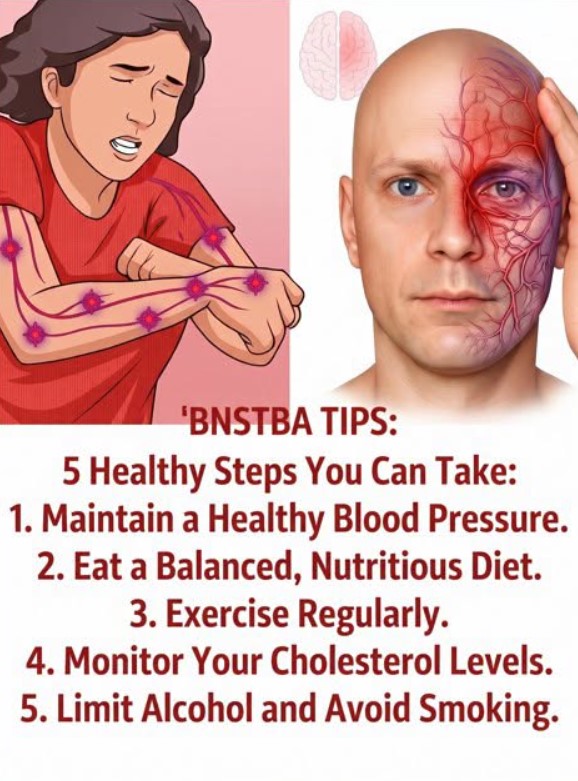
A stroke can happen suddenly. One moment, a person may be talking normally, walking across a room, or preparing breakfast. The next, they may suddenly struggle to speak, see, walk, or move one side of their body.
Because stroke symptoms can appear without much warning, knowing what to look for can make an enormous difference.
However, there is an important point that should not be overlooked: there is no medically proven list of exactly 10 symptoms that reliably predicts a stroke one month in advance. Some people have no noticeable warning beforehand. Others may experience a transient ischemic attack, commonly called a TIA or “mini-stroke,” before a major stroke occurs.
A TIA can cause stroke-like symptoms that disappear after a short time. That temporary improvement can make someone believe the problem has passed. But a TIA is considered a warning sign of a possible future stroke and requires medical evaluation.
That is why sudden, unusual neurological symptoms should never simply be ignored.
First: What Is a TIA?
A transient ischemic attack happens when blood flow to part of the brain is temporarily interrupted. It can produce symptoms that look almost identical to those of a stroke, including weakness, numbness, speech difficulties, vision problems, dizziness, or trouble walking.
The symptoms may disappear, sometimes within minutes.
That does not necessarily mean everything is fine.
At home, it is impossible to reliably determine whether temporary symptoms are caused by a TIA or by a stroke. The Centers for Disease Control and Prevention advises people to seek emergency medical care if stroke symptoms occur, even if those symptoms later disappear.
Think of a TIA as an alarm rather than something to celebrate because it stopped.
The body may have briefly shown that something was wrong with blood flow to the brain.
10 Signs You Should Never Ignore
The following symptoms do not automatically mean that a stroke is about to happen. Many other health problems can cause similar symptoms.
What matters most is sudden onset, particularly when a neurological symptom appears unexpectedly or several symptoms occur together.
1. Sudden Numbness or Weakness
One of the most recognizable stroke symptoms is sudden numbness or weakness in the face, arm, or leg, especially on one side of the body.
You might suddenly notice that one arm feels unusually heavy.
Perhaps one hand becomes difficult to control.
Maybe one side of your face feels strange or numb.
These changes can be subtle at first, but sudden weakness should not be dismissed simply because it isn’t painful.
For example, someone may suddenly drop a cup because one hand no longer feels as strong as usual. Another person may notice that one leg feels weak while walking.
If the change happens suddenly, seek emergency medical attention.
2. A Drooping or Uneven Face
A sudden change in the appearance of the face can be another important warning sign.
Ask the person to smile.
Does one side of the face droop?
Does the smile suddenly look uneven?
Does one side seem difficult to move?
Facial drooping becomes particularly concerning when it occurs together with arm weakness, numbness, confusion, or difficulty speaking.
Do not wait several hours to see whether the face returns to normal.
If the symptom appeared suddenly, treat it as an emergency.
3. Sudden Trouble Speaking
A person experiencing a stroke may suddenly have difficulty communicating.
They may slur their words.
They may struggle to find simple words.
They may say something that doesn’t make sense.
They may know exactly what they want to say but suddenly be unable to get the words out.
Sometimes the change is obvious. Other times, family members notice it first.
Someone who normally speaks clearly might suddenly sound confused or unusually slow.
Sudden difficulty speaking is one of the major warning signs included in the B.E. F.A.S.T. approach used to recognize stroke symptoms.
If it happens unexpectedly, do not assume the person is simply tired, stressed, or distracted.
4. Trouble Understanding What Others Are Saying
Stroke can affect more than the ability to produce speech.
A person may suddenly struggle to understand language.
A simple question may seem confusing.
A familiar conversation may suddenly make no sense.
They may look at you as though they cannot understand what you are asking, even though they were communicating normally moments earlier.
This can be particularly frightening because the person may realize that something is wrong but be unable to explain it.
Sudden confusion or difficulty understanding speech is an important stroke symptom and should receive urgent medical attention.
5. Sudden Vision Changes
Sudden problems with vision can also occur during a stroke.
These changes may include blurred vision, double vision, or sudden loss of vision in one or both eyes.
A person might suddenly feel as though part of their vision has disappeared.
They may have difficulty seeing objects clearly.
They might suddenly see two images instead of one.
Because vision changes can have many causes, it is tempting to blame them on tiredness, eye strain, aging, or an existing eye condition.
But a sudden and unexplained change should not be ignored.
Especially when it occurs together with dizziness, weakness, confusion, or speech difficulties, immediate medical assessment is important.
6. Sudden Dizziness or Loss of Balance
Another possible warning sign is sudden dizziness, trouble walking, loss of balance, or poor coordination.
A person may suddenly feel as though the room is moving.
They might stumble while walking.
They may have difficulty standing without support.
Someone who normally walks steadily might suddenly need to hold onto furniture.
Again, dizziness has many possible causes, including dehydration, inner-ear problems, low blood pressure, medication effects, and other conditions.
But sudden dizziness accompanied by other neurological symptoms deserves urgent attention.
Do not assume that every episode of dizziness is a stroke, but do not ignore a sudden, unusual episode either.
7. A Sudden, Severe Headache
A sudden and severe headache with no known cause can be another emergency warning sign.
This is especially important when the headache is dramatically different from headaches the person normally experiences.
Someone might describe it as extremely intense or say that it appeared suddenly.
A severe headache can have many causes, some harmless and some serious. A hemorrhagic stroke, for example, can occur when a blood vessel in the brain leaks or ruptures.
Because it can be impossible to determine the cause based on the headache alone, sudden severe headache should be medically evaluated urgently.
8. Sudden Confusion
A person who suddenly becomes confused may have difficulty understanding where they are, what is happening, or what other people are saying.
They may ask the same question repeatedly.
They may suddenly have trouble following simple instructions.
They may seem unusually disoriented even though they were completely normal shortly beforehand.
Sudden confusion can have many causes, so it does not automatically mean stroke.
But when it occurs suddenly, especially alongside speech problems, weakness, vision changes, or balance difficulties, it should be treated seriously.
Stroke affects areas of the brain responsible for communication, movement, memory, and other functions, which is why the symptoms can look different from one person to another.
9. Sudden Problems With Coordination
Sometimes a person may notice that their movements suddenly feel awkward or poorly controlled.
They might have trouble picking up an object.
They could struggle to walk in a straight line.
Their hand may suddenly miss the object they are reaching for.
They may feel as though their body is not responding normally.
Sudden loss of coordination can occur with stroke, particularly when it appears alongside dizziness, balance problems, weakness, or other neurological symptoms.
A sudden change in coordination is not something to simply monitor at home.
10. A Combination of Sudden Neurological Symptoms
Sometimes the most important warning isn’t one individual symptom.
It is the combination.
Imagine someone suddenly develops a slightly uneven smile, weakness in one arm, and difficulty getting words out.
Or someone becomes dizzy while also experiencing vision changes and difficulty walking.
When several neurological symptoms appear suddenly, the situation becomes especially concerning.
This is why the B.E. F.A.S.T. method can be useful for recognizing possible stroke symptoms:
B — Balance: Is there sudden loss of balance or coordination?
E — Eyes: Is there sudden vision trouble?
F — Face: Does one side of the face droop when smiling?
A — Arms: Does one arm become weak or drift downward when both arms are raised?
S — Speech: Is speech suddenly slurred, strange, or difficult?
T — Time: If any of these symptoms appear, it is time to call emergency services.
The exact cause cannot be determined through a simple home test. The purpose is to recognize a possible emergency and act quickly.
Why You Shouldn’t Wait for Symptoms to Disappear
One of the most dangerous misconceptions about stroke-like symptoms is that they are no longer important once they disappear.
Imagine that someone suddenly develops weakness in one arm.
After ten minutes, the weakness disappears.
They may say, “I’m fine now.”
But temporary symptoms can be associated with a TIA, which is a warning sign that deserves urgent medical evaluation.
There is no safe rule saying that a symptom can be ignored simply because it lasted only a few minutes.
The brain depends on a continuous supply of oxygen-rich blood. When blood flow is interrupted, brain cells can become damaged.
That is why rapid recognition matters.
What Should You Do If These Symptoms Appear?
If you or someone around you develops sudden symptoms that could indicate a stroke, call your local emergency number immediately.
In the United States, this means calling 911.
Do not wait to see whether the symptoms become worse.
Do not assume that the person simply needs to rest.
Do not drive yourself if emergency medical services are available.
The CDC recommends calling an ambulance because emergency medical personnel can begin care during transport and alert the hospital to prepare for the patient’s arrival.
If possible, note the time when the symptoms first appeared.
That information can be important to medical professionals when deciding which treatments may be appropriate.
Why Time Matters So Much
Stroke is a medical emergency because brain tissue can be damaged when blood flow is interrupted.
There are two major types of stroke: ischemic stroke, which happens when a blood vessel supplying the brain becomes blocked, and hemorrhagic stroke, which happens when a blood vessel ruptures or leaks.
Treatment depends on the type of stroke and other medical factors.
For certain ischemic strokes, treatments designed to restore blood flow may be time-sensitive. This is one reason emergency evaluation should happen as quickly as possible.
The goal isn’t to diagnose yourself at home.
The goal is to recognize that something could be seriously wrong and get professional help quickly.
Stroke Risk Can Build Without Obvious Symptoms
Another reason prevention matters is that some stroke risk factors may exist for years without causing noticeable symptoms.
High blood pressure is one of the major risk factors.
Other factors include diabetes, smoking, certain heart conditions, high cholesterol, physical inactivity, excess weight, and a previous stroke or TIA.
This is why routine medical care matters even when you feel healthy.
A person can feel completely normal while having high blood pressure, elevated cholesterol, or another condition that increases stroke risk.
Regular checkups can help identify these issues and give you an opportunity to discuss ways of managing them with a healthcare professional.
Don’t Wait for a Perfect Warning
The phrase “a month before a stroke” can make it sound as though the body follows a predictable countdown.
It doesn’t.
There is no reliable timetable saying that certain symptoms will appear exactly 30 days before a stroke. Some people may experience a TIA beforehand, while others may have a stroke without any recognizable earlier warning.
What matters is recognizing sudden neurological changes whenever they happen.
If something suddenly feels very different from normal, particularly if it affects movement, speech, vision, balance, or sensation, it deserves attention.
You don’t need to wait for a dramatic collection of symptoms.
One sudden symptom can be enough to justify emergency evaluation.
A Simple Reminder to Keep in Mind
Remember B.E. F.A.S.T.
Balance: sudden dizziness or loss of coordination.
Eyes: sudden vision changes.
Face: sudden facial drooping.
Arms: sudden weakness or numbness, especially on one side.
Speech: sudden trouble speaking or understanding.
Time: call emergency services immediately.
Knowing these signs can help you recognize a possible stroke in yourself or someone else.
You don’t need to be a medical professional to notice that someone’s smile suddenly looks different or that they cannot lift one arm.
And you don’t need to know exactly what caused the symptoms before calling for help.
That is what medical professionals are there to determine.
Final Thoughts
A stroke does not always provide a convenient warning weeks in advance.
Sometimes there are no obvious symptoms beforehand. In other cases, a person may experience a TIA or sudden neurological symptoms that temporarily disappear. Those episodes should never be dismissed simply because the person feels normal again.
Sudden numbness, weakness, facial drooping, difficulty speaking or understanding, vision problems, dizziness, loss of balance, confusion, coordination problems, and unexplained severe headache are among the symptoms that deserve urgent attention.
The most important message is simple: don’t wait to see what happens when possible stroke symptoms appear.
If symptoms are sudden and concerning, call emergency services immediately.
And if symptoms disappear after a few minutes, don’t assume the danger has passed. A TIA can be a warning sign of a future stroke and needs prompt medical evaluation.
Knowing the signs, recognizing them quickly, and acting without delay can make a critical difference.
This article is for general health information and does not replace an evaluation by a qualified healthcare professional.