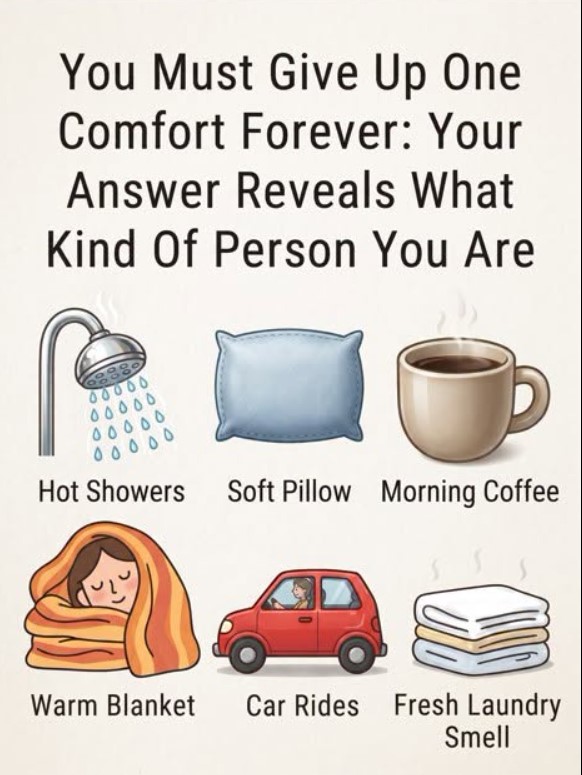
Imagine being given a strange challenge.
You have to give up one comfort forever.
Not for a week.
Not for a month.
Not until you change your mind.
Forever.
And there is one more rule: you cannot choose “none of them,” and you cannot create a clever loophole that somehow lets you keep everything you love.
At first, the question sounds like a simple little game.
But once you start thinking about your options, it becomes surprisingly difficult.
Would you give up your morning coffee?
Your favorite dessert?
Sleeping in on weekends?
Watching television after a long day?
Ordering takeout when you don’t feel like cooking?
Or your smartphone?
Suddenly, the choice doesn’t feel so simple.
That’s because these small comforts often become connected to our routines, memories, emotions, and everyday habits. A cup of coffee might represent the beginning of your morning. A favorite dessert might remind you of childhood. Sleeping late might be the one peaceful moment you get after a busy week.
So perhaps the most interesting part isn’t which comfort you give up.
It’s why you find certain comforts so difficult to lose.
Of course, this is a fun personality-style challenge, not a scientific personality test. One hypothetical decision cannot accurately define an entire person. Human personalities are far more complicated than that.
Still, your answer can make for an interesting conversation.
The Ultimate Comfort Challenge
We all have little things that make ordinary days more enjoyable.
They don’t necessarily have to be expensive.
Sometimes the smallest comforts can have the greatest emotional value.
For one person, it might be a hot drink in the morning.
For another, it might be crawling into a warm bed after a long day.
Someone else might look forward to watching their favorite show every evening.
Another person might consider ordering their favorite meal after a stressful day one of life’s best conveniences.
These things may appear insignificant from the outside, but they can become important parts of our daily rhythm.
That’s why imagining life without one of them can feel surprisingly uncomfortable.
The real question isn’t simply:
“What could you live without?”
It’s:
“Which comfort has become most important to the way you live?”
Why Do Small Comforts Matter So Much?
Comfort isn’t always about physical pleasure.
Sometimes a comfort is connected to a memory.
Think about a favorite food from childhood.
Maybe your mother or grandmother used to make it.
Maybe you associate it with holidays, birthdays, family gatherings, or special celebrations.
Or perhaps it has nothing to do with nostalgia at all. Maybe you simply enjoy the familiar feeling of eating something you know you’ll love.
The same thing happens with everyday routines.
A morning coffee can become a ritual.
A favorite television program can become part of your evening.
A warm blanket can make your bedroom feel safe and peaceful.
A smartphone can connect you with friends, family, entertainment, news, and work.
Over time, these things can become more than simple objects or activities.
They become part of the rhythm of everyday life.
Comfort Is Different for Everyone
There is no universal definition of comfort.
One person’s favorite habit may mean absolutely nothing to someone else.
Someone who enjoys quiet mornings might happily give up television but refuse to sacrifice their morning coffee.
Someone else might never drink coffee and immediately choose that option.
A person who works long hours may consider sleeping in an essential part of the weekend.
Another person might naturally wake up early and have no problem giving it up.
That is what makes the challenge interesting.
There isn’t necessarily a “correct” answer.
Your choice depends on what matters most to you.
So let’s look at the possibilities.
1. Give Up Coffee or Your Favorite Morning Drink
For millions of people, the morning doesn’t truly begin until they have their favorite drink.
Maybe it’s coffee.
Maybe it’s tea.
Maybe it’s hot chocolate or another familiar morning beverage.
There is something comforting about the entire ritual.
You wake up.
You prepare the drink.
You smell the aroma.
You take the first sip.
And suddenly the day has officially begun.
If this would be the hardest comfort for you to sacrifice, it may suggest that you enjoy routines and familiar rituals.
You may appreciate having small anchors throughout your day.
Perhaps you like knowing what comes next.
Maybe your morning routine helps you feel organized and ready for whatever the day brings.
But remember, this is only a playful interpretation.
It doesn’t mean everyone who refuses to give up coffee is automatically a routine-loving person.
Sometimes you simply really like coffee.
And honestly, that’s reason enough for this game!
2. Give Up Your Favorite Dessert
Chocolate cake.
Ice cream.
Cookies.
Brownies.
Pie.
Cheesecake.
Whatever dessert immediately makes you think, “I’ll just have one more piece.”
Now imagine never having it again.
For some people, that would be surprisingly difficult.
Dessert isn’t always about hunger.
Sweet foods can be associated with celebrations, relaxation, rewards, family traditions, or childhood memories.
Maybe you always have cake on your birthday.
Maybe your favorite cookies remind you of holidays.
Maybe ice cream is what you reach for after a difficult day.
Giving up dessert could therefore feel like giving up a small source of happiness.
If you’d sacrifice dessert without hesitation, you may simply value other comforts more.
Perhaps food isn’t your primary form of relaxation.
Or maybe you have plenty of other things that make you happy.
And if dessert is the one option you refuse to sacrifice?
Well, that’s understandable too.
Some decisions are simply difficult when chocolate cake is involved.
3. Give Up Sleeping In
Now imagine this:
No more lazy Saturday mornings.
No more staying under the blankets for another hour.
No more turning off the alarm and thinking, “I’ll get up in five minutes.”
You have to get up on schedule every day.
For people who treasure sleep, this might be the hardest option of all.
Sleeping isn’t simply about comfort.
Rest is an important part of everyday life, and many people look forward to having a slower morning after a busy week.
Sleeping in can also represent personal freedom.
During the workweek, your schedule may be controlled by responsibilities, appointments, school, or work.
The weekend can feel different.
You wake up naturally.
You stay in bed.
You take your time.
If you’re unwilling to give up that experience, it might suggest that you place a high value on rest, recovery, and personal time.
And after a long week, who could blame you?
4. Give Up Television and Streaming
Imagine never watching another television show or movie.
No favorite series.
No movie nights.
No relaxing on the couch after work.
No saying, “Just one more episode.”
For some people, this would barely be a sacrifice.
For others, it would be incredibly difficult.
Television and streaming services can serve many purposes.
They can provide entertainment.
They can help people relax.
They can become a way for couples and families to spend time together.
Sometimes watching a familiar show is simply a way to turn your brain off after a stressful day.
Giving up television might therefore be difficult for someone who relies on entertainment as an important part of their relaxation routine.
On the other hand, if you rarely watch television, you might sacrifice it immediately.
And that illustrates something important about this challenge.
The same choice can mean completely different things to different people.
5. Give Up Takeout and Restaurant Meals
Now imagine that from this moment forward, you have to prepare every meal yourself.
No pizza delivery.
No quick burger after a long day.
No favorite restaurant.
No ordering food because you are too tired to cook.
For some people, this would barely matter.
For others, it would feel like losing one of life’s greatest conveniences.
Restaurant meals aren’t only about food.
They can also be about social experiences.
Meeting friends for dinner.
Celebrating a birthday.
Going out with your partner.
Trying a new restaurant.
Or simply enjoying a meal without having to prepare the ingredients, cook everything, and clean the kitchen afterward.
If you choose to keep restaurant meals above the other options, you may value convenience, variety, social experiences, or simply the pleasure of letting someone else do the cooking.
And there is absolutely nothing wrong with appreciating a night when the kitchen stays closed.
6. Give Up Your Smartphone
This might be the most difficult choice for some people.
Imagine waking up tomorrow and having no smartphone.
No messages.
No social media.
No quick internet searches.
No navigation apps.
No checking the weather.
No taking photos whenever you want.
No scrolling through videos while waiting in line.
No checking notifications every few minutes.
For many people, smartphones have become deeply integrated into everyday life.
They aren’t just entertainment devices anymore.
They are communication tools, cameras, calendars, maps, banking tools, work devices, and sources of information.
Giving one up would therefore require major changes to daily routines.
If this is the comfort you would refuse to sacrifice, it may suggest that you value convenience, connectivity, and immediate access to information.
But it could also simply mean your phone has become an essential practical tool.
The Real Question Behind the Challenge
After looking at all these choices, you might notice something interesting.
The challenge isn’t really about objects.
It’s about what those objects or activities represent.
Coffee can represent routine.
Dessert can represent reward.
Sleeping in can represent rest.
Television can represent relaxation.
Takeout can represent convenience.
A smartphone can represent connection and accessibility.
That is why different people will react differently to the same question.
Your favorite comfort may tell you something about what you currently value in your everyday life.
But it doesn’t tell your entire story.
What If You Can’t Choose?
That’s actually part of the fun.
Maybe every option feels important.
Maybe you love your morning coffee but also love sleeping late.
Maybe you couldn’t imagine giving up your phone, but you also couldn’t imagine never ordering pizza again.
That’s perfectly normal.
The point isn’t to discover a scientifically accurate personality profile.
It’s simply to pause for a moment and ask yourself:
Which small part of my daily life would I miss the most?
That question alone can reveal something interesting.
Think About Your First Reaction
Here’s another way to play the game.
Don’t overthink your answer.
Read the six options again and notice which one immediately makes you uncomfortable.
Which one made you think:
“Absolutely not. I couldn’t give that up.”
That instinctive reaction may be more interesting than a carefully calculated answer.
Maybe you immediately rejected the idea of giving up sleep.
Maybe the thought of losing coffee made you nervous.
Maybe you realized that your favorite dessert means more to you than you expected.
Or perhaps you discovered that you could easily live without television.
Your first reaction can reveal which routines have become especially important to you.
Your Choice May Change Over Time
Another interesting part of this challenge is that your answer may not stay the same forever.
Imagine answering the question at age twenty.
Then answer it again at forty.
Then again at sixty.
Your priorities may be completely different.
A young parent might value sleep more than anything else.
Someone working long hours might prioritize convenience.
A person with an empty nest might have more time for cooking and choose restaurant meals less often.
Someone who has recently become more social might place greater importance on entertainment and connection.
Life changes.
Our routines change.
And our definition of comfort changes with them.
That’s another reason not to treat this challenge as a fixed personality diagnosis.
It’s simply a snapshot of what appeals to you right now.
What Your Choice Might Suggest
If you want to turn this into a playful personality exercise, you can think about the options this way:
Coffee: You may appreciate routine, familiar rituals, and predictable moments of comfort.
Dessert: You may enjoy rewards, pleasure, celebration, and small indulgences.
Sleeping in: You may place a high value on rest, recovery, and having personal time.
Television: You may enjoy relaxation, entertainment, stories, and switching off from daily responsibilities.
Takeout: You may appreciate convenience, variety, social experiences, and saving time.
Smartphone: You may value connection, accessibility, convenience, and staying informed.
Again, these are playful interpretations rather than psychological conclusions.
Your choice doesn’t define you.
The Comfort You Keep May Say More Than the One You Give Up
There’s another way to look at the challenge.
Instead of asking:
“What are you willing to lose?”
ask:
“What are you unwilling to lose?”
That answer might tell you more about your current priorities.
If you immediately protect your sleep, perhaps rest is especially important to you.
If you protect your morning drink, maybe routine plays an important role in your day.
If you refuse to give up your smartphone, perhaps staying connected matters greatly to you.
If dessert is non-negotiable, maybe you enjoy small pleasures and rewards.
None of these interpretations is automatically good or bad.
They’re simply different preferences.
And that’s what makes the challenge enjoyable.
Share the Challenge With Someone Else
This question can become even more interesting when you ask another person.
Ask your partner.
Ask a friend.
Ask a family member.
Ask a coworker.
Then compare your answers.
You may be surprised by how differently people respond.
Someone you thought would never give up coffee might immediately choose it.
A person who rarely watches television might insist that their favorite shows are untouchable.
Someone who always seems busy might choose to protect sleeping in because weekends are their only opportunity to rest.
The conversation can reveal little things about people’s routines that you might never have noticed.
There Is No Wrong Answer
That’s probably the most important part of this entire challenge.
There isn’t a correct choice.
You aren’t more disciplined because you give up dessert.
You aren’t more relaxed because you choose to keep sleeping in.
You aren’t more independent because you can live without your smartphone.
And you aren’t automatically a certain type of person because you refuse to give up coffee.
People are complicated.
Our personalities are shaped by countless experiences, relationships, values, circumstances, and choices.
One imaginary question cannot capture all of that.
But it can make you stop and think.
And sometimes that’s enough.
Final Thoughts
The question sounds simple:
You must give up one comfort forever. Which one would you choose?
But once you start considering the possibilities, the decision becomes much more revealing.
Would you sacrifice your morning coffee?
Your favorite dessert?
Sleeping in?
Television and streaming?
Takeout and restaurant meals?
Or your smartphone?
Each option represents a different kind of everyday comfort, and your reaction to each one can give you an interesting glimpse into the habits and routines you value most.
Just remember that this is a fun thought experiment, not a scientific personality test. Choosing coffee doesn’t automatically make you a routine-loving person, and choosing your smartphone doesn’t necessarily mean you’re dependent on technology.
Your personality is much more complicated than one answer.
Still, the question can be surprisingly revealing because it encourages you to think about what makes your ordinary days feel comfortable, enjoyable, and familiar.
So take a moment.
Read the choices again.
Imagine that you really have to give one of them up forever.
Which comfort would you sacrifice—and which one would you fight to keep?
Your answer may not define who you are.
But it might tell you something interesting about what matters to you right now