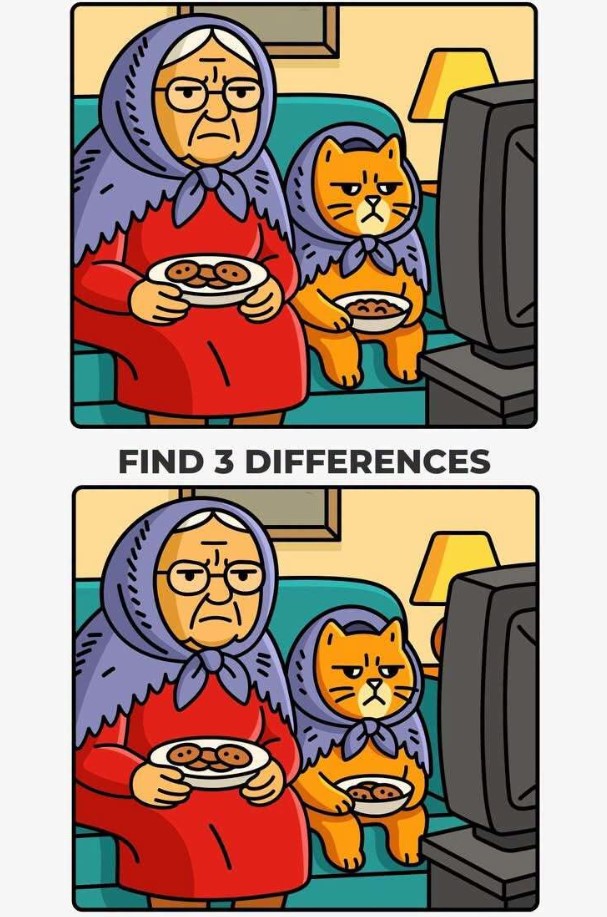
Some picture puzzles look easy at first, but the smallest details can make them surprisingly challenging. This funny visual brain teaser features a grumpy grandmother and her equally grumpy orange cat, sitting side by side on a comfortable sofa. Although the two pictures appear almost identical, three small differences are hiding in plain sight.
The challenge is simple: look carefully at both illustrations and see whether you can spot all three changes.
Meet the Grumpy Grandma and Her Matching Cat
The scene shows an elderly grandmother relaxing on a cozy green sofa. She is wearing a red dress and a purple headscarf, with her round glasses resting on her face. In her hands, she holds a small bowl of cookies as she settles in to watch television.
Sitting right beside her is an adorable orange cat. The cat seems to have inherited its owner’s serious expression, looking just as grumpy and unimpressed. It is even wearing a matching purple headscarf and holding its own little bowl of treats.
The room adds to the comfortable atmosphere. A warm yellow lamp lights the background, while a framed picture hangs on the wall above the sofa. Everything seems peaceful, except for the two serious-looking television fans.
Can You Find All Three Hidden Differences?
At first glance, the upper and lower illustrations seem to show exactly the same moment. The grandmother is sitting in the same position, the cat is beside her, and the room appears unchanged.
However, three details have been altered.
To solve the puzzle, avoid looking at the pictures as a whole. Instead, divide the scene into smaller sections and compare each one carefully.
1. Examine the grandmother
Start with the grandmother’s face and clothing. Look closely at her glasses, headscarf, expression, and the bowl of cookies in her hands. Small changes around the face can be especially difficult to notice because our eyes tend to focus on the character’s expression.
2. Look carefully at the orange cat
Next, turn your attention to the cat. Compare its ears, whiskers, purple headscarf, facial expression, and bowl of treats. Since the cat is dressed to match its owner, it is easy to concentrate on the funny outfit and overlook a tiny detail.
3. Inspect the background
Finally, examine everything behind the grandmother and her pet. Pay attention to the green sofa, the yellow lamp, the framed picture, and the television. Even a small change in an object or its shape can count as one of the hidden differences.
Why Are These Picture Puzzles So Tricky?
Spot-the-difference challenges test more than eyesight. They also require concentration, patience, and the ability to notice details while ignoring distractions.
When two pictures are almost identical, the brain naturally assumes that most of what it sees is unchanged. As a result, we may look directly at a difference without recognizing it.
A useful technique is to compare the images systematically. Start at the top and work your way down, checking the characters before moving to the background. This approach is often more effective than quickly jumping from one part of the picture to another.
A Fun Challenge to Share With Family and Friends
This grandmother-and-cat puzzle is a lovely little activity for a quiet break. You can challenge your family, friends, or children to find all three differences without giving away the answer.
For an extra challenge, set a short time limit. See who can identify all three changes first, then compare everyone’s answers.
Remember, there is no need to rush. The goal is to enjoy the challenge and give your attention to the little details that are easy to miss.
Conclusion :
The challenge of finding the three hidden differences in Grumpy Grandma and Her Matching Cat reminds us that even the simplest-looking pictures can hide details that are surprisingly difficult to notice. At first, the two illustrations seem almost exactly alike. Grandma is sitting comfortably on her sofa, holding her bowl of cookies, while her orange cat sits proudly beside her, dressed to match its owner’s funny appearance. The familiar setting makes it easy to assume that nothing has changed, but a closer look reveals that there is more to the scene than meets the eye.
What makes this puzzle especially entertaining is the way it encourages us to slow down and pay attention. Instead of glancing quickly at the pictures, we must examine the grandmother, her cat, their clothing, the objects they are holding, and the decorations in the room. Sometimes the smallest details are the hardest to find because our brains naturally concentrate on the main characters rather than the little things surrounding them.
These visual challenges are also a wonderful way to take a short break from everyday routines. They encourage observation, concentration, patience, and careful thinking without making the experience feel like a difficult task. Whether you solve the puzzle immediately or need several attempts, every moment spent comparing the illustrations is part of the fun.
And let’s not forget the funniest part of the scene: Grandma and her orange cat look almost like a team, sharing the same serious expression and matching style. Their grumpy faces make the illustration memorable and add a little humor to the challenge. It is the kind of picture that makes you smile even while you are concentrating on finding the differences.
If you managed to spot all three changes without help, congratulations! You have a sharp eye for details. If you missed one or two, do not feel disappointed. These puzzles are designed to make small changes difficult to notice, and sometimes looking again with fresh eyes is all it takes.
Why not share the challenge with your family or friends? Let everyone study the two pictures independently and see who can find all three differences first. You may be surprised by how differently people approach the same puzzle. Most importantly, enjoy the experience, take your time, and remember that sometimes the smallest details make the biggest difference.