Sometimes the most difficult puzzles are not the ones filled with complicated shapes, numbers, or confusing patterns. Instead, they are the simple-looking images that seem almost identical at first glance. They make us question our eyesight, test our concentration, and encourage us to look much more carefully than we normally would.
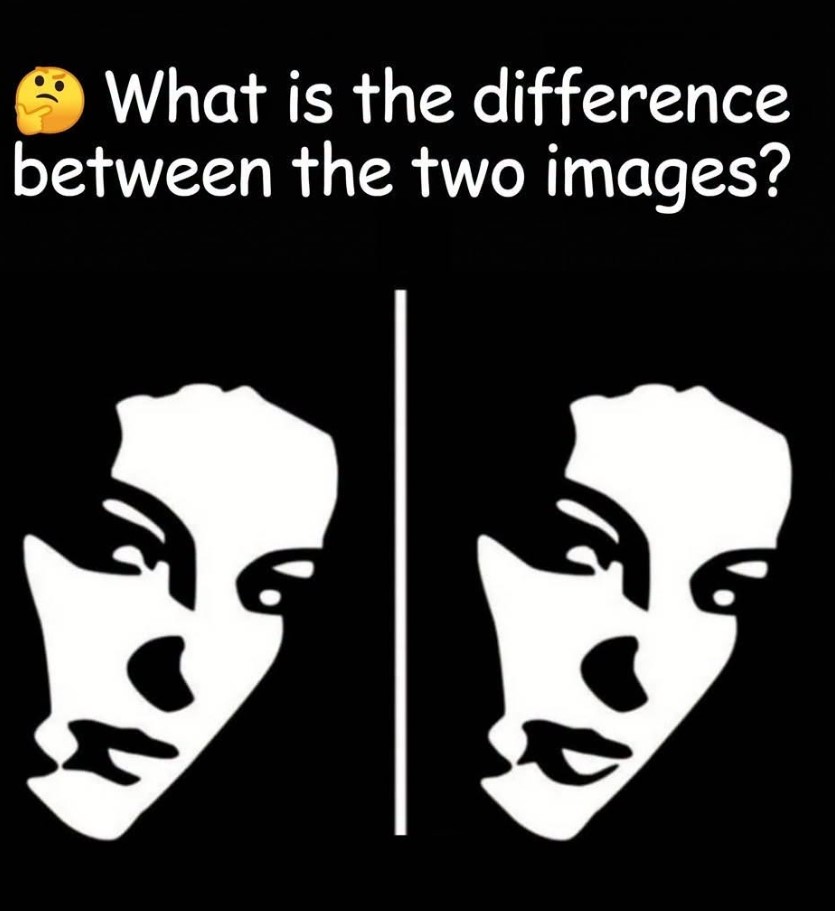
Today’s visual challenge is a perfect example. You are presented with two black-and-white pictures of a human face. Both images appear nearly identical, and their strong contrast makes the shapes and shadows look especially striking. However, there is one small detail that separates them.
Your mission is to study both pictures, compare their features, and discover what has changed. It may seem easy when you first look at the images, but finding the difference can require more patience than you expect.
Take a Closer Look at the Two Images
At first glance, the two illustrations look like copies of one another. Each picture shows a stylized face created using areas of solid black and white. The face has a clearly defined outline, a visible forehead, eyes, a nose, and lips.
The artist has used strong contrasts to create the appearance of light and shadow. Rather than showing every facial feature with realistic detail, the illustration relies on carefully arranged shapes. This gives the face an unusual, almost mysterious appearance.
Because both pictures share the same general design, your eyes may quickly assume that there is nothing different between them. You might notice the eyes first, then move toward the nose and the outline of the head. Everything seems to match, which makes the puzzle more challenging.
But do not give up too quickly. The difference is hiding in one of the facial features, and a careful comparison will help you find it.
How to Find the Hidden Difference
When solving a spot-the-difference puzzle, one of the biggest mistakes is looking at both pictures without following a clear method. Your eyes move from one area to another, and you may repeatedly examine the same details while overlooking the important one.
A better approach is to compare the illustrations section by section.
1. Start with the eyes
Look at the left eye in both pictures, then compare the right eye. Pay attention to the shape of the dark areas, the white spaces, and the small lines around each eye.
The eyes often attract attention because they give a face its expression. However, do not spend too much time on them if they appear identical.
2. Compare the nose
Move your attention toward the center of the face. Examine the nose carefully, including its outline and the dark shadow underneath it.
In black-and-white illustrations, even a small change in the shape of a shadow can make a feature look different. Try comparing the two noses directly rather than relying on your memory of the first picture.
3. Examine the mouth and lips
This is an especially important part of the puzzle. Look at the lips, the small shapes surrounding the mouth, and the position of the dark and white areas.
Because the mouth is made up of several curved lines and contrasting shapes, a small alteration can be easy to miss. Compare the two illustrations closely before deciding that they are identical.
4. Check the overall outline
Finally, look at the outer shape of the face, the forehead, and the chin. Check whether the images have the same proportions and whether any lines or shadows appear in different positions.
Working through the picture in this order makes it easier to notice small changes without becoming distracted by the overall design.
The Answer: What Is Different Between the Two Images?
When you compare the two faces closely, you can see that the shape and arrangement of the lips are not exactly the same. The small change is visible around the mouth in the right-hand illustration.
It is easy to overlook because the rest of the face looks so similar. The eyes, nose, and general outline can distract you from the lower part of the image, where the important detail is hiding.
This is why looking at each feature separately is such a useful technique. Instead of trying to notice everything at once, you give your eyes a chance to recognize the small change.
Why Are Simple Visual Puzzles Sometimes So Difficult?
You might wonder why it can take so long to find one small difference in two pictures. After all, the answer is right in front of you. Shouldn’t it be easy to recognize?
The explanation has a lot to do with the way we naturally process visual information.
When we look at a picture, our brains quickly identify its main subject. In this case, we recognize a human face. We notice the eyes, nose, mouth, and outline, then form an overall impression of what we are seeing.
Once the brain decides that the two pictures look alike, it may stop paying attention to smaller details. This can make a tiny change much harder to recognize.
High-contrast illustrations add another challenge. The large black and white areas create strong visual patterns, and our eyes may focus on those patterns instead of the precise shapes within them.
That is why a picture can appear completely identical for several seconds before one small difference suddenly becomes obvious.
What Skills Does This Puzzle Exercise?
Spot-the-difference puzzles are enjoyable, but they also encourage several useful mental habits.
Observation: You learn to pay attention to small details rather than focusing only on the main subject.
Concentration: Comparing two similar images requires you to stay focused and avoid distractions.
Visual memory: You must remember the appearance of one feature while checking whether it matches the other image.
Patience: Some differences are not immediately obvious. Taking your time and examining the pictures carefully can make a big difference.
Problem-solving: Following a systematic approach helps you work through the challenge instead of guessing randomly.
These activities are not a substitute for formal cognitive training, but they can be an enjoyable way to practise careful observation during a break.
A Fun Challenge to Share With Others
One of the best things about visual puzzles is that they are easy to enjoy with other people. You do not need special equipment, complicated instructions, or previous experience. All you need are the two pictures and a little time.
Show the images to a friend or family member without revealing the answer. Give everyone a chance to study the faces independently. You may be surprised that one person notices the mouth immediately while someone else spends several minutes examining the eyes.
For an extra challenge, set a time limit. Give everyone one minute to identify the difference and see who manages to solve it first.
You can also make the activity more interesting by asking participants to explain exactly where they found the change. This encourages everyone to look closely rather than simply guessing.
Conclusion :
This simple-looking visual puzzle demonstrates just how easily a tiny detail can escape our attention. At first, the two black-and-white faces appear almost completely identical. They share the same general outline, similar facial features, and the same striking contrast between light and shadow. It is natural to assume that the pictures are exact copies, especially when the eyes and nose seem to match perfectly.
However, the real challenge is learning not to trust that first impression. By slowing down and examining each part of the illustration separately, you give yourself a much better chance of discovering what has changed. In this puzzle, the important clue is around the mouth, where the shape of the lips differs between the two images. It is a small alteration, but it is enough to make the pictures different.
What makes this kind of challenge so enjoyable is that it turns an ordinary moment into an opportunity to test your observation skills. You do not need to be an expert at solving puzzles or have exceptional eyesight. Sometimes, all you need is a little patience and the willingness to look again. A detail that seemed impossible to notice at first can suddenly become obvious once you know where to concentrate.
It is also a useful reminder that our first impressions are not always complete. We often look at things quickly, recognize the general picture, and move on without noticing the smaller details. These puzzles encourage us to take a different approach: observe carefully, compare thoughtfully, and avoid rushing toward an answer.
If you found the difference without looking at the answer, congratulations! You have done a great job paying attention to the little details. If you needed a hint or had to check the solution, there is no reason to feel disappointed. The purpose of these challenges is not simply to win but to enjoy the process of discovering something that was hiding in plain sight.
Why not share this puzzle with your friends and family and see who can spot the difference first? Keep the answer secret, let everyone take their time, and enjoy their reactions when they finally discover the changed detail. After all, sometimes the smallest difference can make the biggest challenge!