Some riddles look incredibly simple when you first read them, but they can become surprisingly tricky once you start thinking about the wording. This is exactly what makes a good brain teaser so enjoyable. It doesn’t necessarily require complicated mathematics or advanced knowledge. Instead, it challenges you to pay attention, interpret the clues carefully, and avoid jumping to conclusions.
Today’s puzzle is a perfect example. You are given a short clue involving the numbers four, eight, and nine, along with several possible answers. At first, the challenge may seem straightforward. However, the way the words are written can make you question which option is actually correct.
Many people will quickly choose an answer based on the numbers they see, while others will spend more time analyzing the sentence and looking for a hidden meaning. The trick is to understand exactly what the clue is asking before making your final decision.
Are you ready to test your attention to detail and see whether you can solve it without looking at the answer?
The Riddle: Which Option Is Correct?
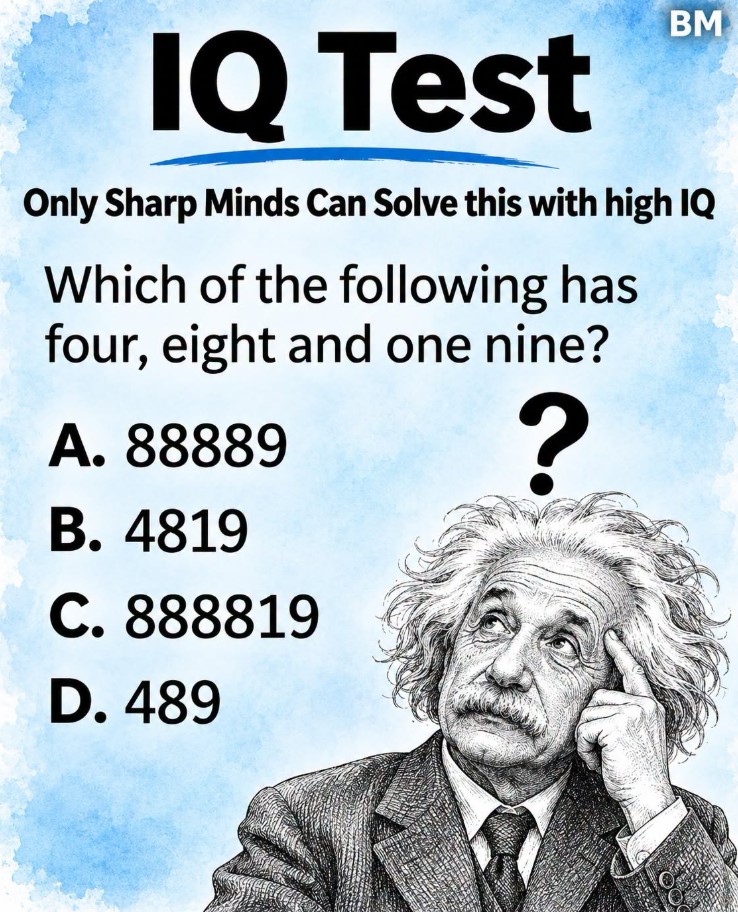
Take a moment to read the clue carefully:
“Four, Eight, One nine.”
You are given several number options, and your task is to determine which one matches the clue.
Here are the choices:
- A. 88889
- B. 4819
- C. 888819
- D. 489
Don’t rush to select an answer. Read the clue again and think about how each word relates to the numbers in the choices.
Does the clue mean that the number must contain the digits 4 and 8, along with a single 9? Or is there something more specific hidden in the way the words are written?
The answer may be easier than you think, but the wording is what makes this puzzle interesting.
Take Your Time Before Choosing
Before revealing the answer, try to examine all four options individually.
Option A contains several 8s and ends with a 9, but it does not contain the digit 4. That immediately makes it difficult to match the clue.
Option B, 4819, contains a 4, an 8, and a 9. It appears to satisfy the requirements because all three digits are present.
Option C also contains multiple 8s and a 9, but it does not include a 4. Therefore, it cannot meet all the conditions if the digit 4 is required.
Option D, 489, contains a 4, an 8, and a 9 as well. It is shorter than option B, but it still appears to match the clue.
This is where the puzzle becomes interesting. If you were simply checking whether the required digits appear in the number, both B and D would seem correct.
So what makes one answer better than the other?
The Correct Answer
According to the explanation provided with the original puzzle, the intended answer is:
D. 489
However, option B, 4819, also satisfies the basic requirement of containing the digits 4, 8, and one 9.
The reasoning behind selecting D comes from interpreting the phrase “One nine” as the number 19 rather than as the instruction to include a single digit 9.
The original explanation points out that there is no comma separating “one” and “nine.” This suggests that the words should be read together rather than as two separate instructions.
Under that interpretation, the clue is more specific than simply asking for a 4, an 8, and a 9 somewhere in the number.
Option D, 489, is therefore presented as the intended answer because it is the shorter number that follows the clue’s interpretation without adding another digit.
Why Option B Is Also a Reasonable Answer
One of the most interesting aspects of this brain teaser is that the wording leaves room for more than one interpretation.
If the clue is understood as requiring the digits 4, 8, and a single 9, then option B, 4819, qualifies. It contains all three digits, and the 9 appears only once.
Option D, 489, also contains those same digits, with the 9 appearing once.
This means that simply counting the required digits does not eliminate option B.
The puzzle relies on the way the clue is interpreted rather than on a strict mathematical rule that clearly excludes one of the two numbers. The explanation favors D because it reads “one nine” as a combined expression rather than as a separate instruction to include one occurrence of the digit 9.
That distinction is what makes the riddle challenging. It encourages you to pay attention not only to the numbers but also to the way the clue is written.
What Makes This Puzzle Tricky?
Many people approach number riddles by looking for a mathematical pattern. They might count the digits, check their positions, compare the lengths of the numbers, or search for a hidden sequence.
But sometimes the solution has very little to do with mathematics.
The wording of a riddle can be just as important as the numbers themselves. A small change in punctuation, spacing, or the way a phrase is interpreted can completely change the meaning of a clue.
In this puzzle, the phrase “One nine” creates the uncertainty. If you interpret it as one occurrence of the digit 9, two options appear to satisfy the conditions. If you interpret it as the number 19, the intended answer becomes more dependent on how the clue is read.
This is a useful reminder that solving puzzles requires more than quick calculations. It also requires patience, careful reading, and the willingness to consider alternative interpretations.
How to Improve Your Riddle-Solving Skills
If you enjoy brain teasers like this one, there are a few simple habits that can help you approach them more effectively.
Read the Clue More Than Once
Your first interpretation may not always be the correct one. Read the sentence slowly and pay attention to words that could have more than one meaning.
Avoid Choosing Too Quickly
A number may look correct at first glance, but compare it with every condition in the clue. Make sure you haven’t overlooked a small detail.
Consider Alternative Interpretations
If two answers seem correct, don’t immediately assume you made a mistake. The wording might be ambiguous, or the puzzle may depend on an interpretation that hasn’t been clearly explained.
Explain Your Reasoning
Try to explain why your chosen answer is correct in one or two sentences. If you cannot explain it clearly, go back and examine the clue again.
Enjoy the Process
Not every puzzle needs to have a perfectly obvious solution. Sometimes the most enjoyable part is discussing different interpretations and discovering why people arrive at different answers.
Final Thoughts
This riddle is a great example of how a few simple words can turn an easy-looking number question into a surprisingly thought-provoking challenge. At first, the options seem straightforward, and it may feel like all you need to do is identify the digits four, eight, and nine. But once you begin examining the wording more carefully, you realize that the interpretation of the clue plays an important role in determining the intended answer.
The original explanation favors D, 489, because it treats “one nine” as a combined expression rather than as a separate instruction to include a single 9. At the same time, B, 4819, also meets the basic digit requirements, which makes the puzzle open to discussion. That is part of what makes it interesting: it encourages you to think beyond the first answer that comes to mind and consider how language can influence the way you solve a problem.
Brain teasers like this are a fun way to exercise attention, reasoning, and patience. They remind us that sometimes the smallest detail can make the biggest difference, and that taking a few extra seconds to read carefully can help us avoid overlooking something important.
Whether you chose D immediately, selected B, or spent several minutes comparing the options, the important thing is that you took the time to think. Not every challenge has to involve difficult calculations to make you stop and reconsider your answer.
So, how did you do? Did you identify the intended answer on your first attempt, or did the wording make you question your choice? Share the answer you picked and see whether others interpreted the clue the same way. Sometimes comparing different ways of thinking is just as entertaining as solving the riddle itself.