Some math problems look so simple that people feel confident they can solve them in just a few seconds. But sometimes, the easiest-looking equations are the ones that cause the most confusion.
This tricky math challenge is a perfect example. At first glance, it appears to be a basic calculation involving only subtraction, multiplication, addition, and division. There are no complicated formulas, fractions, or advanced mathematical concepts.
However, there is one important rule you must remember before calculating the answer. Ignore it, and you could easily end up with the wrong result.
The challenge is to solve the equation without using a calculator. Take a moment, examine the numbers carefully, and see whether you can get the correct answer on your own.
The Math Challenge: Can You Find the Correct Answer?
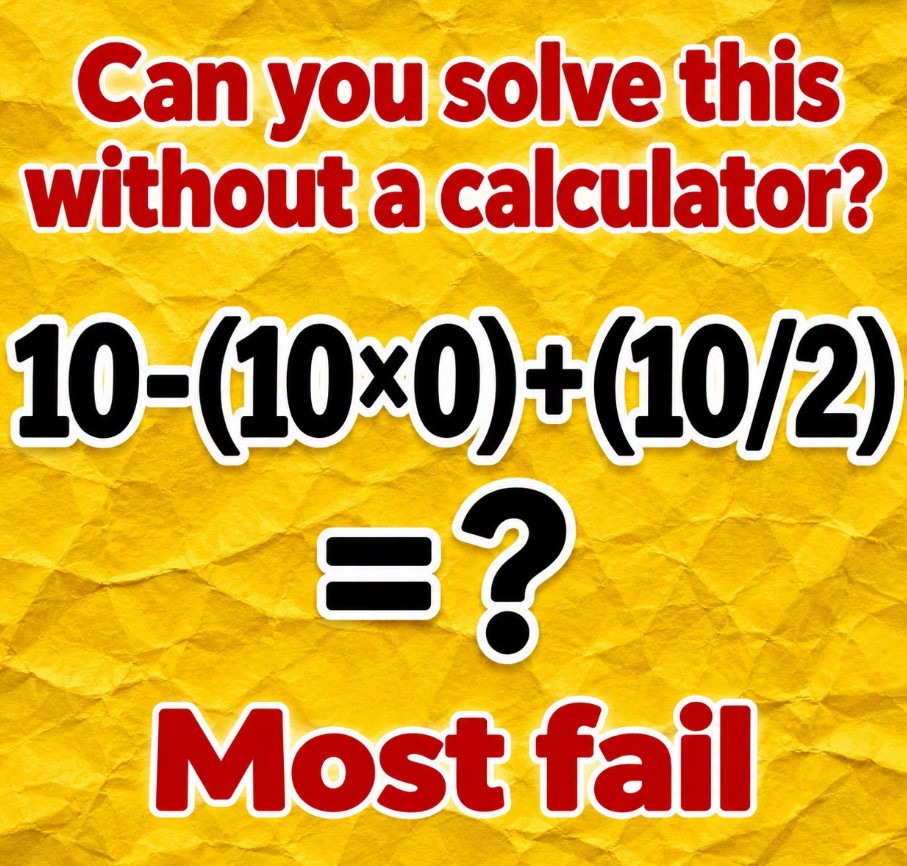
Here is the equation:
10 − 10 × 0 + 10 ÷ 2 = ?
Before looking at the solution, try to work it out yourself.
You have four basic operations to consider:
- Subtraction
- Multiplication
- Addition
- Division
The numbers are small, and every operation should be familiar. So why do so many people make a mistake when solving a problem like this?
The answer comes down to the order in which the operations must be performed.
Some people instinctively begin with the first number on the left and continue calculating from there. Although that approach might seem logical, it is not correct for an equation containing different mathematical operations.
Give yourself a few seconds to think about it. Can you solve it without making that common mistake?
The Common Mistake Most People Make
One of the biggest mistakes people make with this type of puzzle is calculating everything from left to right.
When reading an equation, our eyes naturally move from the beginning toward the end. This can make us want to subtract the first two numbers before considering multiplication or division.
But mathematics follows specific rules. You cannot simply choose whichever operation appears first.
For example, multiplication and division have priority over addition and subtraction. This means that even if subtraction appears at the beginning of an equation, it may need to wait until the multiplication and division have been completed.
For this particular challenge, starting with 10 − 10 would lead you in the wrong direction.
The best way to avoid this mistake is to remember the standard order of operations before doing any calculations.
The Secret Rule: Follow the Order of Operations
To solve the equation correctly, you need to follow the order of operations.
The basic rule is:
- Parentheses first, if there are any.
- Exponents, if present.
- Multiplication and division, working from left to right.
- Addition and subtraction, working from left to right.
This rule is often remembered through the acronym PEMDAS in the United States or BODMAS in other countries.
For this puzzle, there are no parentheses or exponents. Therefore, we can move directly to multiplication and division.
Once those operations are completed, we can finish the remaining addition and subtraction.
Let’s apply the rule step by step.
Step-by-Step Solution
The original equation is:
10 − 10 × 0 + 10 ÷ 2
Step 1: Complete the multiplication.
According to the order of operations, multiplication must be performed before addition or subtraction.
So:
10 × 0 = 0
The equation now becomes:
10 − 0 + 10 ÷ 2
Step 2: Complete the division.
Division also has priority over addition and subtraction.
Therefore:
10 ÷ 2 = 5
After completing the multiplication and division, the equation becomes:
10 − 0 + 5
Step 3: Finish the subtraction and addition.
Now there are no multiplication or division operations left.
We simply calculate from left to right:
10 − 0 = 10
Then:
10 + 5 = 15
And there you have it!
The correct answer is 15.
Why Is 15 the Correct Answer?
The important point is that multiplication and division must be completed before addition and subtraction.
The equation contains two operations that have priority:
- 10 multiplied by 0 equals 0.
- 10 divided by 2 equals 5.
Once these calculations are finished, the original expression becomes 10 − 0 + 5.
The remaining operations are evaluated from left to right, giving us 15.
It is also worth remembering that multiplication and division have equal priority. The same is true for addition and subtraction. When operations have equal priority, you work from left to right rather than automatically performing one type before the other.
Understanding this distinction can help you avoid mistakes in many similar math puzzles.
How to Avoid Making the Same Mistake Again
If you enjoy solving math riddles, remembering a few simple habits can make a big difference.
1. Never assume every equation is solved from left to right.
Although reading naturally happens from left to right, mathematical operations follow their own rules. Always check which operations have priority before calculating.
2. Look for multiplication and division first.
Before doing anything else, scan the entire equation. If multiplication or division appears, complete those operations before moving on to addition and subtraction.
3. Remember that multiplication and division have equal priority.
You should not automatically complete every multiplication before every division. When both appear, work from left to right.
4. Take your time.
These challenges are designed to encourage quick thinking, but rushing can make you overlook an important detail. A few extra seconds can prevent an unnecessary mistake.
5. Check your final calculation.
After completing the priority operations, review the remaining expression. Make sure you have not accidentally skipped a number or changed the order of the calculation.
Why Simple Math Riddles Are Worth Trying
Math puzzles like this one are enjoyable because they challenge something many people believe they already know.
You do not need advanced mathematical knowledge to solve this equation. The numbers are familiar, and the operations are basic. The real challenge is remembering the rules and applying them correctly.
These exercises also encourage concentration. Instead of immediately writing down the first answer that comes to mind, you learn to pause, examine the problem, and think through each step.
They can be especially useful for students who are learning the order of operations, but adults can enjoy them too. Even people who use mathematics regularly may occasionally need a reminder of the rules they learned in school.
The best part is that you can challenge friends and family members with the same equation. Ask everyone to solve it without a calculator, then compare their answers and explanations. You may be surprised by how many different approaches people try before reaching the correct result.
Final Thoughts
This math riddle proves that a problem does not need complicated numbers or advanced formulas to be challenging. Sometimes, a short equation containing only a few familiar operations is enough to make people stop and reconsider what they learned in school.
The biggest lesson is simple: never rush into calculating an expression without checking the order of operations first. Multiplication and division must be completed before addition and subtraction, while operations with equal priority are handled from left to right.
For this challenge, following that rule leads to a clear answer: 15.
If you got it right on your first attempt, congratulations! You remembered the mathematical rule and applied it correctly. If your answer was different, don’t worry. Mistakes like these are a useful reminder that even basic calculations deserve a little attention.
Now try sharing the equation with someone else without revealing the solution. Give them a few seconds to work it out and see whether they make the same mistake.
After all, the real challenge is not just finding the answer. It is understanding why that answer is correct.