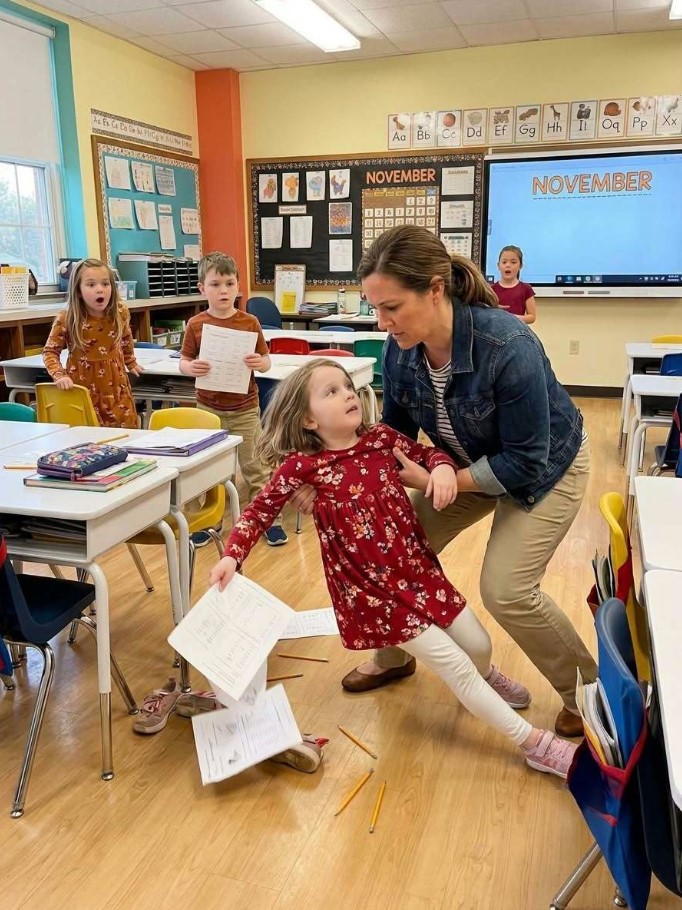
Valerie kept her eyes on Lila.
The little girl had finally said the words aloud.
“My dad said it wouldn’t hurt, but it does.”
Nothing about the sentence sounded dramatic. Lila hadn’t raised her voice. She hadn’t started crying. She hadn’t pointed to anything or explained what had happened.
And somehow, that made it more frightening.
The nurse slowly placed her pen on the desk.
Valerie could see that she was thinking the same thing.
Until that moment, there had still been several ordinary explanations for what happened that morning.
Lila could have been sick.
She could have skipped breakfast.
She could have been dehydrated.
She might have fallen at home and been too embarrassed to tell anyone.
But now there was something else.
Lila had said that her father told her something would not hurt.
Valerie resisted the urge to immediately ask what he meant.
She knew that frightened children could shut down when adults asked too many questions too quickly.
So she stayed where she was.
She didn’t touch Lila.
She didn’t pressure her.
She simply made sure the little girl could see her face.
“You’re not in trouble,” Valerie said softly.
Lila’s eyes filled with tears.
That reaction made Valerie’s stomach tighten.
The girl wasn’t reacting like a child who had simply gotten sick before school.
She looked like a child who was trying to decide whether telling the truth would make her situation safer—or more dangerous.
Valerie had taught for years.
She had seen children cry over broken toys, playground arguments, forgotten homework, and fears that seemed enormous to them at the time.
She knew what ordinary childhood distress looked like.
This was different.
Lila was watching the adults around her carefully.
She looked at the nurse.
Then at the closed office door.
Then back at Valerie.
It was almost as though she was checking whether someone could hear them.
Valerie noticed.
She also noticed that Lila’s fingers were still wrapped around the blanket.
The little girl’s knuckles were pale.
“You can take your time,” Valerie told her.
Lila swallowed.
For several seconds, she said nothing.
The nurse quietly checked the monitor again, but neither adult treated the situation casually anymore.
The earlier explanation of dehydration suddenly felt incomplete.
Valerie’s mind returned to the classroom.
She remembered Lila sitting unusually straight.
She remembered the way she had shifted in her chair.
She remembered the moment her knees pressed together and pain briefly crossed her face.
She remembered Lila placing one hand against the desk before standing.
One step.
Pause.
Another step.
Pause.
At the time, Valerie had wondered whether the girl was simply tired.
Now every one of those details seemed important.
The teacher also remembered Lila’s strange answer.
“I just need to sit up straight.”
It had sounded rehearsed.
Now Valerie wondered whether it had been.
Children normally answered questions with whatever came into their minds. Their explanations were messy. They wandered. They contradicted themselves.
Lila’s answer had been too neat.
Too immediate.
As though she already knew exactly what she was supposed to say.
Valerie looked at her cardigan.
The bottom button was fastened incorrectly.
One button had been skipped.
Another pulled the fabric strangely across her middle.
There was a faint crease in the material that looked as though something firm had pressed against it.
None of those details proved anything.
Valerie knew that.
A teacher couldn’t look at a misplaced button and decide what had happened to a child.
A crease in clothing could mean nothing.
A child could wake up late and dress quickly.
A child could forget to fasten a button.
A child could feel sick for dozens of harmless reasons.
But Valerie wasn’t looking at one detail.
She was looking at all of them together.
The stiff posture.
The careful walking.
The hand braced against the desk.
The expression that disappeared whenever someone looked directly at her.
The prepared answer.
The sudden collapse.
And now this sentence about her father.
Valerie leaned slightly closer.
“Thank you for telling me.”
Lila blinked.
She seemed almost surprised that Valerie hadn’t asked her to explain everything immediately.
The little girl loosened her grip on the blanket for a moment.
Then her fingers tightened again.
Valerie understood something important.
Lila wasn’t refusing to talk because she didn’t know what had happened.
She was afraid to talk because she knew.
That distinction mattered.
The nurse glanced at Valerie.
Neither woman needed to say what they were thinking.
The atmosphere in the room had changed.
This was no longer simply a child who had fainted at school.
Something had happened before Lila arrived.
Something had left her in pain.
And something had frightened her enough that she had spent the morning trying desperately to behave as though nothing was wrong.
Valerie looked toward the health office paperwork.
The documents were ordinary.
The attendance record showed that Lila had arrived at 8:17.
Her math worksheet showed that she had been in class at 8:42.
The nurse’s notes showed that she had been brought into the office shortly after nine.
A simple timeline.
But it told Valerie something she couldn’t ignore.
Whatever had happened had happened before school.
Lila hadn’t suddenly become uncomfortable during math.
She had walked into Room 204 already hurting.
She had carried that pain through the morning while twenty other children talked, laughed, sharpened pencils, and waited for recess.
And somehow, no one had noticed.
Except Valerie.
The teacher felt a heavy sense of responsibility settle over her.
She thought about all the times adults described Lila as “such a good girl.”
Quiet.
Polite.
Never difficult.
Never demanding.
But perhaps being easy to manage wasn’t always a sign that everything was fine.
Perhaps sometimes a child became exceptionally quiet because she had learned that drawing attention to herself wasn’t safe.
Valerie looked back at Lila.
The little girl was staring at the ceiling.
Her breathing was still shallow.
“Lila,” Valerie said gently, “you don’t have to tell me everything right now.”
The girl’s eyes moved toward her.
“But if something happened and you’re scared, you can tell us.”
Lila’s lips trembled.
She looked toward the door again.
That tiny movement told Valerie more than another question might have.
The child was afraid someone would come in.
Afraid someone might hear.
Afraid of what might happen after she spoke.
Valerie kept her voice calm.
“We’re here with you.”
Lila didn’t answer.
But her eyes filled again.
The nurse moved closer to the cot without crowding her.
For several seconds, the three of them remained silent.
Outside the office, the school continued as usual.
Doors opened and closed.
Children walked through the hallway.
Shoes squeaked against the floor.
Somewhere nearby, a teacher was reading aloud to another class.
It sounded like an ordinary Thursday morning.
Inside the nurse’s office, nothing felt ordinary anymore.
Valerie couldn’t stop thinking about the first moment she had seen Lila stand.
One hand against the desk.
A careful breath.
One step.
Then another.
At the time, Valerie had wondered why a seven-year-old was moving like someone twice her age.
Now she understood that the way Lila walked had been communicating something she couldn’t yet put into words.
Her body had been telling the story before she was ready to.
Valerie remembered something else.
When she had first asked whether Lila was okay, the girl had smiled.
Not a natural smile.
A controlled one.
A smile that appeared because she believed it was expected.
That frightened Valerie deeply.
Because children shouldn’t have to practice looking fine when they are hurting.
The teacher lowered her voice again.
“You did the right thing by telling me.”
Lila looked at her.
For the first time that morning, some of the tension in her face seemed to loosen.
Only slightly.
But Valerie noticed.
The nurse reached for the health log and began writing carefully.
She recorded the time.
The symptoms.
The collapse.
The child’s statement.
Every detail mattered.
Valerie understood that they could not guess what had happened.
They couldn’t fill in the blanks themselves.
They couldn’t put words into Lila’s mouth.
They needed to listen.
And they needed to make sure the little girl understood that she was safe enough to speak.
Lila’s fingers slowly relaxed.
Then she whispered again.
Not enough to explain everything.
Just enough to show that there was more.
Valerie waited.
She didn’t interrupt.
She didn’t rush her.
The little girl looked at her teacher with an expression Valerie knew she would never forget.
It wasn’t simply fear.
It was uncertainty.
The uncertainty of a child wondering whether an adult would believe her.
Valerie answered without asking another question.
“I believe that you’re hurting.”
Lila’s eyes filled with tears.
A single tear rolled toward her ear as she stared at the ceiling.
The nurse quietly moved a tissue closer.
Valerie stayed beside her.
She knew the next few minutes could matter enormously.
Whatever Lila had experienced, it had left her frightened enough to hide the pain.
And now, for the first time, someone had noticed.
The clues had been there all morning.
The stiff posture.
The careful movements.
The hand against the desk.
The skipped button.
The sudden collapse.
The rehearsed explanation.
And finally, the sentence that changed everything:
“My dad said it wouldn’t hurt, but it does.”
Valerie knew she would remember those exact words for the rest of her life.
Not because they explained what happened.
They didn’t.
They only opened a door to a much more frightening question.
What had Lila’s father told her wouldn’t hurt?
Why had she been afraid to explain it?
Why had she arrived at school already moving as though every step caused pain?
And why did this seven-year-old seem to believe that the safest thing she could do was sit straight, smile, and insist she was fine?
Valerie didn’t know the answers yet.
But she knew one thing with absolute certainty.
She wasn’t going to ignore what she had seen.
And she wasn’t going to let Lila leave that room believing that nobody had noticed.
For the first time that morning, Lila loosened her grip on the blanket.
Outside, the school day continued.
Inside, Valerie stayed beside the little girl and waited patiently for whatever came next.