Have you ever come across a math puzzle that looks incredibly easy but somehow manages to confuse thousands of people? Sometimes, the simplest equations are the ones that cause the biggest disagreements. People see a few familiar numbers, perform some quick calculations, and confidently share their answers without realizing they may have overlooked an important mathematical rule.
Today’s challenge is a perfect example.
At first glance, the equation looks straightforward. It contains only four number sixes, a few mathematical symbols, and a multiplication by zero. Nothing seems particularly difficult.
However, there is a reason this puzzle has attracted so much attention online. Many people rush to solve it and end up with the wrong result.
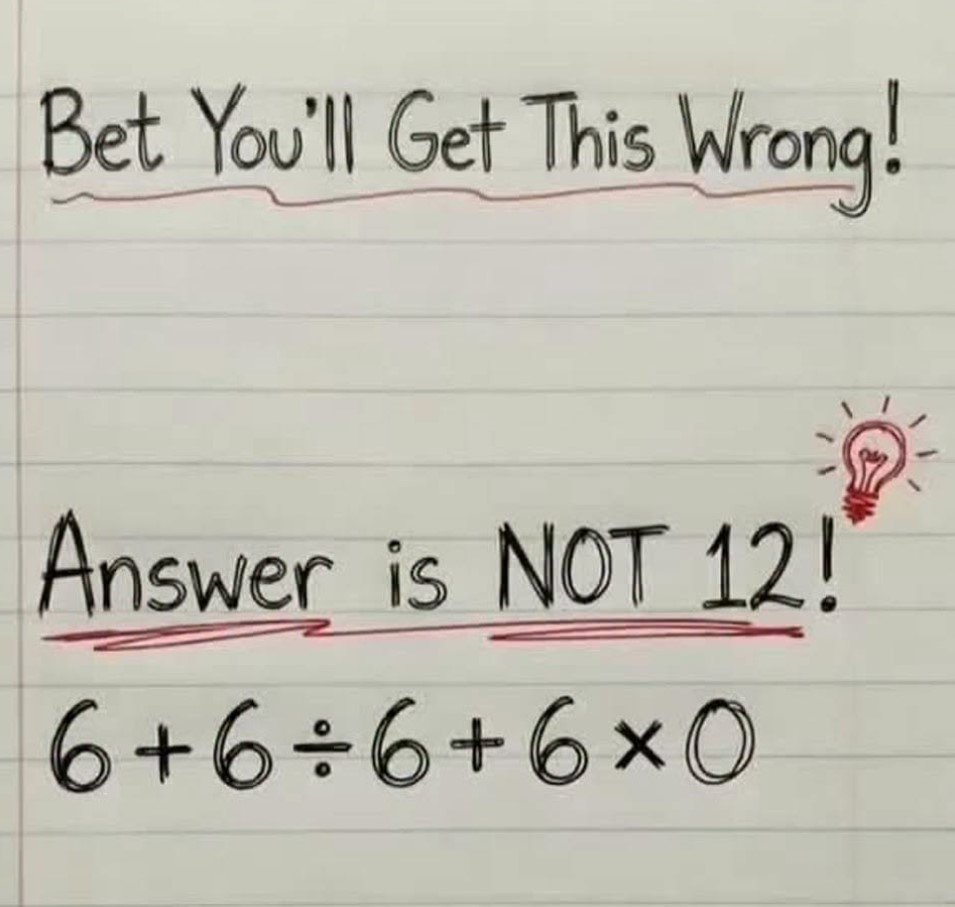
The challenge comes with a warning: Bet You’ll Get This Wrong! Answer is NOT 12!
Are you ready to test your mathematical skills?
Before reading the explanation, take a moment to solve the equation yourself. Remember that the goal is not to calculate as quickly as possible but to follow the correct mathematical rules.
The Math Challenge: Can You Find the Correct Answer?
Here is the complete equation:
6 + 6 ÷ 6 + 6 × 0 = ?
Take a few seconds to examine it carefully.
You might be tempted to start calculating from the left side and work your way toward the right. After all, that is how we often approach simple calculations when there are no complicated symbols involved.
But this equation contains addition, division, and multiplication.
That means you cannot simply perform every operation in the order you encounter it.
Mathematics follows a specific system known as the order of operations. Ignoring these rules can completely change the result, even when all the numbers are easy to understand.
Before looking at the solution, consider these questions:
- Should you calculate the addition first?
- Does multiplication come before division?
- What happens when a number is multiplied by zero?
- Should you solve the equation from left to right?
These small details make all the difference.
Why So Many People Get This Equation Wrong
One of the biggest reasons people struggle with this challenge is that they forget to apply the correct order of operations.
When an equation contains several different mathematical symbols, it is important to know which calculations must be completed first.
Let’s examine two common mistakes.
Mistake 1: Calculating Everything From Left to Right
Some people immediately begin with the first two numbers.
They calculate:
6 + 6 = 12
Then they divide the result by six:
12 ÷ 6 = 2
Next, they add another six:
2 + 6 = 8
Finally, they multiply by zero:
8 × 0 = 0
This approach produces an answer of zero.
Although every individual calculation appears reasonable, the problem is that the operations were performed in the wrong order.
You cannot automatically solve an equation from left to right when multiplication and division appear alongside addition and subtraction.
Mistake 2: Assuming the Answer Must Be 12
Another common mistake happens when people notice the addition of two sixes and immediately focus on the number twelve.
They may calculate the addition first, overlook the division and multiplication rules, or group the numbers incorrectly.
The result is often an answer of 12.
But just because twelve appears naturally during the calculation does not mean it is the final answer.
The equation must be evaluated as a complete expression, following the established mathematical rules.
The Secret Behind the Puzzle: Understanding PEMDAS and BODMAS
To solve this challenge correctly, we need to understand a fundamental mathematical principle called the order of operations.
In many English-speaking countries, students learn this rule using the acronym PEMDAS.
PEMDAS stands for:
- P – Parentheses: Complete calculations inside parentheses first.
- E – Exponents: Calculate powers and roots.
- MD – Multiplication and Division: Perform multiplication and division from left to right.
- AS – Addition and Subtraction: Perform addition and subtraction from left to right.
Another commonly used version is BODMAS:
- B – Brackets
- O – Orders
- D – Division
- M – Multiplication
- A – Addition
- S – Subtraction
Both systems communicate the same basic principle.
One important detail often causes confusion: multiplication does not always come before division, and addition does not always come before subtraction.
When two operations have the same priority, they must be performed from left to right.
For example, multiplication and division share the same level of priority. The same applies to addition and subtraction.
Understanding this distinction is essential when solving equations like today’s challenge.
Step-by-Step Solution: Finding the Correct Answer
Now that we understand the rules, let’s solve the equation carefully.
Our original expression is:
6 + 6 ÷ 6 + 6 × 0
We will follow the correct order of operations.
Step 1: Calculate the Division
First, identify the division operation:
6 ÷ 6
Six divided by six equals one.
We can now replace that part of the original equation with one.
The expression becomes:
6 + 1 + 6 × 0
Notice that we have not performed the additions yet because multiplication must be completed first.
Step 2: Calculate the Multiplication
Next, we look at the multiplication operation:
6 × 0
Anything multiplied by zero equals zero.
Therefore:
6 × 0 = 0
Our equation is now much simpler:
6 + 1 + 0
At this point, all multiplication and division operations have been completed.
Step 3: Complete the Addition
We are left with two addition operations.
We simply calculate from left to right.
First:
6 + 1 = 7
Then:
7 + 0 = 7
There is no further calculation to perform.
The Correct Answer Is 7!
That’s right. The answer is seven, not twelve and not zero.
The solution becomes straightforward once you apply the correct order of operations.
Why Multiplication by Zero Matters
One of the most important clues in this equation is the multiplication by zero.
Many people underestimate how much this small operation can change the final result.
In mathematics, multiplying any number by zero always produces zero.
For example:
- 5 × 0 = 0
- 12 × 0 = 0
- 100 × 0 = 0
- 6 × 0 = 0
It does not matter how large or small the other number is. The result will always be zero.
However, this does not mean you should automatically multiply everything in the equation by zero.
You must first identify exactly which numbers are connected by the multiplication symbol.
In our challenge, the multiplication applies only to the final six and zero.
That is why the expression becomes 6 + 1 + 0 rather than zero.
This is a small but important distinction that separates a correct solution from a common mathematical mistake.
Conclusion: Did You Get the Right Answer?
At first glance, this equation looks like something anyone could solve in just a few seconds. It contains familiar numbers and basic mathematical operations that most people have known since childhood.
Yet, as this challenge demonstrates, knowing how to add, divide, and multiply is not always enough. You also need to understand the order in which those operations must be performed.
The biggest mistake people make is rushing through the calculation without considering PEMDAS or BODMAS. Others become distracted by the number twelve or assume that multiplying by zero automatically makes the entire expression equal zero.
But once you slow down and follow the correct steps, everything becomes clear.
First, divide six by six to get one. Then multiply six by zero to get zero. Finally, add the remaining numbers together to reach the correct result: seven.
So, did you get 7 on your first attempt, or were you convinced the answer was 12 or 0?
Don’t keep the challenge to yourself! Share it with your friends and family, ask them to solve it without giving away the answer, and see who can get it right.
You might discover that even the simplest math problems can spark surprisingly interesting conversations!