Have you ever looked at a picture and felt completely confident about what you were seeing, only to realize a few seconds later that things might not be as simple as they appear? Optical illusions have a special way of confusing our brains, making ordinary objects look unusual and turning simple observations into surprisingly challenging puzzles.
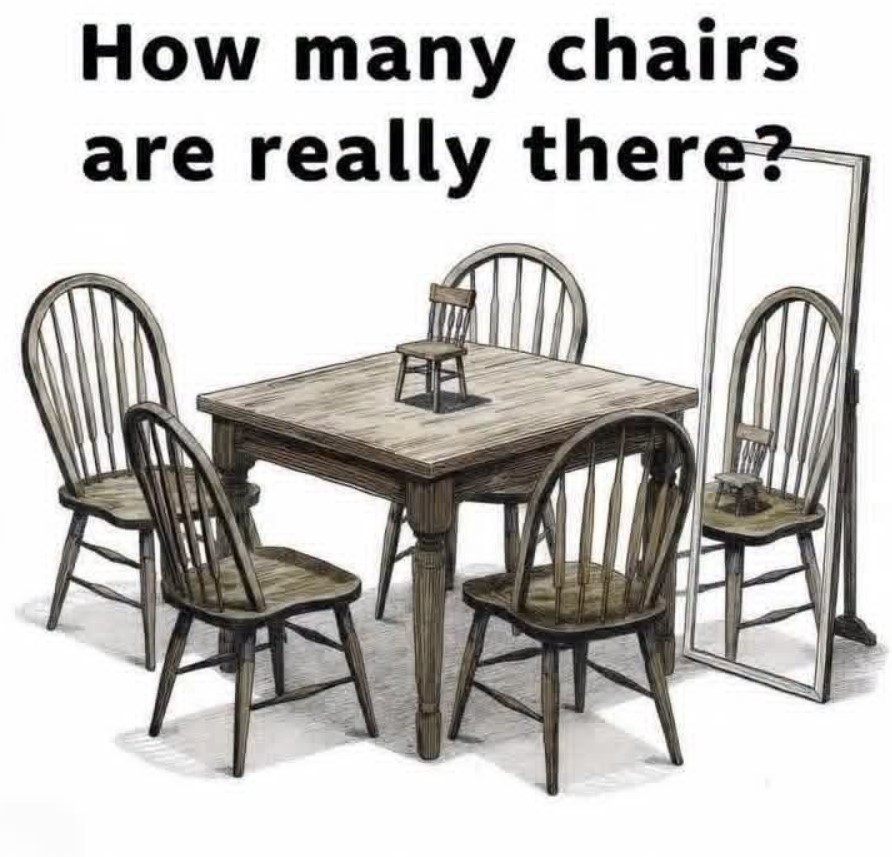
Today’s visual challenge is a perfect example. At first glance, the image appears to show an ordinary wooden dining table surrounded by several chairs. Nothing seems particularly complicated. However, when you take a closer look, certain details begin to raise questions.
The challenge is simple: How many chairs are really there?
Before rushing to an answer, take a moment to examine the entire picture. Look at the chairs around the table, pay attention to the small chair sitting on the tabletop, and don’t forget to examine the large mirror on the right.
You might be surprised by what you discover!
The First Impression: What Our Eyes See Immediately
When you first look at the illustration, your eyes naturally focus on the wooden table positioned in the center of the room.
Around it, several traditional wooden chairs with curved backs appear to be arranged in a familiar dining-room setup.
On the left side of the table, you can identify two chairs. One is positioned farther back, while the other is closer to the viewer.
On the front-right side, another chair is clearly visible. Behind the table, there also appears to be an additional chair standing in the background.
So far, counting seems relatively easy.
But then something unusual catches your attention.
Right on top of the wooden table sits a miniature chair. It looks like a tiny version of the larger chairs surrounding the table. Its unusual position immediately makes you wonder whether it is simply a decorative object or an important clue in the puzzle.
And there is one more detail that makes the entire illustration even more confusing.
On the far-right side stands a large mirror. Inside its reflection, you can see what appears to be another full-sized chair, with a miniature chair sitting on its seat.
Now the puzzle becomes much more interesting.
Should the reflected chairs be included in the total? Could some of the objects actually represent the same chair from different perspectives?
These questions are exactly what make this visual challenge so entertaining.
The Clues and the Confusion: Looking Closer
To solve the puzzle, you need to look beyond the obvious objects and pay attention to how everything is positioned.
The mirror is probably the most important detail in the entire illustration.
A mirror reflects objects that are positioned in front of it. It does not create additional physical furniture. However, an artist can use reflections to create an optical illusion that makes it difficult to understand where one object ends and another begins.
In this picture, the mirror shows a large chair with a tiny chair resting on its seat.
Now compare that reflection with the objects around the actual table.
The miniature chair appears to be sitting directly on the tabletop. At the same time, the chair positioned behind the table seems to line up with it in a rather unusual way.
The back of the larger chair appears to connect visually with the miniature chair, creating the impression that the two objects might belong to one continuous shape.
Could the chair behind the table and the tiny chair on the tabletop actually be two parts of the same visual trick?
This is where the illusion becomes especially clever.
Your brain automatically tries to interpret the drawing as a realistic three-dimensional room. It uses familiar shapes, distances, and perspectives to understand what it sees.
But when an illustration deliberately combines unusual angles and overlapping objects, those natural assumptions can lead you in the wrong direction.
The best way to approach this challenge is to examine every visible chair separately before deciding which objects should count as independent chairs.
Analyzing the Logical Possibilities
There are several ways to approach this puzzle, depending on whether you focus on the optical illusion or simply count every chair-shaped object visible in the illustration.
Let’s explore the two main interpretations.
Theory 1: The Optical Illusion Trick
The first interpretation focuses on the unusual relationship between the miniature chair, the chair behind the table, and the reflection inside the mirror.
Look carefully at the mirror.
It appears to show a large chair with a tiny chair sitting directly on its seat. However, when you examine the actual room, the arrangement does not seem to match what you would normally expect from a realistic reflection.
The chair behind the table and the tiny chair on the tabletop also appear to align in a way that makes their relationship difficult to understand.
Under this interpretation, the artist may have deliberately drawn the objects so that two apparently separate chairs could actually represent different parts of one visual arrangement.
If you accept this optical illusion theory, the total number of chairs is reduced.
The proposed answer under this interpretation is four chairs.
This is an interesting way to approach the challenge because it encourages you to question your first impression instead of automatically counting every shape.
Theory 2: The Total Visual Approach
Another approach is much simpler: count every individual chair-shaped object that appears in the illustration.
Instead of trying to determine whether certain objects are connected through perspective, you simply examine the entire drawing and record every visible chair.
Start with the left side of the table. There are two chairs clearly visible.
Next, look at the front-right side. There is another full-sized chair.
Behind the table, you can identify one more chair.
Then comes the miniature chair resting on the tabletop. Although it is much smaller than the others, it is still clearly recognizable as a chair.
Finally, examine the mirror.
Inside the reflection, you can see a large chair and another miniature chair resting on it.
When every visible chair-shaped object is counted separately, the total becomes seven.
This approach does not attempt to combine objects or interpret the artist’s perspective. It simply counts everything that can be identified as a chair in the picture.
The Final Verdict: What Is the Best Answer?
So, after examining the different details, how many chairs are really there?
The answer depends on how you interpret the optical illusion. However, according to the article’s final counting approach, the best answer is seven chairs.
Here is the complete breakdown:
- Two chairs on the left side of the table.
- One chair on the front-right side.
- One chair positioned behind the table.
- One miniature chair sitting on the tabletop.
- One large chair visible inside the mirror.
- One miniature chair reflected on top of the large chair.
That gives us a total of seven visible chair-shaped objects.
The alternative interpretation gives four chairs by treating some of the unusual visual elements as part of the same optical illusion.
The important distinction is that the seven-chair answer counts every visible chair shape separately, including those appearing in the mirror.
Why Optical Illusions Are So Difficult to Solve
Puzzles like this are more than just entertaining pictures. They demonstrate how easily our brains can be influenced by perspective, positioning, and familiar patterns.
When we look at an ordinary room, we rarely stop to question whether a chair is real, reflected, miniature, or simply part of an unusual drawing. Our brains quickly organize the information and create a picture that makes sense.
Optical illusions interrupt this automatic process.
They force us to slow down, reconsider what we see, and pay attention to details that we might otherwise overlook.
Sometimes the smallest object becomes the most important clue. In other situations, a reflection or an unusual angle completely changes how we understand an image.
That is why these challenges can produce so many different answers. Two people can examine exactly the same picture and notice completely different things.
Conclusion
The chair puzzle reminds us that appearances can be misleading, even when we are looking at something as familiar as a dining table surrounded by wooden chairs.
At first, counting the chairs seems like an easy task. But the miniature chair on the table and the unusual mirror reflection quickly turn a simple observation into a genuine brain teaser.
Although the optical illusion interpretation suggests that there may be only four chairs, the final literal count presented in this challenge is seven.
What makes the puzzle interesting is not just reaching the final number. It is discovering how perspective can influence what we see and how easily our brains can overlook important details.
So, what about you? Did you find all seven chairs on your first attempt, or did the mirror trick you into choosing a different answer?
Share your answer and challenge your friends and family to solve the puzzle too. You might be surprised by how many different answers people come up with when they examine the exact same picture!