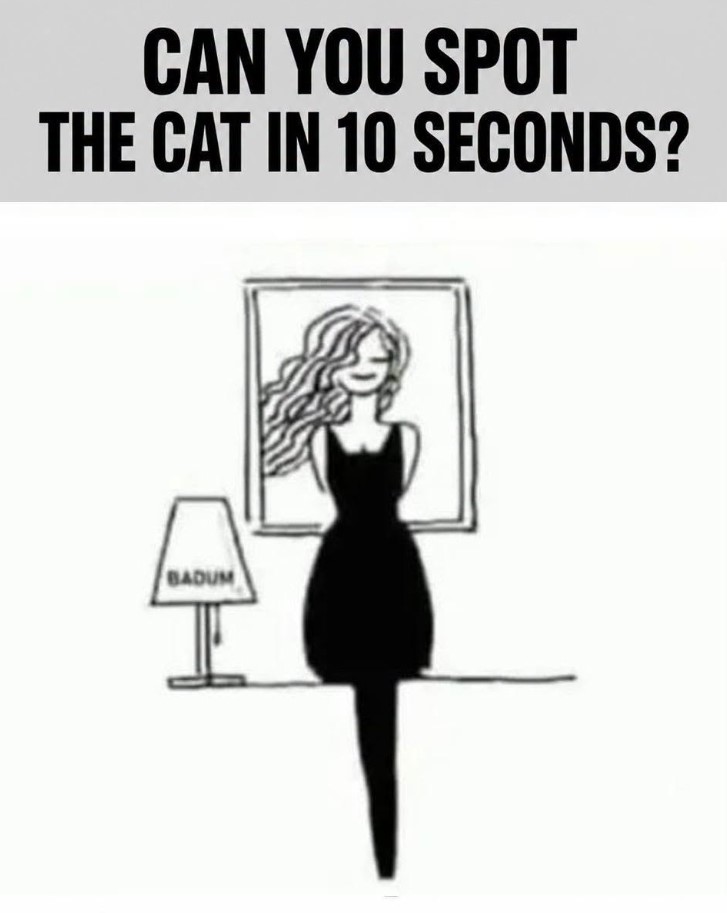
Sometimes the simplest-looking pictures can hide the trickiest visual puzzles. An image may appear completely ordinary at first, but once you know there is something unusual hidden inside it, you suddenly start seeing details you missed before. Today’s challenge is exactly that kind of brain teaser.
The question is simple: Can you spot the cat in 10 seconds?
Take a careful look at the picture and challenge yourself before reading the explanation. At first, you may notice a woman sitting in the room, her long hair, the framed picture behind her, and the small lamp beside her. Everything seems straightforward. But there is another shape cleverly concealed within the artwork.
The original puzzle presents a minimalist black-and-white illustration and challenges viewers to locate the hidden cat within ten seconds.
A Simple Picture With a Clever Secret
At first glance, there does not seem to be much to investigate. The central figure immediately attracts your attention because of the large dark shape of the woman’s dress. Her hair and facial features are visible above it, while a framed picture hangs on the wall behind her.
There is also a small table lamp positioned nearby, adding another recognizable object to the scene.
Because these elements are so easy to identify, your brain quickly decides that it understands the entire picture. This is one of the reasons hidden-object puzzles can be surprisingly difficult. Instead of carefully examining every line and shape, we tend to recognize familiar objects and move on.
The creator of this puzzle has taken advantage of that natural habit.
The cat isn’t presented as an obvious little animal sitting somewhere in the background. Instead, its appearance is cleverly incorporated into the existing shapes of the illustration.
Your 10-Second Challenge
Before looking for the answer, give yourself a genuine chance to solve it.
Set a timer for 10 seconds and look closely at the picture.
Try not to immediately focus only on the woman’s face or the framed artwork. Examine the darker areas, the outlines, and the shapes created by the woman’s clothing and body.
Ready?
3… 2… 1… GO!
Can you see the cat?
Don’t zoom in immediately. Try solving the puzzle using the original image just as it is.
Look carefully at the central part of the illustration. Instead of searching for a traditional-looking cat with clearly drawn ears, paws, and whiskers, consider whether the animal might be formed by another object or silhouette.
That small change in thinking can make all the difference.
Why Is the Cat So Easy to Miss?
One reason this puzzle works so well is that your brain tends to recognize the largest and most obvious shapes first.
When you look at the image, the woman in the dark dress is the dominant feature. Your eyes naturally settle on her because she occupies the center of the composition. Once your brain identifies her, it doesn’t necessarily continue analyzing every individual contour.
This is a common feature of visual perception.
We often see what we expect to see rather than examining every detail equally. When a picture appears simple, we may assume there is nothing else to discover.
That’s exactly what makes hidden-object challenges so entertaining.
The puzzle encourages you to question your first impression. Instead of asking, “What objects are in this picture?” you need to ask, “Could one of these shapes actually represent something else?”
A Helpful Hint
If you are still searching, concentrate on the large dark shape in the middle of the picture.
Don’t simply look at it as a dress or silhouette. Pay attention to the outline and the way the shape extends downward.
Sometimes the secret in a visual puzzle isn’t hidden in a tiny corner. It is sitting directly in front of you, disguised by the way the surrounding shapes are arranged.
Try moving your attention away from the woman’s face and toward the lower central portion of the image. Look at the silhouette as a whole and allow your eyes to interpret it differently.
You may suddenly notice the hidden form.
And once you see it, it becomes much easier to understand how the illusion works.
Still Can’t Find It?
Don’t worry. These puzzles are designed to make you look twice.
If ten seconds have already passed, give yourself another opportunity without the pressure of the countdown. Slowly examine the illustration from top to bottom.
First, look at the woman’s hair.
Then examine the framed picture.
Next, check the lamp.
Finally, return your attention to the large black shape in the center.
Instead of searching for a complete drawing of a cat, look for the outline of an animal created by the existing silhouette.
The trick is not necessarily about having perfect eyesight. It’s about changing your perspective.
The Answer
Did you find it?
The hidden cat can be spotted within the dark central silhouette of the woman. The shape has been designed so that what initially looks like part of her black dress can also be interpreted as the form of a cat. The answer image highlights the concealed shape, making the trick much more obvious once it has been pointed out.
This is one of those puzzles where the answer can make you wonder how you failed to notice it the first time.
Before the solution is revealed, your brain sees a woman wearing a dark dress. After the solution becomes clear, the same collection of lines and shapes can suddenly be interpreted in an entirely different way.
That’s the fun of optical illusions.
What Makes This Puzzle Interesting?
The challenge isn’t really about finding a tiny object hidden behind another object. Instead, it plays with shape recognition and visual interpretation.
The same lines can suggest more than one thing depending on how you look at them.
At first, you see clothing.
Then, after changing your perspective, you can recognize the animal hidden within the silhouette.
This type of illusion demonstrates how important context can be when we interpret images. Our brains are constantly organizing visual information and trying to make sense of it as quickly as possible.
That’s useful in everyday life, but it can also make us overlook unusual details in puzzles like this one.
Did You Beat the 10-Second Record?
Now comes the important question:
How long did it take you to find the cat?
- Under 5 seconds: Your observation skills are seriously sharp!
- Around 5–10 seconds: Nicely done—you spotted the trick before time ran out.
- More than 10 seconds: No problem! These puzzles are meant to challenge you.
- You needed the hint: You’re definitely not alone. The hidden shape is designed to blend into the picture.
There’s no real winner or loser here. The goal is simply to slow down, examine the image carefully, and have fun with the challenge.
Challenge Your Friends and Family
Once you’ve found the answer, don’t tell everyone immediately.
Instead, send them the picture and ask:
“Can you spot the cat in 10 seconds?”
Give them the same countdown and see whether they can solve it without a hint.
You may be surprised by how differently people approach the exact same image. Some people immediately notice the unusual silhouette, while others spend their entire ten seconds examining the background.
You can even turn it into a friendly competition and keep track of who finds it fastest.
Why Hidden-Object Puzzles Are So Addictive
There is something satisfying about finally discovering something that was hiding in plain sight.
Before you find the answer, the image can seem confusing. You may scan it repeatedly without success. Then, suddenly, the hidden shape becomes obvious.
That moment of discovery is what makes these puzzles so enjoyable.
It also encourages you to slow down and pay attention to details that you might normally ignore. Instead of quickly glancing at an image, you begin examining outlines, negative space, shadows, proportions, and unusual shapes.
And sometimes, the best strategy isn’t looking harder—it’s looking differently.
Final Thoughts
This hidden-cat puzzle may look like a simple black-and-white drawing, but it is a clever test of observation and perception. The woman, lamp, framed picture, and dark silhouette give your brain plenty of familiar shapes to focus on, allowing the hidden animal to blend into the scene.
The biggest lesson is that our first impression isn’t always the complete picture. When something seems obvious, taking a second look can reveal an entirely different interpretation.
So, did you manage to spot the cat within 10 seconds?
If you found it before the timer ended, congratulations—you have a sharp eye for hidden details! And if you needed a little extra time, don’t feel bad. The whole point of this puzzle is to make you look twice.
Now share the challenge with someone else and see how quickly they can find the sneaky cat!