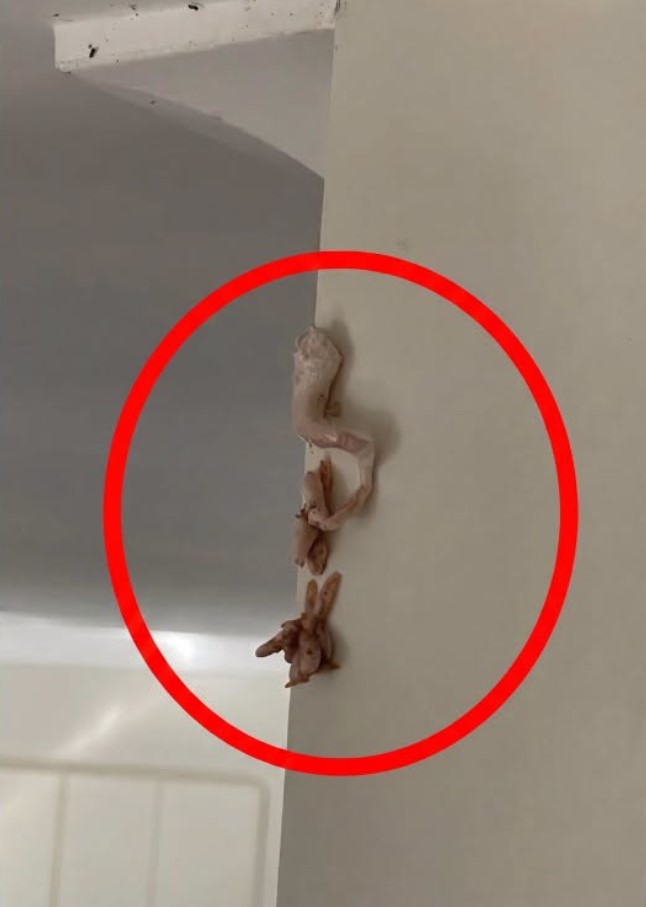
Finding something strange attached to a wall can make you stop immediately.
Finding something pink, oddly shaped, and crunchy-looking can make the discovery even more unsettling.
At first glance, you might wonder whether you’re looking at mold, a strange fungus, an insect nest, or something that somehow grew out of the wall.
The more unusual the object looks, the more your imagination starts working.
But before assuming the worst, it’s worth taking a closer look.
A hard or crunchy pink object protruding from an interior wall can have several possible explanations, and one of the most ordinary possibilities may actually be construction foam.
It Doesn’t Look Like an Ordinary Household Material
The mystery begins with the appearance.
Imagine walking through your home and noticing a pinkish object sticking out from the wall.
It isn’t flat.
It doesn’t look like paint.
It isn’t obviously part of the wall itself.
Instead, it appears slightly raised, irregular, and firm.
Depending on the lighting, it might even look like something organic.
That is exactly what makes these discoveries so confusing.
When something appears to be growing out of a wall, the natural reaction is to assume that it must have developed there.
But walls contain many hidden spaces, gaps, seams, and openings.
Sometimes an ordinary material simply finds its way through one of them.
The Most Likely Explanation: Expanding Foam
One possibility worth considering is expanding construction foam.
Spray foam and similar products are widely used around homes for sealing gaps, insulating spaces, reducing drafts, and filling openings.
When the material is applied, it expands.
If some of that foam reaches a small crack or opening, it can push outward before hardening.
Once exposed to air, the foam becomes much firmer.
What initially starts as a soft, expanding material can eventually become surprisingly hard and lightweight.
That means a piece sticking through a wall can look completely different from the product people remember seeing in its original container.
Why Would Construction Foam Be Pink?
The color alone doesn’t provide enough information to identify an unknown material.
Different construction products can have different colors, and materials can also change appearance over time because of age, lighting, dust, moisture, or exposure to the surrounding environment.
A pink or reddish appearance therefore doesn’t automatically mean that something biological is growing inside the wall.
This is one reason it’s important not to identify a mystery substance based solely on color.
Texture and location can provide much better clues.
Look at How It Is Attached
One of the most useful things you can examine is the point where the object meets the wall.
Does it appear to be coming through a tiny crack?
Is there a hole behind it?
Does it emerge from a seam?
Is it near a window frame?
Could it be close to plumbing or electrical work?
These details matter.
If the material appears to be protruding from a small opening and has a lightweight, hardened, foam-like texture, construction material becomes a reasonable possibility.
Could It Be Mold?
Mold is one of the first things many people think of when they see unusual growth inside a home.
And moisture-related growth should never be dismissed without considering the surrounding conditions.
However, a hard, dry, crunchy object isn’t the classic appearance most people associate with ordinary household mold.
Mold commonly appears as patches, spots, fuzzy growth, or discoloration, although its appearance can vary considerably.
If the mysterious material is accompanied by dampness, a musty smell, peeling paint, bubbling wallpaper, or water stains, then moisture deserves closer attention.
The important question becomes less about the strange pink object itself and more about why the wall may be getting wet.
Moisture Is an Important Clue
Take a careful look around the area.
Is the wall damp?
Does the paint appear swollen?
Are there brown or yellow water stains?
Is wallpaper beginning to peel?
Does the area smell musty?
If you notice several of these signs together, there could be a leak or persistent moisture problem behind or around the wall.
Possible sources include:
- Leaking plumbing
- Roof leaks
- Poorly sealed windows
- Condensation
- Bathroom moisture
- HVAC-related condensation
- Exterior water intrusion
A recurring growth or deposit can sometimes be a symptom of a larger moisture problem.
What About Pink or Orange Microbial Growth?
Certain microorganisms can produce pink or orange-colored deposits in damp environments.
For example, Serratia marcescens is a bacterium that can produce pink or reddish buildup in moist areas, particularly around bathrooms and other surfaces where moisture and soap residues accumulate.
But color alone isn’t enough to conclude that this is what you’re seeing.
A dry, hard object emerging from a wall would point toward a different set of possibilities than a slimy pink film around a damp bathroom surface.
Context matters.
Could an Animal Have Left It There?
Another possibility people sometimes consider when they discover strange material indoors is animal activity.
Insects and other small creatures can leave behind unusual biological material.
Egg masses, dried secretions, nesting material, shed material, or other deposits can sometimes look surprisingly strange once they’ve dried.
That doesn’t mean an animal is necessarily responsible for every mysterious object found on a wall.
But if you notice additional clues, it’s worth investigating.
Look for:
- Small holes
- Droppings
- Shed insect skins
- Scratching sounds
- Insect activity
- Repeated deposits
- Damage around the wall
- Small openings nearby
One unusual object by itself isn’t strong evidence of an infestation.
Several related signs are much more meaningful.
Why Does It Look Like It Grew Out of the Wall?
The location can make an ordinary object seem much more mysterious than it really is.
If material emerges through a small crack, seam, or opening, it can appear as though it somehow developed there.
But behind the visible surface of a wall there can be empty spaces, insulation, pipes, wiring, construction materials, and small cavities.
Something doesn’t necessarily have to “grow” there to appear as though it did.
A material could have been pushed through an opening.
Moisture could have transported or changed something.
An insect could have deposited material in a hidden space.
Or a previous repair could have left behind something that only became noticeable later.
Don’t Immediately Scrape It Off
When you see something strange on your wall, the instinct may be to remove it immediately.
That isn’t always the best first step.
Before touching it, take several photographs.
Get one picture showing the entire wall.
Take another close-up.
Photograph the point where the material meets the surface.
If possible, photograph it from the side as well.
This can preserve useful information that might disappear if you immediately scrape, crush, or clean the object away.
What Should You Look For?
Without disturbing the material, consider its basic characteristics.
Is it:
- Hard or soft?
- Crunchy or rubbery?
- Dry or wet?
- Smooth or fuzzy?
- Lightweight or heavy-looking?
- Brittle or flexible?
- Attached to a crack?
- Coming from a hole?
- Producing an odor?
These observations can help narrow down the possibilities.
A hard, lightweight, foam-like substance emerging from a gap is different from a soft, damp, fuzzy patch spreading across a wall.
Check Around Windows
Windows are another place worth inspecting.
Small gaps around frames can allow drafts and moisture to enter.
They can also be locations where insulation and sealing materials are applied.
If the mystery object is close to a window, check whether the frame has cracks, damaged caulking, condensation, or signs of water intrusion.
A problem around the window could help explain why an unusual substance is appearing nearby.
Check Near Plumbing
If the object is located on a wall shared with a bathroom, kitchen, laundry area, or other plumbing, investigate the possibility of moisture.
You don’t need to immediately open the wall.
Start by looking for visible clues.
Check nearby faucets, pipes, cabinets, and fixtures for leaks.
Look for water stains or soft areas on the wall.
If there is an active leak, addressing the water source is much more important than simply removing whatever has appeared on the surface.
What If It Keeps Coming Back?
Repeated appearance is an important clue.
If you remove the material and it never returns, it may have been a one-time deposit or leftover construction material.
But if it keeps appearing in the same location, something is likely supplying or creating it.
That could be:
- Ongoing moisture
- A hidden opening
- Construction material expanding through a gap
- Repeated insect activity
- Another source inside the wall
Take photographs before removing anything again.
If the material repeatedly returns, consider having the area inspected rather than repeatedly cleaning the surface.
Could Expanding Foam Really Look This Strange?
Absolutely.
Construction foam isn’t always visually obvious once it has hardened.
Depending on how it was applied, how much it expanded, what surface it contacted, and how long it has been exposed to the environment, it can develop an unusual shape.
A small amount emerging from a narrow opening may harden into a protruding lump.
It can then collect dust and debris, making it look even stranger.
Over time, exposure to light and the surrounding environment can also alter its appearance.
That’s why an old piece of construction material can look surprisingly mysterious.
Don’t Assume Every Pink Object Is Mold
This is probably the biggest takeaway.
Pink is simply a color.
It isn’t a diagnosis.
A pink substance could potentially be:
- Construction foam
- Dried biological material
- Microbial growth
- Old adhesive
- A deposit
- Paint or another building material
- Pest-related material
- Something completely unrelated
The texture and location are far more informative than the color by itself.
Why Internet Photos Can Be Misleading
Mystery objects are perfect for online speculation.
Someone posts a photograph.
People immediately start suggesting explanations.
One person says it’s mold.
Another says it’s an insect nest.
Someone else insists it must be expanding foam.
And suddenly dozens of theories appear.
The problem is that photographs don’t always show texture accurately.
Something that looks soft might actually be hard.
Something that appears solid may have a soft interior.
Lighting can also change color dramatically.
Without being able to inspect the object directly, confident identification can be difficult.
When Should You Call a Professional?
You don’t necessarily need professional help every time you find something unusual on a wall.
But an inspection is a good idea when the material:
- Keeps returning
- Is associated with water damage
- Appears to be coming from deep inside the wall
- Is accompanied by a strong odor
- Appears alongside pest activity
- Is associated with electrical components
- Appears alongside structural damage
- Cannot be safely identified
If you’re renting, report persistent moisture, wall damage, or unexplained recurring material to your landlord or property manager.
For suspected pests, a qualified pest professional can help.
For suspected water intrusion, a plumber or building professional may be appropriate.
Don’t Open the Wall Without Knowing Why
When something mysterious appears, it can be tempting to start cutting into drywall to see what’s behind it.
That can turn a small mystery into a much bigger repair.
Before opening a wall, determine whether there’s evidence that something inside actually needs investigation.
If there are electrical wires, plumbing, insulation, or structural components behind the wall, cutting blindly can create unnecessary risks.
If inspection is necessary, it’s better to have someone qualified determine the safest way to investigate.
What If It Is Mold?
If a professional determines that the material is mold or microbial growth, the next step isn’t simply to wipe the visible area and forget about it.
The moisture source needs to be addressed.
Otherwise, the problem can return.
That might mean fixing a leak, improving ventilation, correcting condensation, or repairing water damage.
Removing visible growth without correcting the underlying moisture problem often doesn’t solve the root cause.
What If It Is Construction Foam?
If the material turns out to be hardened construction foam, the situation may be much simpler.
It could simply be leftover material from an old repair or insulation job.
The important question is why it is visible now.
If it has been exposed for a long time, the protruding section may simply need to be trimmed or repaired appropriately.
However, don’t start cutting unknown material if you don’t know what’s behind it.
A professional can determine whether it is harmless excess foam or part of a larger building issue.
A Simple Way to Investigate
If you discover a strange pink substance on your wall, follow a few simple steps.
First, don’t panic.
Second, photograph it.
Third, examine the surrounding area without disturbing it.
Fourth, check for moisture.
Fifth, look for cracks, openings, insects, or construction clues.
Finally, seek professional identification if the mystery remains.
This approach is much safer than immediately scraping away something you don’t recognize.
The Strange Object May Be Less Mysterious Than It Looks
The human brain naturally tries to find explanations for unfamiliar things.
A pink object sticking out of a wall looks unusual.
It doesn’t resemble anything familiar.
So our first instinct may be to assume that something unusual is happening inside the house.
But homes contain countless hidden materials.
Insulation, adhesives, foam, sealants, wiring, plumbing, and construction debris can all exist behind walls.
Sometimes an ordinary material simply becomes visible in an unusual way.
Final Thoughts
A crunchy pink object protruding from your wall can certainly look like something from a strange home mystery.
But the appearance alone doesn’t tell you what it is.
One reasonable possibility is expanding construction foam, particularly if the material is lightweight, firm, foam-like, and emerging through a crack or small opening.
Other possibilities include moisture-related microbial growth, dried biological material, pest-related deposits, old adhesives, or other construction materials.
The key is to avoid making a diagnosis based on color alone.
Instead, look at the texture, location, surrounding conditions, and point where the object meets the wall.
Check for leaks.
Look for moisture.
Inspect nearby windows and plumbing.
Watch for signs of pests.
And don’t immediately scrape or crush an unidentified substance before documenting it.
If the object keeps returning, is associated with water damage, or appears to be coming from inside the wall, getting professional help is the safest choice.
What looks like a bizarre pink growth may ultimately turn out to be something surprisingly ordinary.
Sometimes the strangest things inside our homes aren’t mysterious at all.
They’re simply everyday materials, moisture, or natural processes appearing in a way we’ve never noticed before.