
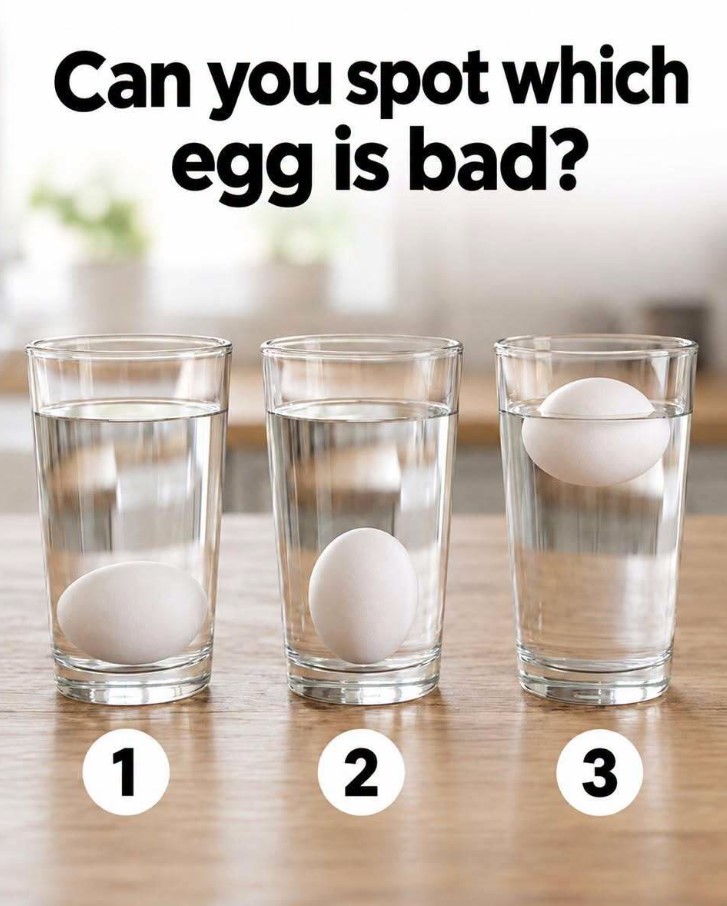
At first glance, the three eggs in this simple water test look almost identical. However, their different positions reveal an interesting clue about how fresh they might be.
One egg rests flat at the bottom of the glass, another stands upright, and the third floats near the surface. Can you identify which one is most likely to be bad?
The answer may seem obvious, but there is an important detail behind this popular kitchen test that many people overlook.
The Simple Egg Water Test
You don’t need special equipment to try this test at home. All you need is a glass or bowl filled with enough water to completely cover an egg.
Gently place the egg into the water and observe what happens.
As an egg gets older, its internal air cell gradually becomes larger. This happens because moisture and some gases escape through the tiny pores in the eggshell over time.
The growing air pocket changes the egg’s buoyancy, which explains why older eggs behave differently when placed in water.
Let’s examine the three eggs one by one.
Egg 1: The Freshest-Looking Egg
Egg 1 sinks to the bottom of the glass and lies mostly flat.
This is generally the position associated with a fresher egg. Its internal air cell is relatively small, allowing it to remain balanced at the bottom.
Among the three examples, Egg 1 appears to be the freshest.
However, remember that the water test is only a rough indication of an egg’s age. It cannot guarantee that an egg is completely safe to eat.
Egg 2: An Older Egg That Still Sinks
Egg 2 also sinks to the bottom, but instead of lying flat, it stands upright.
This position usually indicates that the egg is older than Egg 1.
As time passes, the air pocket inside the shell grows. This changes the egg’s balance and causes one end to rise when it is submerged in water.
The interesting part is that an egg standing upright is not automatically spoiled.
It may simply be older, and it could still be suitable for use if it has been stored properly and shows no signs of spoilage.
Egg 3: The Egg That Floats
Now look at Egg 3.
Unlike the other two, this egg floats near the surface of the water.
This happens because the air pocket inside the egg has become larger as moisture and gases have escaped through the shell.
The increased air space makes the egg more buoyant, allowing it to rise toward the surface.
This is why Egg 3 is considered the oldest of the three examples and the one most likely to raise concerns.
But there is something important to understand: a floating egg is not automatically spoiled or unsafe to eat.
The floating test can help estimate an egg’s age, but it cannot detect harmful bacteria or confirm whether the egg is safe.
How to Check Whether an Egg Has Actually Gone Bad
If you are unsure about an egg, don’t rely on its position in water alone.
There are a few practical things you should check before deciding whether to use it.
1. Check how it was stored
Eggs should be kept refrigerated at a consistent temperature when refrigeration is recommended for the eggs you buy. Avoid using eggs that have been stored improperly or left at room temperature for too long.
2. Crack it into a separate bowl
Before adding an older egg to your recipe, crack it into a clean, separate bowl. This prevents one questionable egg from ruining an entire mixture.
3. Look for unusual changes
Pay attention to anything unusual in the egg’s appearance, including unexpected discoloration or an abnormal texture.
4. Check the smell
A spoiled egg often has a strong, unpleasant sulfur-like or rotten smell after being cracked open.
If the egg smells bad or looks unusual, throw it away.
One important precaution: harmful bacteria may be present even when an egg looks and smells normal. Never taste an egg to determine whether it is safe, and cook eggs thoroughly.
What Does Each Egg Position Mean?
Here is a quick summary of the three results:
- Egg 1: Sinks and lies flat. Generally the freshest position.
- Egg 2: Sinks but stands upright. Usually older, but not necessarily spoiled.
- Egg 3: Floats near the surface. Generally the oldest and most likely to be questionable.
The larger the air pocket becomes, the more likely an egg is to rise in water.
Why This Simple Kitchen Test Can Be Misleading
The egg water test has been used in many kitchens for years because it is easy to perform and requires almost no equipment.
However, it is important to understand what the test actually measures.
It gives you an indication of how much the air cell inside the egg has grown. It does not directly measure freshness in terms of food safety.
An egg can float without necessarily being spoiled, while an egg that sinks is not guaranteed to be free from harmful bacteria.
That is why proper refrigeration, careful handling, and thorough cooking remain essential.
Conclusion
So, did you spot the egg that stands out?
The correct answer to this puzzle is Egg 3. It floats near the surface because it has developed a larger air pocket, making it the oldest of the three eggs and the one most likely to be questionable.
Egg 1 appears to be the freshest because it sinks and rests flat at the bottom, while Egg 2 falls somewhere in between because it sinks but stands upright.
However, the most important lesson is that age and spoilage are not exactly the same thing. The floating test can give you a useful clue, but it cannot confirm whether an egg is safe to eat.
Sometimes, a simple glass of water can reveal more than you expect, but knowing what the result really means is what makes the difference.
Did you choose Egg 3? Share this little kitchen puzzle with your friends and see if they can spot the answer too!