Are you confident in your observation skills? Do you think you can count a group of birds correctly without missing a single one? This simple-looking visual puzzle is ready to put your eyes and concentration to the test!
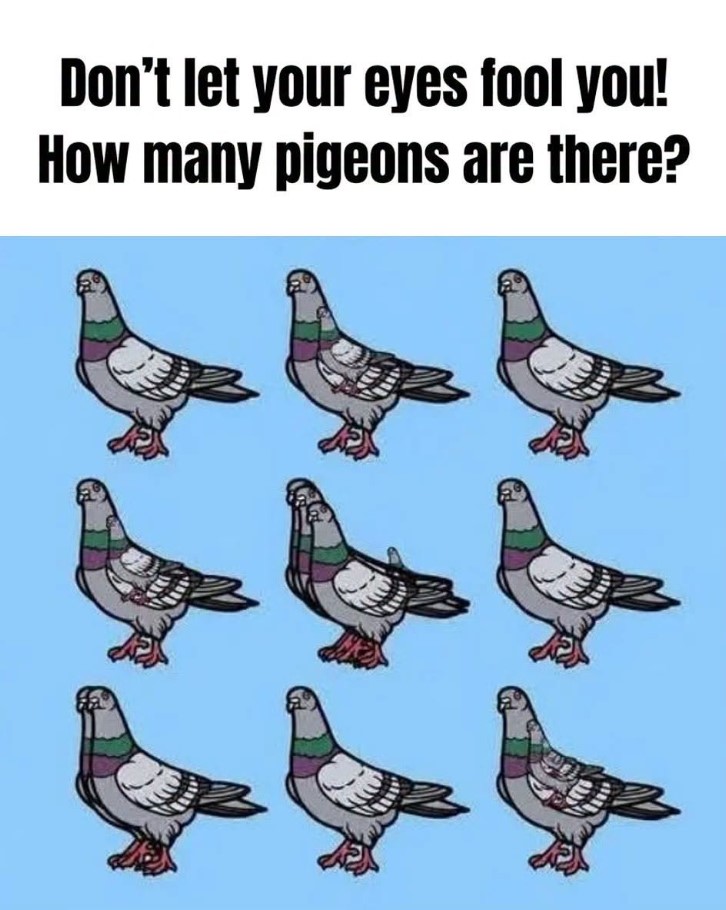
At first glance, the challenge seems easy. You are presented with a group of pigeons arranged in a neat pattern against a blue background. All you have to do is count them.
Sounds simple, right?
But don’t be too quick to give your answer. Some of the pigeons appear close together, and certain details can make it difficult to distinguish one bird from another. What looks like a single figure at first might require a second look.
So, take your time, examine the entire picture, and see whether you can discover the correct number.
The Challenge: How Many Pigeons Can You See?
Look carefully at the image before reading any further.
Your mission is to count every pigeon in the picture, from the first row at the top to the last row at the bottom.
Try not to rush. Counting quickly can make you overlook birds that are close together or partly hidden by the way the figures are arranged.
Here are a few things to keep in mind:
- Look at the pigeons one row at a time.
- Pay attention to their heads, wings, and feet.
- Check the spaces between neighboring birds.
- Make sure you don’t count the same pigeon twice.
- Take another look at any area where the shapes seem to overlap.
You can even write down your count as you move from one row to the next. This simple method makes it easier to keep track of the birds you have already counted.
Why Is This Puzzle More Difficult Than It Looks?
The challenge is not necessarily the number of pigeons. It is the way our eyes process a crowded image.
When several similar objects appear close together, our brains sometimes group them into larger shapes. Instead of recognizing every individual bird, we may see a single cluster and underestimate the total.
The opposite can also happen. A wing, shadow, or overlapping shape may look like part of another pigeon, causing us to count the same bird more than once.
That is why a careful approach is much better than making a quick guess.
A Simple Trick to Improve Your Count
If you are struggling to find the total, try dividing the picture into smaller sections.
Start at the top and count each pigeon before moving to the next row. Once you finish a section, keep that number in mind and continue with the remaining birds.
You can also move your eyes slowly across the image from left to right. This helps prevent you from jumping between different areas and accidentally counting a pigeon twice.
If necessary, zoom in on the picture to examine the smaller details.
Remember, the goal is not to finish as quickly as possible. The goal is to find every single bird.
Have You Found the Correct Number?
Before revealing the solution, think about your final count.
Did you see fewer pigeons than expected? Perhaps you counted a group quickly and moved on without checking the individual shapes.
Or did you take your time and carefully examine every section?
Whatever your result, this is a fun opportunity to test your patience and attention to detail.
The Answer: 17 Pigeons!
If you counted 17 pigeons, congratulations! You found the correct answer according to the original puzzle.
If your number was different, don’t worry. The closely arranged birds can make this challenge confusing, especially when you try to count everything at once.
The important lesson is to look carefully at each individual figure rather than relying on your first impression.
Why Do Visual Counting Challenges Fool Us?
Our brains are constantly organizing the information that reaches our eyes. This helps us recognize objects quickly without having to examine every tiny detail.
However, that ability can sometimes work against us in visual puzzles.
When objects have similar shapes and are positioned close together, it becomes harder to separate them mentally. We may overlook something that is clearly visible or mistakenly treat two objects as one.
Taking a slower, more systematic approach gives us a better chance of noticing what we missed the first time.
Final Thoughts
This pigeon puzzle is a great reminder that appearances can sometimes be misleading. A picture that seems easy to understand may become surprisingly challenging when you have to count every individual detail.
The answer is 17 pigeons, but reaching that number requires patience, concentration, and careful observation.
Did you manage to find all 17 birds without looking at the answer? Or did you have to count them more than once?
Share your result and challenge your friends and family to try the puzzle. You might be surprised by how differently everyone approaches the same image!