Have you ever come across a math puzzle on social media that looks incredibly simple but leaves thousands of people arguing about the correct answer?
Some puzzles require complicated calculations, while others challenge something much more basic: our ability to pay attention to small details.
Today’s challenge is a perfect example. At first glance, it looks like an ordinary arithmetic problem involving nothing more than the number 1 and a single multiplication by zero. However, the way the numbers are arranged creates a surprising twist.
Many people rush to calculate the answer without examining the layout carefully. Others come up with different results because they interpret the arrangement in another way.
Are you ready to test your observation skills and mathematical thinking?
The Viral Math Puzzle: Can You Find the Correct Answer?
Take a close look at the puzzle and try to solve it before reading the explanation.
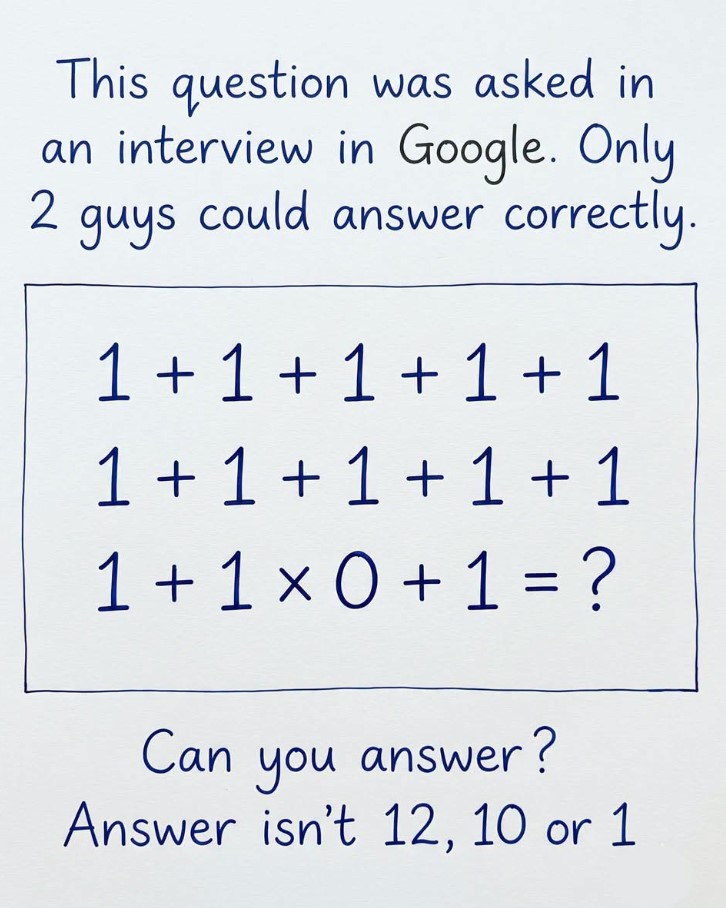
The image contains three rows of numbers:
First row:
1 + 1 + 1 + 1 + 1
Second row:
1 + 1 + 1 + 1 + 1
Third row:
1 + 1 × 0 + 1
At first, everything seems straightforward. You might be tempted to add the numbers in the first two rows and then calculate the final row separately.
But there is something unusual about the way the three lines are displayed.
Before looking at the solution, take a moment to decide what you think the correct answer should be.
Why Do So Many People Get This Puzzle Wrong?
One reason this puzzle attracts so much attention is that people often focus on the arithmetic while overlooking the visual arrangement.
When we see numbers written on separate lines, we naturally assume that each line represents a separate mathematical expression. That assumption can lead to different answers depending on how the puzzle is interpreted.
Some people simply add every visible number together and arrive at 12.
Others focus on the multiplication by zero and believe that it changes the entire expression. Some calculate only the final row, forgetting that the numbers above it are also part of the challenge.
However, the puzzle’s intended solution depends on paying attention to how the numbers connect from one row to the next.
The Hidden Detail That Changes Everything
Look carefully at the end of the first row.
The final number is 1, and there is no plus sign, minus sign, or equals sign after it.
Now examine the beginning of the second row. It also starts with the number 1.
According to the interpretation used in the puzzle, these two adjacent digits connect to form the number 11.
The same thing happens between the second and third rows. The final 1 from the second line joins the first 1 from the third line, creating another 11.
This changes the expression considerably.
Instead of treating every line as a separate calculation, we combine the numbers into one continuous expression.
The Correct Way to Rewrite the Equation
Once the two pairs of adjacent digits are joined, the expression becomes:
1 + 1 + 1 + 1 + 11 + 1 + 1 + 1 + 11 + 1 × 0 + 1
Now the calculation becomes easier to follow.
The next step is to remember the basic order of mathematical operations.
Remember the Order of Operations
Before adding everything together, we must deal with multiplication.
According to the standard order of operations, multiplication is performed before addition.
In this expression, the multiplication is:
1 × 0 = 0
We can now replace that part of the equation with zero.
The expression becomes:
1 + 1 + 1 + 1 + 11 + 1 + 1 + 1 + 11 + 0 + 1
Now all that remains is addition.
Step-by-Step Calculation
Let’s work through the numbers carefully:
- 1 + 1 + 1 + 1 = 4
- 4 + 11 = 15
- 15 + 1 + 1 + 1 = 18
- 18 + 11 = 29
- 29 + 0 = 29
- 29 + 1 = 30
The final result is:
30
So, according to the puzzle’s intended interpretation, the correct answer is 30.
Is There Really a Trick?
The interesting part of this challenge is that the difficulty does not come from complicated mathematics.
The calculations themselves are quite simple. The real challenge is understanding how the numbers are arranged and deciding whether the line breaks are meant to separate the expressions or simply continue them.
There is also an important mathematical detail: a line break by itself does not automatically join two digits into a two-digit number. The answer of 30 relies on the puzzle’s intended visual interpretation.
If the three rows were meant to be separate equations, the result would be different. That is why the exact layout and the way the expression is presented matter so much.
What Does This Puzzle Teach Us?
This viral challenge offers a useful reminder that solving a problem requires more than performing calculations quickly.
It encourages us to:
- Read the entire problem before attempting an answer.
- Pay attention to small details and unusual arrangements.
- Apply the correct mathematical rules.
- Avoid making assumptions too quickly.
- Check whether the information has been presented clearly.
These habits are useful not only when solving math puzzles but also when dealing with everyday problems.
Final Thoughts
The Viral Math Puzzle proves that even a few simple numbers can create a surprisingly entertaining challenge.
At first, the expression looks like an easy addition problem with a little multiplication thrown in. But once you notice how the digits connect across the rows, the entire calculation changes.
The intended answer is 30, and the explanation shows why careful observation is just as important as mathematical knowledge.
Did you find the answer before reading the explanation, or did you initially get 12, 10, or another result?
Share this puzzle with your friends and family and see who can solve it. You might be surprised by how many different answers people come up with!