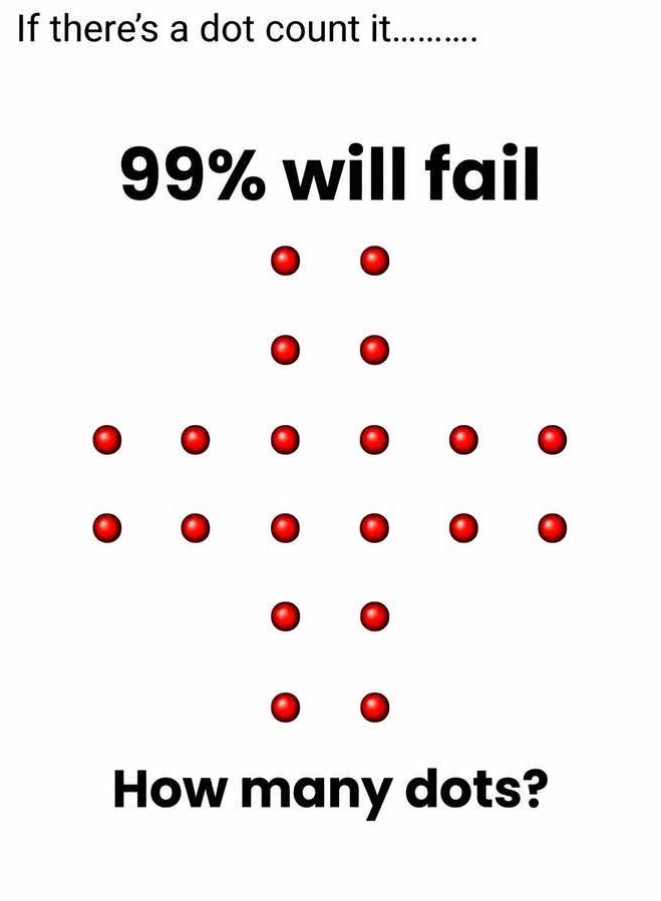
At first glance, this puzzle looks incredibly simple. After all, it’s just a collection of red dots arranged in a cross-like pattern with one straightforward question: “How many dots do you see?” But don’t be too quick to answer. Challenges like this are designed to test your observation skills, attention to detail, and ability to look beyond the obvious.
Visual brain teasers have become increasingly popular on social media because they encourage people to slow down and carefully examine what they’re seeing. While many participants immediately count the visible red dots, others notice that the image contains additional dots hidden in places most people overlook. That’s why puzzles like this often claim that “99% will fail”—not because they’re impossible, but because our brains naturally focus on the most obvious details.
Before scrolling any further, take a moment to study the image carefully and come up with your own answer.
The Challenge
The question is simple:
How many dots do you see?
Seems easy enough, right?
Most people begin counting only the red circles arranged in the center of the image. If you did that, you probably arrived at one answer. But is that really the complete picture?
The trick is that the puzzle asks how many dots you can see—not just how many red dots.
Start by Counting the Red Dots
Let’s begin with the most obvious part of the puzzle.
The red circles form a symmetrical cross shape.
Carefully counting each visible red dot gives us:
20 red dots
Many people stop here and confidently submit their answer.
However, that’s exactly what makes this puzzle so deceptive.
Look Beyond the Red Circles
Now examine the rest of the image.
Can you spot any additional dots?
You’ll notice punctuation marks made of dots in the sentence near the top:
“If there’s a dot count it……….”
Those trailing periods are also dots.
Then look at the question near the bottom:
“How many dots?”
Don’t forget the dot in the question mark and the period-like punctuation elsewhere in the image if applicable.
Some versions of this puzzle even include dots inside letters such as:
- i
- j
- punctuation marks
- ellipses (…)
This is why different people often arrive at different totals.
Why People Disagree
One reason these puzzles become viral is that they don’t always specify which dots should be counted.
Some participants count:
- Only the red dots.
- Red dots plus punctuation.
- Every visible dot, including those inside letters.
As a result, several answers can seem reasonable depending on how the question is interpreted.
The real challenge isn’t difficult math—it’s careful observation.
What This Puzzle Teaches
Visual riddles like this help improve several important cognitive skills:
- Observation
- Attention to detail
- Pattern recognition
- Critical thinking
- Patience
Instead of rushing to the first answer that comes to mind, they encourage us to inspect every part of the image before reaching a conclusion.
This same habit can be valuable in everyday life, whether you’re solving problems at work, reading instructions, or making important decisions.
Why Our Brains Miss the Hidden Details
Human brains are incredibly efficient at filtering information. When we recognize a familiar pattern, we tend to ignore details that seem unimportant.
In this puzzle, your brain immediately recognizes the cross made of red dots and naturally focuses on counting those. Meanwhile, the tiny dots in the text become almost invisible because your brain treats them as part of the writing rather than separate objects.
This phenomenon is known as selective attention, and it’s one reason optical illusions and visual puzzles are so fascinating.
Share the Challenge
Now that you’ve taken a closer look, why not challenge your friends and family?
Show them the image without revealing the trick and ask them:
“How many dots do you see?”
You’ll probably hear several different answers before someone notices the hidden dots in the text.
It’s a fun way to spark conversation while putting everyone’s observation skills to the test.
Conclusion :
This simple-looking puzzle is a perfect reminder that appearances can be deceiving. While many people immediately focus on counting the obvious red dots, the real challenge lies in paying attention to every detail throughout the entire image. By encouraging us to slow down and observe more carefully, puzzles like this help sharpen our concentration, improve visual awareness, and remind us that the first answer isn’t always the complete one.
Whether you counted only the red circles or spotted the hidden dots in the text as well, the real value of this brain teaser isn’t just finding the “correct” answer—it’s exercising your mind. Observation puzzles challenge us to think differently, question our assumptions, and pay closer attention to the world around us.
The next time you come across a viral visual riddle, don’t rush. Take a second look, examine every corner of the image, and remember that sometimes the smallest details are the ones that make all the difference. After all, great problem-solving often begins with simply learning to look a little more carefully.