Do you enjoy testing your brain with clever math puzzles? If so, you’re not alone. Mathematical riddles have become incredibly popular on social media because they challenge our thinking, improve problem-solving skills, and often reveal how easy it is to overlook simple rules. At first glance, many of these puzzles appear straightforward, but they often hide a clever twist that catches even confident math lovers by surprise.
Today’s challenge is a perfect example. It looks like an easy calculation, yet thousands of people arrive at different answers because they forget one of the most important principles in mathematics: the correct order of operations. Before reading further, take a moment to solve it yourself without using a calculator. You might be surprised by the result!
The Challenge
Here’s the equation:
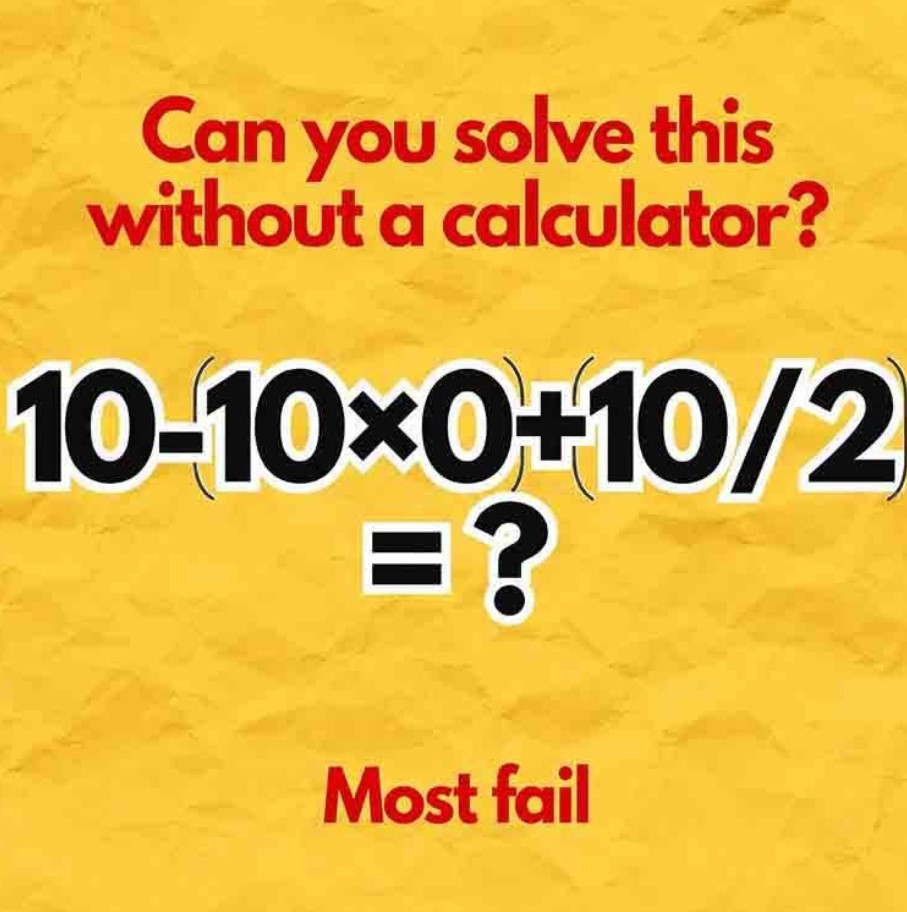
10 − 10 × 0 + 10 ÷ 2 = ?
What answer did you get?
Many people quickly answer 5, 0, or even 10, but only one result is mathematically correct.
Before checking the solution, let’s review the rule that makes all the difference.
Remember the Order of Operations
Whenever an equation contains multiple mathematical operations, they should not simply be solved from left to right.
Instead, follow the standard order of operations:
- Parentheses (if any)
- Multiplication and Division (from left to right)
- Addition and Subtraction (from left to right)
This rule ensures that everyone solving the same equation reaches the same correct answer.
Solving the Puzzle Step by Step
Let’s calculate the expression carefully.
10 − 10 × 0 + 10 ÷ 2
Step 1: Multiplication
10 × 0 = 0
Now the equation becomes:
10 − 0 + 10 ÷ 2
Step 2: Division
10 ÷ 2 = 5
Now we have:
10 − 0 + 5
Step 3: Subtraction and Addition
10 − 0 = 10
10 + 5 = 15
✅ Correct Answer: 15
If you got 15, congratulations! You applied the order of operations correctly.
Why So Many People Get It Wrong
This puzzle tricks people because our brains naturally want to solve the equation from left to right.
For example, someone might do:
10 − 10 = 0
Then:
0 × 0 = 0
Then:
0 + 10 ÷ 2 = 5
This approach ignores the proper order of operations, leading to the wrong answer.
It’s a reminder that mathematics relies on rules rather than intuition.
Why Math Riddles Are So Popular
Math puzzles are entertaining because they combine logic with a bit of surprise. Even simple-looking equations can spark debates online, with people confidently defending different answers.
These challenges help improve:
- Logical thinking
- Attention to detail
- Mental calculation skills
- Problem-solving abilities
- Confidence in basic mathematics
They’re also a fun way to exercise your brain in just a few minutes.
Tips for Solving Similar Puzzles
If you enjoy these kinds of brain teasers, keep these strategies in mind:
- Never rush to the answer.
- Identify every mathematical operation.
- Apply multiplication and division before addition and subtraction.
- Work carefully from left to right when operations have the same priority.
- Double-check your calculations before deciding on your final answer.
Following these simple habits will help you avoid common mistakes and solve even more challenging puzzles with confidence.
Challenge Your Friends
Now that you know the correct answer, why not share this puzzle with your friends or family? Ask them to solve it without using a calculator and see what answers they come up with. You might be surprised at how many different responses you hear!
These friendly math challenges often lead to interesting discussions and are a great way to encourage critical thinking while having fun.
Conclusion
Math riddles like this one prove that even the simplest equations can be surprisingly deceptive. At first glance, the expression 10 − 10 × 0 + 10 ÷ 2 looks easy enough to solve in seconds, but it quickly reveals how important it is to follow the correct order of operations. Rather than relying on instinct or solving the equation from left to right, taking a moment to apply the proper mathematical rules leads to the correct answer: 15.
Beyond being an entertaining brain teaser, puzzles like this help sharpen your analytical thinking, improve concentration, and reinforce essential math skills that we often take for granted. They remind us that accuracy is just as important as speed and that paying attention to small details can make all the difference.
Whether you’re a math enthusiast or simply enjoy a good mental challenge, solving puzzles like this is an excellent way to keep your mind active. So the next time you come across a viral math riddle, don’t rush—take your time, think logically, and let the rules guide you. You may discover that the trickiest puzzles often have the simplest solutions once you approach them correctly.