At first glance, this visual puzzle seems almost too easy to be challenging. All you need to do is look at an image and count the dots. There are no complicated calculations, difficult clues, or special mathematical skills required.
But don’t be too confident just yet!
This little brain teaser has been catching people’s attention because the answer is not as obvious as it first appears. Most people immediately focus on the large group of green dots in the middle of the picture. They begin counting them one by one, convinced that the solution is somewhere in that pattern.
However, the puzzle contains a clever little trick. Some of the dots are not part of the main design at all. They are hidden in places that many people completely overlook.
So, how many dots are actually visible in the image? Can you count every single one without missing the smaller details?
Take a moment, examine the picture carefully, and see whether your observation skills are sharp enough to find the correct answer.
The Challenge: How Many Dots Can You Find?
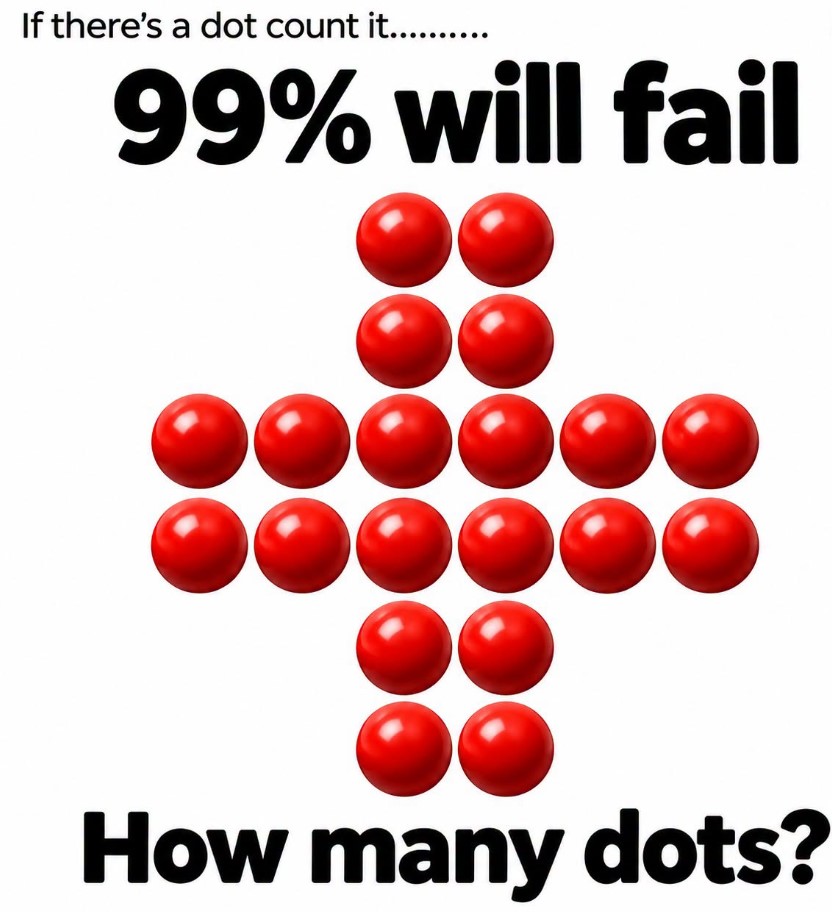
The puzzle features a group of green dots arranged in a cross-like pattern. At first, your eyes are naturally drawn toward this central design.
Your task is simple: count every dot you can see in the entire image.
Before checking the answer, try to complete the challenge yourself.
Don’t rush through the counting process. Look carefully at the green pattern, but also pay attention to the surrounding words and symbols.
Here are a few things to remember:
- Count every visible green dot in the central arrangement.
- Don’t assume that every dot belongs to the main pattern.
- Examine the text surrounding the image.
- Pay attention to small punctuation marks.
- Make sure you haven’t counted the same dot twice.
Many people find the first part of the challenge easy. The real difficulty begins when they try to determine whether there are any additional dots outside the obvious arrangement.
Why Do So Many People Miss the Hidden Dots?
The interesting thing about this puzzle is that the dots are not particularly difficult to see. The problem is that people tend to focus on the most noticeable part of an image.
When we look at a picture containing a large, organized pattern, our brains quickly identify its overall shape. Once we recognize the cross-like arrangement, we naturally concentrate on counting the green circles.
This makes us less likely to notice small details elsewhere.
The same thing happens in everyday situations. We sometimes overlook something directly in front of us because our attention is focused on a larger task.
For example, you might search for your keys while they are sitting on the table in front of you. You may also read an entire sentence without noticing a small punctuation mark.
This puzzle uses that natural tendency to make a simple counting exercise surprisingly challenging.
The secret is to stop looking at the image as one large pattern and start examining every individual element.
The Answer: Did You Find All 23 Dots?
Have you finished counting?
If you found 20 dots, you successfully counted the main green arrangement. However, there are three additional dots that need to be included.
According to the original puzzle’s explanation, the complete answer is:
23 dots in total.
Here’s how the number is calculated.
Step 1: Count the Green Dots
The main cross-shaped arrangement contains 20 green dots.
These are the most noticeable circles in the image, and they are usually the first ones people count.
Step 2: Look Carefully at the Text
After counting the green dots, you still need to examine the words and punctuation surrounding the puzzle.
The original explanation identifies three additional dots:
- One dot in the word “will.”
- One dot in the word “fail.”
- One dot in the question mark.
These small details are easy to overlook because most people concentrate entirely on the green circles.
Step 3: Add Everything Together
Now that you have counted both the main pattern and the additional details, the calculation is straightforward:
20 green dots + 3 additional dots = 23 dots.
The final answer is 23.
If you counted 23 on your first attempt, congratulations! You managed to notice details that many people overlook.
If your answer was 20, you weren’t far off. You simply focused on the most obvious part of the image and missed the smaller details.
What Makes This Puzzle So Tricky?
This challenge is a good example of how something simple can become difficult when our attention is directed toward the wrong place.
There are three main reasons why people struggle with it.
1. The Main Pattern Attracts Your Attention
The green dots form a clear cross-like shape. Because the arrangement is organized and visually noticeable, your eyes naturally focus on it.
You may spend the entire time counting the circles without considering that the puzzle could include other dots elsewhere.
2. Small Details Are Easy to Ignore
The additional dots are much less noticeable than the green circles. They appear in the surrounding text and punctuation rather than in the central design.
When you’re concentrating on counting a specific object, you may automatically ignore other visual elements.
3. People Often Stop Counting Too Early
Once someone reaches 20, they may feel confident that the puzzle is solved.
That confidence can prevent them from checking the rest of the image. The challenge is a reminder that reaching an expected number doesn’t necessarily mean you have found every detail.
Simple Ways to Improve Your Observation Skills
If you enjoy visual puzzles, there are several habits that can help you become more accurate.
1. Examine the Entire Image
Don’t focus only on the largest or brightest objects. Look at the corners, surrounding text, punctuation, and smaller elements that might be easy to overlook.
2. Divide the Picture Into Sections
Instead of examining everything randomly, divide the image into smaller areas. Count one section at a time before moving to the next.
This makes it easier to stay organized and reduces the chance of counting the same object twice.
3. Question Your First Answer
Your first answer might be correct, but it’s worth checking before deciding that the challenge is finished.
Take another look and ask yourself whether you have included every visible detail.
4. Pay Attention to Unusual Details
Visual puzzles often hide their tricks in unexpected places. A tiny mark, a small symbol, or a detail in the background may be just as important as the main objects.
5. Practice With Different Types of Puzzles
Spot-the-difference games, hidden-object challenges, and counting puzzles can all encourage you to examine images more carefully.
The more you practice, the more comfortable you may become with noticing small visual details.
Final Thoughts
This dot-counting puzzle proves that even the simplest challenges can make us stop and think. At first, counting the green circles seems like the only task. But once you take a closer look, you discover that the answer depends on paying attention to the entire image rather than just its most noticeable feature.
The most important lesson is not simply that the correct answer is 23. It is that small details matter, even when they seem unrelated to the main challenge.
Many people stop counting after finding the 20 green dots because the central pattern looks complete. But the three additional dots hidden in the text and punctuation change the final result.
Whether you found all 23 immediately or needed to check the explanation, this puzzle gives your attention and observation skills a fun little workout.
Now it’s your turn to challenge someone else. Show them the same image, ask them how many dots they can find, and resist the temptation to reveal the answer too quickly.
Will they notice all 23, or will they make the same mistake as many others?
Sometimes, the smallest details are the ones that make the biggest difference.