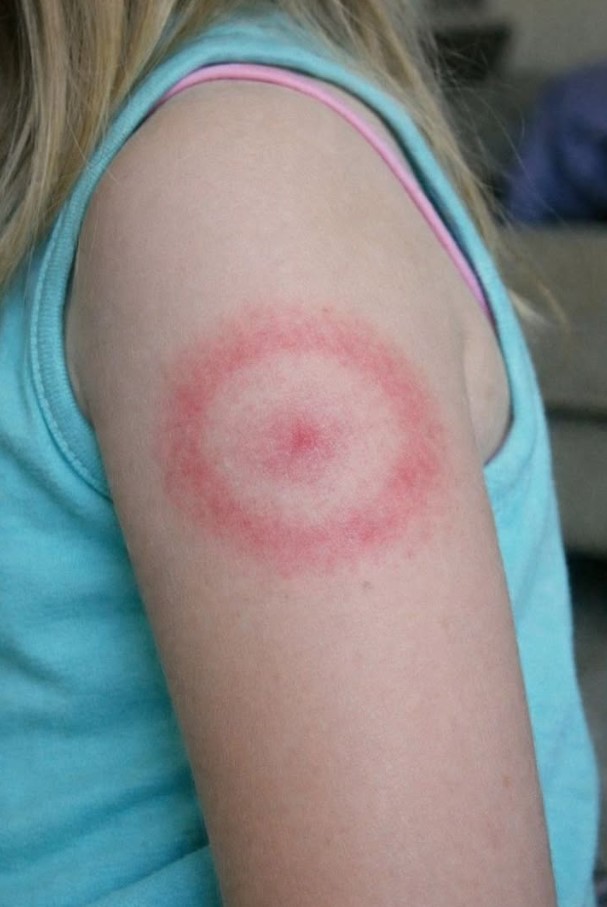
Seeing a strange mark appear on your child’s skin overnight can be alarming—especially when it looks unusual, like a red ring that seems to be expanding. Even if your child says it doesn’t hurt or itch, the appearance alone can trigger worry and confusion for any parent.
Red, ring-shaped rashes can have several causes, ranging from harmless skin irritation to infections that need treatment. While it’s natural to feel panicked, not every rash is an emergency. However, some do require medical attention—especially when they appear to be spreading.
Let’s break down what this could be, what signs to watch for, and when you should seek medical care.
What does a red ring-shaped rash usually mean?
A circular or ring-like rash is called an annular lesion. It’s a descriptive term, not a diagnosis, meaning several different conditions can look this way.
Common causes include:
- Fungal infections (like ringworm)
- Insect bite reactions
- Skin inflammation conditions
- In some cases, early signs of tick-related illness
The key detail doctors look at is whether the rash has scaling, itching, spreading patterns, or central clearing.
1. Ringworm (tinea corporis) – the most common cause
Despite its name, ringworm is not caused by a worm. It is a fungal skin infection.
Typical signs include:
- A round or oval red patch
- A slightly raised, scaly border
- Slow outward expansion
- Sometimes mild itching, but not always
It often starts small and gradually spreads in a ring shape, which is why it can look alarming.
Ringworm is common in children and can spread through:
- Skin contact
- Shared towels or clothing
- Pets (in some cases)
Doctors usually confirm it visually and treat it with antifungal creams.
2. Insect bite reaction
Sometimes a mosquito or insect bite can trigger a larger skin reaction.
This can look like:
- A red expanding circle
- Mild swelling
- Little or no itching in some cases
Unlike infections, this type of rash usually:
- Does not continue spreading for long
- Fades on its own within days
3. Lyme disease rash (important to rule out in some cases)
In rare cases—especially if there was possible tick exposure—a red expanding ring can be a sign of erythema migrans, the early rash of Lyme disease.
Key features:
- Expanding circular rash
- May or may not itch or hurt
- Often grows larger over days
It can sometimes look like a “bull’s-eye,” but not always.
This type of rash requires medical treatment with antibiotics.
4. Other possible skin conditions
There are several less common causes, including:
- Allergic skin reactions
- Eczema-like rashes forming circular patterns
- Granuloma annulare (non-infectious skin condition)
- Other inflammatory skin responses
Many of these are harmless but still need proper diagnosis.
When should you be concerned?
A red ring on the skin is not always an emergency, but you should seek medical advice if:
- The rash is steadily expanding
- New rings or spots appear
- Your child develops fever, fatigue, or flu-like symptoms
- The rash becomes painful, warm, or swollen
- There is possible tick exposure
If the rash is only small and stable, observation for 24–48 hours may be reasonable—but spreading patterns should always be checked.
What you should NOT do
To avoid making things worse:
- Don’t apply strong steroid creams without advice
- Don’t ignore rapid spreading
- Don’t try multiple random treatments at once
- Don’t scratch or irritate the area
Incorrect treatment can sometimes worsen fungal infections or delay proper care.
What doctors usually do
A healthcare provider may:
- Examine the rash visually
- Ask about recent outdoor activity or animal contact
- Possibly do a skin scraping (if fungal infection is suspected)
- Prescribe antifungal or antibiotic treatment if needed
Most ring-shaped rashes are treatable once correctly identified.
Conclusion :
A red ring-shaped rash on your child’s arm can look frightening at first, especially when it appears suddenly or seems to be spreading. However, in many cases, the cause is something common and treatable, such as a fungal infection like ringworm or a mild skin reaction.
The most important factor is not just how the rash looks, but how it behaves over time. Slow expansion, new symptoms, or changes in the skin are signs that it should be checked by a healthcare professional.
While it’s understandable to feel worried, the key is to stay observant and avoid guessing treatments. Most causes of circular rashes are manageable once properly diagnosed, and early attention often leads to quick and simple recovery.
In the end, when it comes to skin changes in children, it’s always better to check early rather than wait too long—just to be safe and give yourself peace of mind.