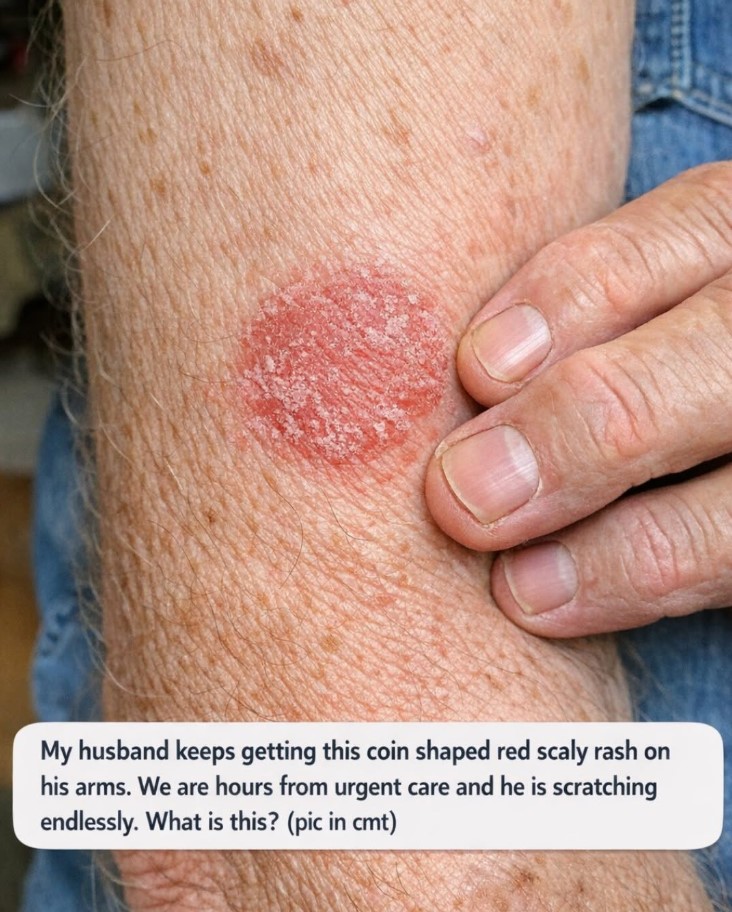
It started with what looked like an ordinary patch of irritated skin.
But then it happened again.
My husband developed another round, red, scaly patch on his arm, and this time the itching was so intense that he could barely stop scratching it. The spots looked almost as though someone had pressed coins against his skin and traced around them.
Because we live hours from urgent care, the first question was obvious: Is this something we can safely manage at home for the night, or does he need to be seen immediately?
A recurring, intensely itchy, coin-shaped rash can have several possible explanations. One of the most recognizable is nummular eczema, also called discoid eczema. It causes round or oval, inflamed patches that can become dry, rough, scaly, cracked, and extremely itchy. It commonly affects the arms and legs and can return repeatedly.
However, the shape alone doesn’t prove that eczema is the cause.
Ringworm, psoriasis, contact dermatitis, insect reactions, and bacterial infections can sometimes produce similar-looking patches. That’s why paying attention to how the rash behaves—and whether there are other symptoms—is so important.
If someone is dealing with a rash like this, here’s what to know about the possibilities, what can make it worse, what can safely be done while waiting for medical advice, and which warning signs mean the trip to urgent care should no longer be postponed.
What Is Nummular Eczema?
Nummular eczema is a type of eczema that produces distinctive round or oval patches on the skin.
The word “nummular” comes from a Latin term associated with coins, which explains why people often describe these lesions as coin-shaped rashes.
The patches may be red or pink on lighter skin and can appear darker red, brown, gray, or violet on darker skin. They can be raised, dry, rough, crusty, or scaly. In some cases, tiny bumps or blisters appear first and eventually merge into a larger circular patch.
One feature that often stands out is the itching.
Nummular eczema can itch intensely. Some people find that the itching becomes particularly difficult at night, after a hot shower, when they become overheated, or when clothing rubs against the affected skin.
That creates a frustrating cycle:
Itching → scratching → damaged skin → more inflammation → even more itching.
If your husband is scratching almost continuously, that cycle may already be contributing to the severity of the rash.
Why Does It Keep Coming Back?
Nummular eczema is associated with a weakened skin barrier.
Healthy skin helps keep moisture inside while keeping irritants outside. When that barrier becomes dry or damaged, the skin can lose moisture more easily and become more vulnerable to irritation.
Several factors can contribute to flare-ups, including:
- Very dry skin
- Cold or dry weather
- Indoor heating
- Long, hot showers
- Harsh soaps
- Fragranced body washes
- Rough fabrics
- Wool
- Scratches or small injuries
- Insect bites
- Stress
- Certain medications or skin sensitivities
The American Academy of Dermatology notes that nummular eczema can develop on extremely dry skin and may appear after an injury such as a cut, scrape, or bug bite.
This can explain why someone may have an apparently random circular rash that keeps returning.
The skin becomes irritated, the person scratches it, the barrier becomes weaker, and the next flare can be easier to trigger.
What Does Nummular Eczema Usually Look Like?
The patches are commonly round or oval and may range from roughly a small coin-sized area to several centimeters across, although larger patches can develop.
They may appear on:
- Forearms
- Upper arms
- Hands
- Legs
- Torso
- Areas around the elbows
The surface can look dry and flaky.
Some patches are relatively flat, while others become raised and thickened.
The itching can be intense enough to interfere with sleep.
In some cases, the skin may crack, sting, ooze clear fluid, or develop crusting.
If several similarly shaped patches appear on both arms or elsewhere on the body, nummular eczema becomes one possibility worth discussing with a healthcare professional.
But there is an important complication.
Other conditions can look very similar.
Could It Be Ringworm Instead?
Absolutely.
This is one of the most important possibilities to distinguish from nummular eczema.
Despite its name, ringworm isn’t caused by a worm. It’s a fungal infection of the skin.
Ringworm often creates a circular or ring-like rash with a more pronounced, scaly outer edge and a center that may look clearer than the surrounding skin.
Nummular eczema, by contrast, often affects the entire patch more evenly, with dryness and inflammation throughout the coin-shaped area.
Unfortunately, the distinction isn’t always obvious from a quick glance.
A person may assume they have eczema and use a steroid cream, only to discover that the rash continues spreading because the actual problem is fungal.
That’s why persistent or worsening circular rashes deserve professional evaluation rather than repeated self-treatment without a diagnosis.
What About Psoriasis?
Psoriasis can also cause red, scaly patches.
However, psoriasis often produces thicker plaques with more noticeable scaling. It commonly affects areas such as the elbows, knees, scalp, and lower back, although appearances and locations can vary.
The degree of itching can also differ.
Nummular eczema tends to be particularly itchy, while psoriasis may be more dominated by thick scaling and inflammation.
Again, these are clues—not a substitute for an examination.
Could It Be an Allergic Reaction?
Yes.
Contact dermatitis can produce red, itchy, irritated patches after the skin comes into contact with something that triggers irritation or an allergic response.
Think about whether anything recently changed:
- New soap
- Laundry detergent
- Fabric softener
- Body lotion
- Cologne
- Cleaning products
- Gloves
- Metal
- New clothing
- Plants
- Occupational chemicals
If the rash began after a new product or repeated exposure to something touching his arms, that history could be important.
What Can Make the Itching Worse?
One of the biggest problems is scratching.
It feels natural to scratch an intensely itchy patch.
But scratching can damage the skin further.
Tiny breaks in the skin create additional inflammation and may allow bacteria to enter.
That’s why the goal isn’t simply to moisturize the skin.
The goal is to break the itch-scratch cycle.
Hot water can also make matters worse. A long, steaming shower may feel soothing temporarily, but it can strip oils from already-dry skin and increase irritation afterward. The American Academy of Dermatology recommends lukewarm bathing and moisturizing afterward for people with nummular eczema.
What Can You Do Tonight While Waiting for Care?
If he is otherwise well and there are no emergency warning signs, several simple measures may help calm irritated skin.
Start With Lukewarm Water
If he needs to shower, keep it short and lukewarm rather than hot.
There’s no need to scrub the affected areas.
Afterward, gently pat the skin dry rather than rubbing it vigorously.
Moisturize Immediately
While the skin is still slightly damp, apply a thick, fragrance-free cream or ointment.
The American Academy of Dermatology recommends fragrance-free creams or ointments for nummular eczema because they help trap moisture in the skin.
Plain petroleum jelly or a thick fragrance-free moisturizer may be useful options if he has tolerated them before.
Try a Cool Compress
A clean washcloth dampened with cool water can be placed over the itchy area for several minutes.
This can provide temporary relief without exposing the skin to additional irritants.
Avoid putting ice directly against the skin.
Keep Fingernails Short
This sounds like a small detail, but it can make a difference.
If he scratches while asleep, short fingernails may reduce the amount of damage caused by unconscious scratching.
Soft cotton clothing can also reduce friction against the affected areas.
What About Hydrocortisone?
For mild eczema, an over-the-counter 1% hydrocortisone product may sometimes help reduce inflammation and itching.
However, this is where caution is important.
A circular rash isn’t automatically eczema.
If the rash is actually fungal, using a steroid alone can make the infection more difficult to recognize and potentially worsen its appearance.
For that reason, if the diagnosis is uncertain—especially if the rash has a distinct raised border or is steadily spreading—it’s better to seek medical advice rather than repeatedly treating it as eczema.
A healthcare professional can recommend the appropriate treatment based on what the skin actually looks like.
When Does It Become More Than a Simple Rash?
A rash that is itchy and scaly is uncomfortable.
A rash that becomes painful, hot, swollen, rapidly expanding, or draining fluid is more concerning.
Scratching can break the skin and create an opening for bacteria.
Watch for:
- Increasing warmth
- Significant tenderness
- Swelling
- Yellow drainage
- Honey-colored crust
- Rapidly spreading redness
- Increasing pain
- Red streaks traveling up the arm
- Fever
- Chills
These can indicate infection and warrant prompt medical attention.
When Should You Seek Emergency Help?
Being hours from urgent care can make the decision more difficult.
But distance shouldn’t be the deciding factor if serious symptoms appear.
Seek urgent or emergency medical help if he develops:
- Difficulty breathing
- Swelling of the lips, tongue, or throat
- Widespread hives
- A rapidly spreading rash
- Severe pain
- Significant swelling of an arm
- Fever accompanied by a rapidly worsening rash
- Confusion or severe weakness
- Signs of a serious infection
Those symptoms require a higher level of attention than a typical itchy eczema flare.
If he has significant medical conditions that affect his immune system or wound healing, such as certain forms of immune suppression or poorly controlled diabetes, it’s also wise to have a lower threshold for contacting a healthcare professional.
How Can You Tell Whether It’s Getting Better?
Take a photograph.
Then take another one later under similar lighting.
If possible, place a ruler or familiar object beside the rash for scale.
This gives you a way to compare the size and appearance instead of relying on memory.
A photograph can also be helpful during a telehealth consultation.
The original article recommends documenting the rash and monitoring its progression, particularly when access to urgent care is difficult.
Don’t repeatedly poke, scratch, scrub, or irritate the area simply to see whether it’s changing.
Let the skin rest.
What Will a Doctor Want to Know?
When he eventually speaks with a healthcare professional, expect questions about the history of the rash.
For example:
When did it first appear?
Has it happened before?
Does it return in the same locations?
Is it spreading?
Is it itchy or painful?
Did it begin after a bite, scrape, or other skin injury?
Has he changed soaps, detergents, lotions, or medications?
Has anyone else in the household developed a similar rash?
Has he experienced fever or other symptoms?
Does he have a history of eczema, allergies, or asthma?
These details can help distinguish nummular eczema from fungal infections, contact dermatitis, psoriasis, scabies, and other skin conditions.
Why Recurrent Rashes Deserve a Proper Diagnosis
If the rash keeps coming back, treating each flare separately isn’t necessarily enough.
Recurring nummular eczema may have identifiable triggers.
A dermatologist can look for patterns involving:
- Dry skin
- Allergies
- Irritating products
- Environmental factors
- Medication reactions
- Repeated skin trauma
- Other types of eczema
Once the trigger is identified, prevention becomes much easier.
The American Academy of Dermatology notes that recurrent nummular eczema can often be managed through regular moisturizing and avoiding known triggers.
What Treatment Might a Doctor Recommend?
Treatment depends on the diagnosis and severity.
For nummular eczema, a clinician may recommend prescription-strength topical corticosteroids or other anti-inflammatory treatments.
For persistent or extensive disease, additional approaches can include medicated dressings, wet-wrap therapy, phototherapy, or other treatments.
If a bacterial infection has developed, treatment may be needed for that infection.
If the rash turns out to be ringworm, antifungal treatment—not eczema treatment—is generally required.
That’s why getting the diagnosis right matters.
How Can Future Flare-Ups Be Prevented?
If this does turn out to be nummular eczema, everyday skin care can make a significant difference.
Moisturize regularly, particularly after bathing.
Choose fragrance-free products.
Avoid extremely hot showers.
Use mild cleansers.
Wear soft clothing that doesn’t rub against irritated areas.
Avoid scratching whenever possible.
Use a humidifier when indoor air becomes very dry.
And pay attention to patterns.
If every flare seems to happen after a particular product, activity, season, or type of exposure, mention that pattern to a healthcare professional.
The goal isn’t simply to make the current rash disappear.
It’s to reduce the chances of the next one appearing.
The Bottom Line
A recurring coin-shaped, red, scaly, intensely itchy rash on the arms can be consistent with nummular eczema, also known as discoid eczema. This condition is not contagious and often affects dry skin, producing round or oval patches that can be extremely itchy.
But appearance alone isn’t enough to diagnose it.
Ringworm, psoriasis, contact dermatitis, insect reactions, and infected skin can produce similar symptoms. If the rash has a sharply defined raised border, is spreading outward, appears on other household members, or doesn’t improve with appropriate skin care, another diagnosis may need to be considered.
For tonight, if he has no emergency symptoms, focus on protecting the skin: avoid hot showers, use a thick fragrance-free moisturizer, try cool compresses, keep his nails short, and minimize scratching.
Most importantly, watch for signs that change the situation—rapid spreading, increasing warmth or pain, swelling, pus or yellow crusting, fever, red streaks, breathing difficulty, or other significant symptoms. Those are reasons to seek medical attention promptly rather than waiting simply because urgent care is far away.
And if the rash keeps returning, don’t settle for repeatedly guessing what it is. A proper evaluation can distinguish eczema from fungal infection and other look-alikes and can help create a treatment plan that prevents the same miserable cycle from happening again.
A coin-shaped rash may look alarming, but many causes are manageable once the correct diagnosis is made. The key is knowing when home skin care is reasonable—and when the skin is telling you that it’s time to get professional help.