As soon as my mother-in-law heard that I was out of labor and that our baby had finally arrived, she burst into my hospital room while I was still asleep.
I didn’t know what was happening.
One moment I was drifting in and out of exhaustion, my body aching after hours of labor.
The next, I heard a woman’s voice rising sharply across the room.
“Everyone come look!”
My eyes opened.
At first, everything was blurry.
The ceiling lights hurt my eyes. My abdomen throbbed every time I moved, and my mouth was so dry that I could barely swallow.
Then I heard my baby crying.
A frightened, desperate cry.
I tried to sit up.
Pain shot through my stomach, forcing me back against the pillow.
“What happened?” I whispered.
Nobody answered.
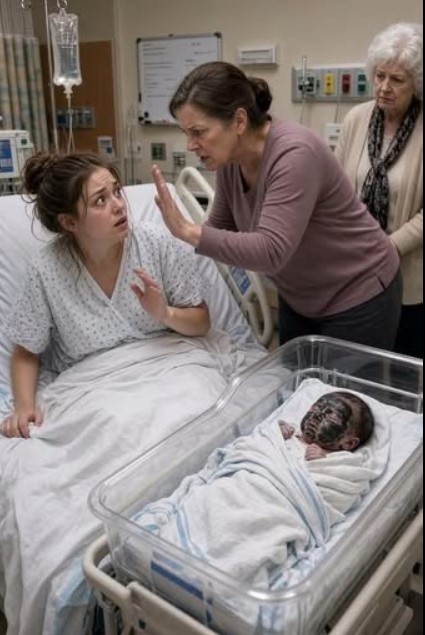
My mother-in-law stood beside the bassinet with a strange expression on her face.
She looked almost triumphant.
My mother stood near the opposite wall.
Two relatives were whispering beside the door.
And my newborn son was crying.
“Give me my baby,” I said.
My mother-in-law turned toward me.
“Don’t touch him yet.”
I stared at her.
“What?”
“Your husband needs to see this first.”
My heart began pounding.
I looked toward the bassinet.
And then I saw him.
My baby.
His tiny face, cheeks, forehead, arms and fingers were covered in some kind of dark black substance.
It had been smeared across his skin unevenly.
Some of it had collected in the folds around his neck.
The white hospital blanket beneath him was stained.
For a second, I couldn’t understand what I was seeing.
Then I screamed.
“What did you do to my baby?”
My mother-in-law folded her arms.
“I knew there was something wrong.”
“What did you put on him?”
“He doesn’t look like my son.”
My entire body went cold.
“What are you talking about?”
She pointed toward my newborn.
“Look at him! Everyone can see it.”
I couldn’t believe what I was hearing.
I had just given birth.
I was still bleeding.
I could barely sit upright.
And this woman was standing over my newborn accusing me of something I hadn’t even had the strength to understand.
“Give him to me!”
She moved between me and the bassinet.
“Not until my son sees the truth.”
“Someone get a nurse!”
My voice cracked.
A nurse rushed through the door almost immediately.
She took one look at the baby.
Then at my mother-in-law.
Her expression changed.
“Who put something on this newborn?”
My mother-in-law didn’t even hesitate.
“That’s his skin.”
The nurse stared at her.
“No, it isn’t.”
She immediately put on gloves.
Another nurse came running into the room.
They carefully lifted my baby from the bassinet and began checking his breathing, eyes and mouth.
I was crying so hard that I could barely speak.
“Is he okay?”
The nurse looked at me.
“We’re checking him now.”
“What did she put on him?”
“We don’t know yet.”
My mother-in-law stepped forward.
“I was only proving something.”
The nurse turned toward her.
“You covered a newborn with an unknown substance while his mother was unconscious.”
“He needed to see—”
“Please step away.”
The nurse’s voice was firm now.
She dampened a piece of gauze and carefully touched my son’s ankle.
Black pigment immediately came away onto the white cloth.
Everyone went silent.
The nurse used another piece.
More black residue appeared.
My mother covered her mouth.
One of the relatives whispered, “Oh my God.”
My mother-in-law’s expression changed.
“This proves nothing.”
The nurse looked at her.
“It proves that this substance was placed on the baby.”
Then she told another nurse to take my son for a more thorough examination and cleaning.
I reached out desperately.
“Please don’t take him away.”
The nurse leaned toward me.
“We’re not taking him away from you. We’re making sure he’s safe.”
Those words were the first comfort I had heard since waking up.
Then the door opened.
My husband walked in.
He had gone downstairs less than twenty minutes earlier to bring my hospital bag from the car.
He stopped immediately.
His eyes went from me to the nurses, then to the bassinet.
Finally, he saw the black residue on the nurse’s glove.
“What happened?”
His mother rushed toward him.
“Ben, I knew something was wrong. Look at the baby. He came out and—”
“Stop.”
His voice wasn’t loud.
But everyone stopped.
He wasn’t looking at his mother.
He was looking at the nurse.
“What happened?”
The charge nurse answered.
“Your mother applied an unknown substance to your newborn while your wife was unconscious. We’re examining him now.”
My husband went completely still.
Then his eyes moved to me.
My cheek was still red from where my own mother had slapped me.
His gaze stopped there.
“Who hit my wife?”
My mother lowered her eyes.
He didn’t need anyone to answer.
He slowly turned toward her.
Then he looked at his mother.
“You put something on my newborn son.”
His mother immediately started crying.
“I was trying to protect you.”
“Protect me from what?”
“From her!”
She pointed toward me.
“She knows what she did.”
My husband stepped between his mother and the bassinet.
“You put something on my child while his mother was unconscious.”
“I only wanted you to see him before she cleaned him.”
“Mom.”
“I knew something wasn’t right!”
“Enough.”
Security officers appeared at the door.
My husband pointed toward his mother.
“Take her out.”
For the first time, she looked genuinely frightened.
“You’re choosing her over your own mother?”
My husband looked at our son.
Then at me.
Then back at his mother.
“I’m choosing my wife and child over the person who did this to them.”
Security escorted her into the hallway.
She continued protesting.
She said she was being misunderstood.
She said she was protecting her son.
She said everyone would eventually understand.
But my husband didn’t follow her.
He stayed beside me.
The door closed.
Silence filled the room.
Then my mother approached my bed.
Her face was wet with tears.
She whispered my name.
My husband stepped in front of her.
“No.”
My mother stopped.
“You don’t get to hug her yet.”
She looked at him.
He pointed toward the chair.
“Sit down.”
She slowly sat.
“Now tell my wife why you hit her before you even asked what happened.”
My mother began crying harder.
“I thought…”
“Thought what?”
She looked toward the bassinet.
“I thought your mother was telling the truth.”
I felt something inside me break.
“About what?”
My mother couldn’t look at me.
“She said the baby didn’t look like your husband.”
My husband’s jaw tightened.
“She said something was wrong,” my mother whispered. “She said you had deceived everyone.”
I stared at my mother.
“And you believed her?”
“I was shocked.”
“You hit me because you were shocked?”
She covered her face.
“I was wrong.”
I wanted those words to make me feel better.
They didn’t.
Because the slap wasn’t the only thing that hurt.
What hurt was knowing that my own mother had looked at me—her daughter of twenty-nine years—and believed a terrible accusation without asking me a single question.
A nurse eventually returned with my baby.
He was clean.
His skin looked pink and delicate again.
There was still a small area near his ankle being monitored, but his breathing was steady.
The nurse placed him gently against my chest.
I started crying.
This time, they were tears of relief.
My husband stood beside me with one hand resting on my shoulder.
The charge nurse returned carrying a sealed evidence bag.
Inside were the gauze, the stained blanket and samples of the substance removed from my baby’s skin.
“We’re preserving these for the hospital report,” she explained.
My mother stared at the bag.
“What was it?”
“We don’t know yet.”
Something changed in her expression.
Until that moment, she had treated the entire situation like a family argument that had gone too far.
Now she understood.
An unknown substance had been deliberately put on a newborn.
She looked at me.
“I should never have hit you.”
“No,” I whispered. “You shouldn’t have.”
She nodded.
“I know.”
My husband stepped into the hallway to make a phone call.
When he returned, his expression was different.
“What happened?” I asked.
He sat beside me.
“My mother called my sister before she came here.”
My stomach tightened.
“What did she say?”
“She told my sister she was going to prove something about the baby.”
I looked down at my son.
“Prove what?”
“She didn’t explain what she was going to use. But she told my sister she had been watching the baby since we announced the pregnancy.”
Watching.
That word made my skin crawl.
My husband continued.
“She had already decided before he was born that he wasn’t mine.”
My mother looked up.
“So this was planned?”
My husband nodded.
“That is what it looks like.”
I thought back to everything.
The strange comments during my pregnancy.
The questions about the baby’s appearance.
The way my mother-in-law would stare at my stomach.
The little remarks she made whenever my husband wasn’t in the room.
I had dismissed all of it.
Now it suddenly made sense.
She hadn’t discovered a problem.
She had already decided there was one.
And she had been waiting for the right moment to create “proof.”
My husband took my hand.
“I should have stopped her sooner.”
“You weren’t here.”
“I left you with my mother because I thought you were safe.”
“You couldn’t have known.”
He looked down at our son.
“I know that now.”
A nurse checked the baby’s vital signs again.
Everything was stable.
For the first time since I opened my eyes, I could breathe.
But then my mother spoke.
“There is something else.”
My husband turned toward her.
“What?”
She twisted her hands together.
“Your mother called me a few days ago.”
My heart tightened.
“What did she want?”
My mother hesitated.
“She wanted me to watch you.”
“Watch me?”
“She said you had become distant. She said you were controlling her son. She told me to pay attention to how you acted whenever anyone mentioned the baby.”
I stared at her.
“You didn’t tell me.”
“I thought she was being dramatic.”
“But you listened.”
My mother nodded.
“Yes.”
“And when she accused me today, you believed her.”
She lowered her head.
“Yes.”
That answer hurt more than an excuse.
My husband stood.
“She was building this story before the baby was even born.”
Nobody spoke.
Then my phone buzzed on the bedside table.
My husband picked it up.
There were several missed calls.
All from his mother.
Then another message arrived.
He read it.
His expression changed.
“What does it say?” I asked.
He handed me the phone.
The message was short.
If you want the truth, check what I left at home.
Then there was our home address.
My husband looked at me.
“I don’t want to leave you here alone.”
“You aren’t leaving me alone.”
The nurse immediately stepped in.
“You don’t need to go yourselves. Someone else can retrieve whatever she left behind.”
My husband called his sister.
She agreed to go to our house with a trusted family friend.
While we waited, I held my son.
My mother remained in the chair.
She didn’t try to touch me.
She didn’t make excuses.
She simply sat there crying quietly.
After several minutes, she stood.
“I know sorry isn’t enough.”
I looked at her.
“No. It isn’t.”
She nodded.
“I’ll accept whatever you need from me.”
I didn’t know what that would be.
I wasn’t ready to forgive her.
Maybe forgiveness would come eventually.
Maybe it wouldn’t.
But I knew one thing.
Trust couldn’t be repaired simply because someone cried after being caught.
Then my husband’s sister called.
He answered on speaker.
“We found something,” she said.
My husband straightened.
“What?”
“Photographs.”
“Of what?”
“A lot of things.”
My stomach dropped.
She continued.
“Pictures of the nursery. The baby’s things. The hospital bag. Your wife sleeping in the living room. Screenshots of messages between the two of you.”
My husband closed his eyes.
“Anything else?”
“There is a notebook.”
“What does it say?”
“I haven’t read everything.”
“Read whatever matters.”
There was a long silence.
Then she said:
“She wrote that the baby had to be exposed before you signed the birth paperwork.”
The room went completely silent.
My husband looked at me.
Suddenly, I understood.
This had never really been about the baby’s appearance.
His mother had wanted to create doubt.
She wanted my husband to question me at the most vulnerable moment possible.
She wanted him uncertain before the birth paperwork was completed.
She had been constructing her accusation for weeks.
Maybe months.
And the black substance had been her final attempt to turn that accusation into something she could point to.
But she had made one enormous mistake.
She had done it inside a hospital.
There were nurses.
There were witnesses.
There was evidence.
There was a report.
And there was a husband who had walked into the room before she could control the story.
My husband sat beside me.
He took my hand.
“I believe you.”
I looked at him.
“I know.”
But this time, those words meant something different.
Because he hadn’t simply told me he believed me.
He had shown me.
The next morning, the pediatric team confirmed that our son was doing well.
The hospital completed its documentation.
My mother-in-law was not permitted back onto the maternity floor.
My mother asked whether she could visit me again another day.
I told her I needed time.
She accepted it.
There was no dramatic reconciliation.
No magical speech.
No instant forgiveness.
There couldn’t be.
A single apology doesn’t erase a slap.
And tears don’t erase betrayal.
But at least the truth was finally out in the open.
Before we left the hospital, my husband stood beside the bassinet and watched our son sleeping.
Then he looked at me.
“I thought the hardest part of becoming a father would be the delivery.”
Despite everything, I smiled.
“The delivery was easier than this.”
He laughed quietly.
Then his expression became serious.
“I should have protected you before anyone had to ask me to.”
I reached for his hand.
“You protected us when it mattered.”
He looked at our son.
“No one gets to use him to hurt you again.”
This time, I believed him.
We left the hospital together.
Our son was safely wrapped in his blanket, sleeping between us.
Behind us were the reports, the photographs, the notebook, the hospital records, and the family members who would now have to live with the consequences of what they had done.
Ahead of us was something much harder.
We had to decide who could be trusted around our child.
And that decision would not be based on blood.
It would not be based on apologies.
It would not be based on who cried the loudest.
It would be based on actions.
Because becoming a mother had taught me something I had never understood before.
Family isn’t simply the people who share your blood.
Family is the people who protect you when you’re vulnerable.
The people who believe you when everyone else has already judged you.
The people who don’t use your weakest moment as an opportunity to destroy you.
And sometimes, loving someone means drawing a boundary so firm that they finally understand what their actions have cost.
My mother would have to earn my trust again.
My mother-in-law would have to face the consequences of what she had done.
And my husband and I would have to rebuild the sense of safety that had been shattered on the day our son was born.
But as I looked down at my sleeping baby, I realized something.
His first day in this world had begun with cruelty.
But it would not define his life.
He would grow up knowing that he was wanted.
That he was loved.
That his mother had fought to protect him.
And that his father had stood beside us when it mattered most.
The day I gave birth was supposed to be the happiest day of my life.
Instead, it became the day I discovered exactly who I could trust.
And when my husband stopped his mother, then asked my mother one question, everything changed.
He didn’t ask which family member was right.
He didn’t ask who had the better excuse.
He asked the question that mattered:
Why did you hurt the woman who had just given birth before you even asked her what happened?
And sometimes, one question is enough to expose an entire lie.