But I didn’t yell.
I didn’t insult her.
Instead, I calmly asked, “Did you open the box?”
There was silence on the other end.
Then Kelsey whispered, “Yes.”
“And?”
“You knew exactly what you were doing.”
“I usually do.”
She began breathing heavily.
“You are unbelievable.”
“No, Kelsey,” I said quietly. “What’s unbelievable is that you thought you could destroy something that belonged to my grandmother and simply tell me to clean it up.”
She didn’t answer.
I looked toward the photograph of Grandma hanging on the wall.
She was standing in front of the lake house, wearing her faded blue gardening gloves, her hands covered in soil and her face glowing with the kind of happiness that came from taking care of something she loved.
I remembered being eight years old and sitting on those porch steps while she planted roses.
Back then, she had told me something I didn’t understand.
“People show you who they are when they think they have nothing to lose.”
At the time, I thought she was talking about gardening.
Now I finally understood.
“Kelsey,” I said, “there’s a letter underneath everything else in that box.”
“What letter?”
“The one at the bottom.”
She went quiet.
Then I heard paper moving.
A few seconds passed.
“What does this say?”
“Read it.”
She began reading.
Then suddenly she stopped.
Her breathing changed.
“What…?”
“What?”
“Where did you get this?”
“It was in Grandma’s files.”
Another long silence followed.
Then Kelsey whispered, “You knew?”
“About the house?”
“No.”
Her voice was suddenly much smaller.
“About… this.”
I didn’t answer.
Because the truth was, even I hadn’t expected what was inside that box to become so important.
The box wasn’t filled with expensive jewelry.
It wasn’t filled with money.
It contained copies of the original property agreement for the lake house, photographs showing exactly how the property looked before the wedding, a professional restoration estimate, and one final document.
A document that could change everything.
“You said it was your wedding,” I reminded her.
“You said you could do whatever you wanted.”
“I was angry.”
“You were careless.”
“I said I was sorry!”
“No, you didn’t.”
She went silent.
“You told me I should have started cleaning.”
“I didn’t mean it like that.”
“You meant exactly what you said.”
I could hear her crying now.
For the first time since I’d known Kelsey, I heard genuine fear in her voice.
“What do you want me to do?”
I looked at Grandma’s photograph again.
“I want you to come to the lake house tomorrow.”
“Why?”
“Because there’s something you need to see.”
“What?”
“You’ll find out when you get there.”
She hesitated.
“Are you going to sue me?”
“Maybe.”
She gasped.
“But that’s insane!”
“Is it?”
“You can’t threaten me because my wedding got messy!”
“Your wedding didn’t get messy, Kelsey.”
I paused.
“You destroyed property.”
Silence.
Then she whispered, “How much is it going to cost?”
“That isn’t the point.”
“Then what is?”
“The point is that you thought because I was family, there would be no consequences.”
I ended the call.
I didn’t sleep much that night.
Not because I felt guilty.
Because I knew the next morning was going to change everything.
The following morning, I drove to the lake house early.
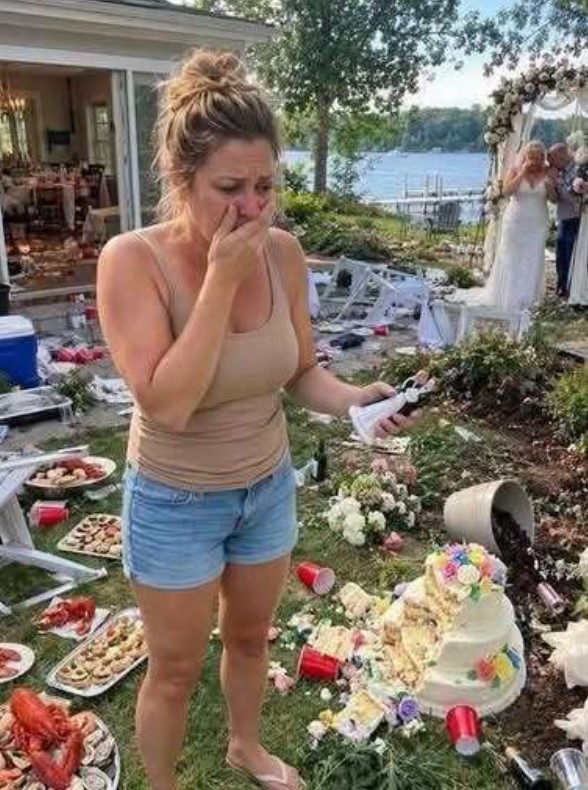
The damage looked even worse in daylight.
Grandma’s roses were gone.
The flower beds she had spent years caring for were nothing but torn soil.
There were footprints everywhere.
Someone had apparently driven a vehicle over part of the lawn.
One of the wooden garden benches was broken.
A champagne bottle was still lying underneath the porch.
I picked it up.
Then I noticed something strange.
There was a name written on the label.
Not Kelsey’s.
Someone else’s.
I found another bottle.
A different name.
Then another.
Different name again.
That was strange.
I’d assumed the destruction was simply the result of a careless wedding party.
Now I wasn’t so sure.
I began taking photographs of everything.
The damaged cabinets.
The ruined lawn.
The broken furniture.
The destroyed flower beds.
I wanted proof of exactly what had happened.
Then, beneath the kitchen table, I noticed a small envelope.
It wasn’t mine.
There was no name on it.
Only one sentence written across the front:
For the owner of the lake house.
My heart began beating faster.
I opened it.
Inside was a photograph.
I stared at it.
It showed Kelsey standing in the backyard.
But she wasn’t alone.
Several people were gathered around her.
Behind them stood a large white tent.
I looked at the date.
It had been taken on the night of the wedding.
But according to Kelsey, the tent had been rented by the caterer and removed before midnight.
So why was it still there?
And who had taken the photograph?
I turned it over.
There was another handwritten message.
You need to know what really happened that night.
I stood completely still.
Suddenly, the destruction didn’t feel random anymore.
Then I heard a car approaching the driveway.
Kelsey.
I quickly put the photograph back inside the envelope.
A few moments later, she stepped out of her car.
She looked nothing like the confident bride I’d seen before the wedding.
Her makeup was gone.
Her hair was messy.
Her eyes were swollen from crying.
She slowly walked toward me.
“You said there was something I needed to see.”
“There is.”
She looked at the destroyed garden.
For once, she didn’t make a joke.
She didn’t complain.
She didn’t tell me it wasn’t a big deal.
She simply stared.
“I’m sorry,” she whispered.
I looked at her.
“Are you?”
She nodded.
Then she surprised me.
She walked over to the flower bed.
She crouched down and touched the torn soil.
“I didn’t know.”
“You didn’t know what?”
“How much this place meant to you.”
I shook my head.
“That isn’t true.”
She looked up.
“You knew.”
Her eyes dropped.
“I did.”
That admission hurt more than I expected.
Because it meant she hadn’t been careless because she didn’t understand.
She had been careless because, at the time, she simply didn’t care.
I pulled the envelope from my pocket.
“What is this?”
She looked at it.
“I don’t know.”
“I found it inside.”
She opened it.
The instant she saw the photograph, all the color drained from her face.
“What?”
“Who are these people?”
She stared at the photograph.
“I don’t know.”
“Look carefully.”
She did.
Then she suddenly pointed toward one person.
“Wait.”
“What?”
“I know him.”
“Who?”
She swallowed.
“That’s my wedding planner.”
I looked at the photograph again.
“And the man beside him?”
Kelsey shook her head.
“I don’t know.”
I turned the photograph over.
She read the message.
Her face became pale.
“Someone was here that night.”
“Apparently.”
“But everyone was supposed to leave after the wedding.”
“Apparently.”
She looked at me.
“Why would someone leave this for you?”
“I don’t know.”
Then I noticed something else.
The mysterious man in the photograph was holding something.
A small metal key.
I recognized it immediately.
It was the key to Grandma’s old storage room.
The room I’d kept locked for years.
The room nobody was supposed to enter.
I looked at Kelsey.
She looked back at me.
Neither of us spoke.
Then we heard something from inside the house.
A faint metallic click.
We both turned toward the front door.
It had just moved.
There was no wind.
Kelsey grabbed my arm.
“Did you hear that?”
I nodded.
Slowly, we walked toward the house.
As I reached for the door handle, I realized something terrifying.
The door was locked.
From the inside.
Someone was still in the house.
I looked at Kelsey.
“Stay behind me.”
She nodded.
I turned the handle.
The door opened.
Nothing.
The living room was empty.
The curtains moved gently in the morning breeze.
For a moment, neither of us moved.
“Maybe the wind opened it,” Kelsey whispered.
I shook my head.
“The door was locked.”
We stepped inside.
Nothing appeared disturbed.
The furniture was still where it belonged.
The photographs on the walls were untouched.
Then I noticed something.
The hallway door leading toward the storage room was open.
My stomach tightened.
That door had been locked for years.
I walked toward it.
Kelsey followed.
“What’s in there?”
“Things my grandmother left behind.”
“Why was it locked?”
“Because Grandma asked me never to open it unless I was ready.”
“Ready for what?”
“I never knew.”
I reached the storage-room door.
There was a fresh scratch around the lock.
Someone had forced it open.
I pushed the door.
It creaked.
Inside were old boxes, photographs, furniture covered with white sheets, and several wooden trunks.
But one trunk was open.
Something was missing.
I knew immediately what it was.
Grandma’s old leather folder.
The one containing the original documents for the property.
I turned around.
“Kelsey.”
“What?”
“Did anyone know about this room?”
She shook her head.
“No.”
“Think carefully.”
She hesitated.
Then she whispered, “My wedding planner knew you owned the house.”
“That isn’t what I asked.”
She looked frightened.
Then she admitted, “I might have told him there were old things stored here.”
I closed my eyes.
“Why?”
“He asked if the house had any interesting history. He wanted the wedding to feel… special.”
I stared at her.
“Did you give him permission to enter?”
“No!”
Her voice cracked.
“I swear I didn’t.”
Then we heard a car door slam outside.
Kelsey froze.
We looked at each other.
I moved quickly toward the window.
A black SUV was parked near the driveway.
The same man from the photograph stepped out.
Kelsey gasped.
“That’s him.”
“Who?”
“The man beside my wedding planner.”
He started walking toward the house.
I locked the front door.
Kelsey whispered, “Call the police.”
“I already did.”
Her eyes widened.
“You did?”
“While you were looking through the storage room.”
For the first time that morning, I saw relief on her face.
We waited.
A few minutes later, police arrived.
The man tried to leave.
He didn’t get far.
And that’s when the truth finally began to come out.
His name was Daniel.
He had worked with Kelsey’s wedding planner.
The wedding planner had convinced Kelsey that the lake house would be the perfect emergency venue.
But there was something Kelsey hadn’t known.
Daniel had been interested in the property long before the wedding.
He had discovered that the lake house sat on valuable waterfront land.
He believed I might eventually sell it.
The wedding had given him an opportunity.
While everyone was celebrating, Daniel entered the locked storage room looking for the property documents.
The destruction outside wasn’t entirely accidental either.
Tables had been dragged across the lawn to make room for the tent.
Flowers had been ripped from Grandma’s garden because the planner wanted natural decorations.
Furniture had been moved.
Doors had been scratched.
And when guests spilled drinks or broke things, nobody bothered to clean up.
Everyone simply assumed I’d handle it later.
But Daniel had used the chaos to search through Grandma’s belongings.
He had photographed the property documents and planned to use the information to pressure me into selling.
I looked at Kelsey.
She looked devastated.
“I didn’t know,” she whispered.
“I know.”
For the first time, I believed her.
Not because she deserved immediate forgiveness.
But because I could see the truth on her face.
She had been selfish.
Entitled.
Careless.
But she hadn’t known about the larger scheme.
She looked at the ruined garden.
Then at me.
“I ruined everything.”
I didn’t answer.
She began crying.
“I thought because you were family, you would forgive me.”
I looked toward Grandma’s garden.
“That’s exactly what you thought.”
She wiped her eyes.
“And I was wrong.”
“Yes.”
She nodded.
“I’ll pay for everything.”
“Everything?”
“The garden. The lawn. The repairs. All of it.”
I looked at her.
“You can’t replace Grandma’s flowers.”
“I know.”
“Some of those plants were older than you.”
“I know.”
Her voice broke.
“But I’ll do everything I can.”
I didn’t forgive her that day.
And I didn’t need to.
Some things require time.
But I accepted her apology.
And I made her keep her promise.
Over the next several months, Kelsey paid for the restoration.
She came to the lake house every weekend.
She replanted the garden.
She repaired the damaged furniture.
She helped restore the lawn.
She even found a specialist who could reproduce some of Grandma’s handmade cushions from old photographs.
And something unexpected happened.
Kelsey began to understand why the house mattered so much to me.
One afternoon, while we were planting roses, she looked at me.
“I finally understand.”
“Understand what?”
“Why you fought so hard for this place.”
I smiled faintly.
“Grandma left me more than a house.”
Kelsey nodded.
“She left you memories.”
“Exactly.”
She looked at the garden.
Then she said quietly:
“I wish I had understood that before my wedding.”
“So do I.”
A few weeks later, I received another box.
This time, it was from Kelsey.
Inside was a small wooden frame.
There was a photograph of Grandma’s garden before the wedding.
Underneath it was a handwritten note:
I can’t undo what I did. But I promise I’ll never treat something precious to someone else like it means nothing.
I stared at those words for a long time.
Then I smiled.
Not because everything was forgotten.
It wasn’t.
But because sometimes the greatest lesson isn’t making someone suffer.
Sometimes it’s making someone finally understand what they almost destroyed.
As for the “special wedding gift” I’d sent Kelsey?
It wasn’t the property documents.
It wasn’t the photographs.
It wasn’t even the restoration bill.
Those were consequences.
The real gift was the letter I’d placed at the bottom of the box.
It was a copy of something Grandma had written years before she died.
One sentence was underlined:
“A person who is given something precious should never confuse kindness with permission.”
Kelsey kept that letter.
Later, she told me she carried it in her wallet.
And whenever she was tempted to think the world owed her something, she read it.
The lake house eventually looked beautiful again.
The roses grew back.
The lawn recovered.
Grandma’s kitchen once again smelled like pancakes on Sunday mornings.
And every spring, when the flowers bloomed, I remembered the day I thought my grandmother’s garden was gone forever.
But I also remembered something else.
The wedding that was supposed to be a celebration had revealed a much bigger truth.
It showed me what happened when people mistook kindness for weakness.
It taught Kelsey a lesson she would never forget.
And it reminded me of something Grandma had understood all along:
You can be generous without allowing people to walk over you.
I never regretted helping Kelsey.
I only regretted that she had to lose something before she learned how to value it.
And that was the wedding gift she would never forget.