The door moved.
For seven months, that door had been the boundary of my world.
I knew every scratch in the wood. I knew the crooked nail near the frame and the little crack at the bottom. I knew how the wood swelled whenever the weather became damp.
And now it was open.
My first instinct was to run.
My second was stronger.
Don’t.
I had heard the house go quiet before. More than once, I had convinced myself they had finally left me alone, only to discover another locked door, another camera, another person waiting downstairs.
They enjoyed making me believe I was almost free.
So I stayed still.
I pushed the smuggled phone deeper against my body and stepped into the hallway.
The floor creaked beneath me.
I froze.
Nothing.
I took another step.
Then another.
For the first time, I looked back at the attic from outside it.
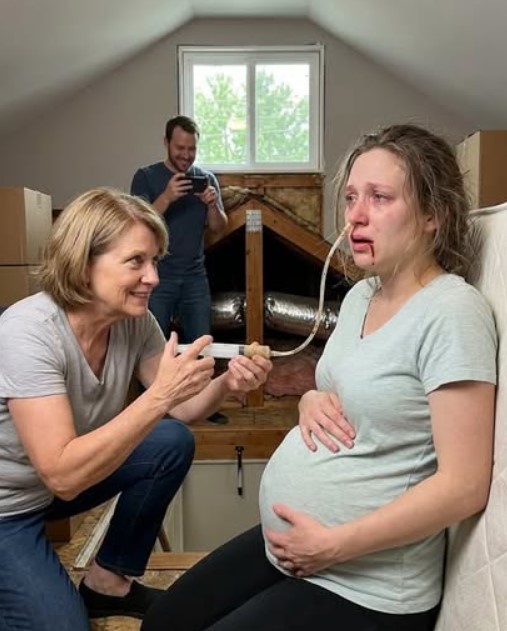
The filthy mattress.
The stained blanket.
The bucket they expected me to use.
The restraints hanging from the bedframe.
Seven months of my life had been reduced to a handful of objects.
I wanted to cry.
Instead, I clenched my teeth.
Not yet.
I wasn’t going to give them my tears now.
I reached the top of the stairs.
The staircase disappeared into darkness below.
Then I heard the television.
My stomach dropped.
My husband was home.
I had thought he had gone.
I had been wrong.
A man’s voice came from the television, followed by canned laughter.
Then I heard my husband’s voice.
Not from the television.
From the living room.
“Did you check upstairs?”
My entire body went cold.
My mother-in-law answered.
“I thought you did.”
“I told you to check.”
Their voices were calm.
Too calm.
I backed away from the stairs.
The attic door was still open behind me.
I could go back.
I could pretend nothing had happened.
But the phone against my skin suddenly felt impossibly heavy.
The recordings.
Their voices.
The dates.
Everything I had risked.
If they caught me now, they wouldn’t just take the phone.
They would know.
They would know I had been watching them.
They would know I had been waiting.
And people who believed they owned another person’s fear did not react well when that person stopped being afraid.
Then my husband appeared at the bottom of the stairs.
He didn’t come up immediately.
He simply stood there.
Waiting.
Then he called my name.
Softly.
Almost affectionately.
That frightened me more than shouting would have.
“Are you awake?”
I didn’t answer.
He took one step upward.
The stair groaned.
I looked around desperately.
There was nowhere to hide.
Then I noticed something I had never seen before.
A narrow door beneath the sloping roof.
It was almost completely hidden behind an old wooden trunk.
I had never been allowed near that side of the attic.
My husband took another step.
I moved toward the little door.
Another step.
I grabbed the handle.
Locked.
Behind me, the staircase creaked again.
His hand appeared around the banister.
He was coming up.
I pulled the handle harder.
Nothing.
Then I remembered the tiny metal edge of the old SIM tool I kept inside my phone case.
My hands shook as I pulled it out.
The lock was old.
Cheap.
The kind designed to keep a frightened person from trying.
Not the kind designed to withstand someone desperate.
I worked the little metal piece into the mechanism.
Once.
Twice.
Nothing.
My husband was almost at the top.
“Why is the attic door open?”
I stopped breathing.
Then the lock clicked.
I pushed.
The little door swung inward.
A wave of cold air touched my face.
I slipped through and pulled it nearly closed behind me.
Darkness swallowed me.
I heard my husband step onto the attic floor.
He stopped.
“Where are you?”
I pressed both hands over my mouth.
My breathing sounded impossibly loud.
I could hear him walking.
One step.
Two.
Three.
Then silence.
He was standing beside the mattress.
I knew because the floorboard beneath him made that familiar cracking sound.
He said nothing for several seconds.
Then he laughed.
A quiet little laugh.
“You really thought you could leave?”
My eyes filled with tears.
But I stayed silent.
He moved around the room.
The mattress squeaked.
The bucket scraped across the floor.
Then his footsteps stopped directly beside the hidden door.
My blood turned cold.
He knew.
His fingers touched the handle.
I closed my eyes.
The door moved half an inch.
Then my mother-in-law shouted from downstairs.
“Come down here!”
He let go.
“What?”
“I said come down!”
“What happened?”
“I found something.”
His footsteps moved away.
The door closed.
I waited.
Five seconds.
Ten.
Twenty.
Then their voices became muffled beneath me.
I didn’t understand what she had found.
But whatever it was, it had frightened her.
I turned slowly inside the cramped space.
There was barely enough room to sit.
It smelled of damp wood and old paper.
My fingers brushed against something.
A box.
I pulled it toward me.
Dust covered the lid.
There was no label.
I opened it.
Inside were envelopes.
Dozens of them.
Some were yellow with age.
Some were recent.
I picked up the first one.
My name was written across the front.
I nearly dropped it.
My name.
Written in handwriting I recognized immediately.
My husband’s.
My hands began to shake.
I opened the envelope.
There was a photograph inside.
It took several seconds for my mind to understand what I was seeing.
It was me.
But not the broken woman I had become.
This photograph had been taken months earlier.
Before the attic.
Before the pregnancy became unbearable.
Before I understood what they were capable of.
I was standing in our bedroom.
Smiling.
My husband stood behind me with his arm around my waist.
We looked like a normal married couple.
Happy.
Safe.
I turned the photograph over.
There was a date written on the back.
Then another line.
A sentence.
My husband had written it.
I read it twice.
Then a third time.
My hands became numb.
The date was from before I had even known I was pregnant.
And the sentence suggested that what was happening to me had been planned long before I ever entered that attic.
I heard footsteps downstairs.
I shoved the photograph into my clothing.
Then I looked at the other envelopes.
Every one had a date.
Every one had my name.
Suddenly I understood.
The attic wasn’t only where they had kept me.
It was where they had kept records.
Records of me.
Records of what they had done.
Perhaps even records of what they planned to do next.
I reached for another envelope.
Then another.
My fingers stopped on one with a red mark across the corner.
Unlike the others, it had no date.
Only two words.
AFTER DELIVERY.
My heart seemed to stop.
I stared at those words until they blurred.
Then I heard my mother-in-law downstairs.
“Where did you put the key?”
My husband answered.
“I don’t know.”
“The spare.”
“I said I don’t know.”
“You had it.”
Silence.
Then she whispered something I couldn’t hear.
My husband answered.
“No. We can’t do that yet.”
I leaned closer to the little gap in the door.
My mother-in-law spoke again.
“If she knows what’s in that box, we’re finished.”
My husband didn’t answer.
Then he said something that made every part of me go cold.
“She doesn’t know.”
A pause.
“She doesn’t even know whose baby it is.”
I stopped breathing.
My hand went instinctively to my stomach.
For seven months, I had believed the worst thing they could do was hurt me.
Now I understood.
The pain had never been the whole story.
The humiliation had never been the whole story.
The recordings had never been the whole story.
There was something about my pregnancy they had never told me.
Something they had hidden even from me.
I held the envelope marked AFTER DELIVERY against my chest.
Then I heard the stairs.
Someone was coming back up.
Not slowly this time.
Fast.
I looked toward the door.
My husband was running.
I shoved the envelope into my clothes and searched the darkness for another way out.
There was none.
The attic door opened.
Light spilled across the floor.
I pressed myself against the wall and held my breath.
My husband stepped inside.
He looked directly at the mattress.
Then at the open attic door.
His face changed.
He knew.
He walked toward the place where I had been sleeping.
He bent down.
And picked up the empty case from the hidden phone.
For several seconds, he simply stared at it.
Then he smiled.
Not the smile he used for his recordings.
Something colder.
Something real.
“She’s been recording us.”
Behind the hidden door, I closed my eyes.
Because in that moment, I knew my escape had already begun.
But I also knew something much worse.
They were no longer trying to hide what they were doing.
Now they were going to come looking for me.
The Door They Couldn’t Open
My husband stood in the middle of the attic holding the empty phone case.
For a moment, neither of us moved.
Then he smiled.
It was the same smile I had seen hundreds of times through the tiny opening of the camera.
The smile he wore when he thought my suffering belonged to him.
But this time, I wasn’t looking at the camera.
I was looking at him.
And for the first time, he looked afraid.
He searched the attic.
Under the mattress.
Inside the bucket.
Behind the old trunk.
His movements became more frantic with every second.
My mother-in-law appeared behind him.
“Did you find it?”
“No.”
“You said you knew where she kept it.”
“I thought I did.”
She stared at him.
Then her eyes moved slowly around the attic.
“She’s still here.”
My heart slammed against my ribs.
My husband turned toward the hidden door.
I stepped backward.
There was nowhere else to go.
His hand reached for the handle.
I looked down at the envelope hidden against my body.
AFTER DELIVERY.
Whatever was inside that envelope had been important enough for them to hide.
Important enough to frighten them.
I needed to know.
But first I needed to survive.
The handle began to turn.
Then a sound came from downstairs.
A car door slammed.
My husband froze.
My mother-in-law looked toward the stairs.
“Who is that?”
Neither of them answered.
A second car door slammed.
Then voices.
Several voices.
My husband’s face lost its color.
“What did you do?” he whispered.
My mother-in-law looked at him.
“What did you do?”
He shook his head.
“I didn’t call anyone.”
The voices became louder.
Someone entered the house.
Then came three sharp knocks on the front door.
My mother-in-law whispered:
“Don’t move.”
My husband stepped away from the hidden door.
They hurried downstairs.
I waited.
Five seconds.
Ten.
Then I heard a man’s voice.
“Police. Open the door.”
My entire body went weak.
Police.
For a few seconds, I couldn’t believe it.
I had imagined this moment so many times.
But in every version, I had been stronger.
Standing.
Speaking.
Explaining.
Instead, I was curled inside a dark storage space, seven months pregnant, trembling so badly I could barely think.
Then I remembered the recordings.
The phone was still with me.
They had searched for the empty case.
They hadn’t found the phone.
I pulled it out.
The screen showed the recordings.
Seven months.
Hundreds of files.
Dates.
Voices.
Their laughter.
Their instructions.
Everything I had secretly preserved.
I pushed open the little door.
Then I heard my mother-in-law scream.
Not at me.
At the police.
“You have no right to be here!”
A man’s voice answered calmly.
“We have a warrant.”
My husband shouted something.
Furniture moved.
I crawled out of the hidden room.
My legs nearly collapsed beneath me.
I held the wall and slowly made my way toward the stairs.
At the top, I stopped.
I could see the living room below.
Two officers stood near my husband.
Another woman in a dark jacket was speaking to my mother-in-law.
My husband looked up.
He saw me.
Everything stopped.
His expression changed completely.
There was no smile now.
No confidence.
No camera.
Only fear.
“Please,” he said.
It was the first time in seven months that he had said that word to me.
Please.
I almost laughed.
Instead, I held up the phone.
“I have everything.”
The room became silent.
One of the officers looked at me.
“Are you hurt?”
I couldn’t answer.
The question broke something inside me.
Because nobody had asked me that in seven months.
Not once.
My husband had asked whether the camera was recording.
His mother had asked whether I was cooperating.
But nobody had asked whether I was hurt.
I started crying.
Not quietly.
Not carefully.
I cried until my entire body shook.
The officer came toward me slowly.
“You’re safe now.”
I wanted to believe him.
But safety felt like a language I had forgotten.
They took me downstairs.
An ambulance was waiting outside.
The night air touched my face.
It was cold.
Clean.
Real.
I looked back at the house.
Seven months earlier, I had entered it believing it was my home.
Now I understood that a house could have walls without ever being a home.
Before they took me away, one of the investigators asked about the phone.
I handed it to her.
“There are recordings,” I whispered.
“How many?”
“I don’t know.”
She looked at the screen.
Her expression changed.
“Did you record all of this yourself?”
I nodded.
She looked at me for a long moment.
“You may have saved your own life.”
I looked toward the house.
“No,” I said quietly.
“I think I saved the truth.”
The Envelope Marked “After Delivery”
The next morning, after doctors examined me, an investigator returned.
She placed a plastic evidence bag on the table.
Inside was the envelope I had found in the hidden room.
The red mark was still visible.
AFTER DELIVERY.
“You should know,” she said, “we found several other documents.”
My throat tightened.
“What documents?”
“Medical records. Messages. Financial transfers.”
She paused.
“And a private agreement between your husband and another person.”
I stared at her.
“What person?”
She didn’t answer immediately.
Instead, she slid a photocopy across the table.
There was a name at the top.
A name I recognized.
My husband’s biological father.
A man who had supposedly died years before I met my husband.
But according to the document, he was alive.
And he had been sending money to my mother-in-law for months.
I looked at the investigator.
“What does this have to do with my baby?”
She took a breath.
“We’re still investigating.”
Those four words frightened me more than any answer could have.
Still investigating.
There were pieces missing.
Then she showed me one final document.
A handwritten note.
My mother-in-law had written it.
The date was from before my pregnancy.
It said that once the baby was born, I was to be told that the child had died.
My hands went cold.
“What?”
The investigator nodded.
“That appears to have been the plan.”
I stared at the paper.
All the humiliation.
All the secrecy.
All the cameras.
The drugs.
The recordings.
They hadn’t simply wanted to hurt me.
They had been preparing for something after the birth.
Something involving my child.
I pressed both hands over my stomach.
For the first time, I understood why my mother-in-law had always watched me so carefully.
Why she had counted everything.
Why she became furious whenever I mentioned seeing a doctor alone.
Why my husband insisted on controlling every appointment.
The baby wasn’t just part of their cruelty.
The baby was part of their plan.
Months Later
The investigation lasted for months.
There were interviews.
Court hearings.
Medical examinations.
Questions I hated answering.
Questions I had to answer anyway.
There were days when I wished I had never found the phone.
There were nights when every sound outside my window made me afraid.
But I kept going.
Because the recordings spoke when I couldn’t.
My husband’s voice.
His mother’s voice.
Their laughter.
Their instructions.
Their arguments.
Their own words became the evidence they could no longer escape.
The private humiliation channel disappeared.
The recordings were recovered.
The people who had watched them were identified.
The truth my husband had tried to turn into entertainment became evidence in a courtroom.
Eventually, there was a verdict.
I didn’t celebrate.
There was nothing to celebrate.
Seven months of my life were still gone.
My body still carried memories my mind couldn’t erase.
But when the judge read the decision, I felt something I hadn’t felt in a very long time.
Finality.
My husband looked at me one last time.
He seemed smaller than I remembered.
He tried to speak.
I didn’t let him.
I simply stood.
I didn’t owe him forgiveness.
I didn’t owe his mother forgiveness.
I didn’t owe anyone an explanation for surviving.
The Last Recording
Months later, I listened to the final recording alone.
It was the recording from the night I escaped.
At the beginning, there was only the sound of my breathing.
Then my husband’s voice.
Then his mother’s.
Then the moment they realized the phone was missing.
I listened until the recording reached the end.
There was a long silence.
Then my own voice.
Barely audible.
“I’m still here.”
I stopped the recording.
For a long time, I sat beside the window.
My child was sleeping in the next room.
Safe.
Warm.
Free.
I looked at the sunlight coming through the curtains.
I thought about that attic.
The hot dust.
The sour smell.
The footsteps on the stairs.
The door I had been afraid to touch.
For seven months, I had believed that surviving meant simply making it through another day.
I was wrong.
Survival was the first step.
After that came something harder.
Learning that what happened to me was not my fault.
Learning that silence did not make their cruelty less real.
Learning that I didn’t have to become the person they had tried to turn me into.
I opened the phone one final time.
The recordings were still there.
I didn’t delete them.
I never would.
Not because I wanted to remember.
But because some truths deserve to survive, even when the people who created them desperately want them buried.
I looked toward my sleeping child.
Then I whispered the words I had been unable to say in that attic.
“I got us out.”
And this time, nobody laughed.
This time, nobody was watching.
This time, the door was open.
And I walked through it.