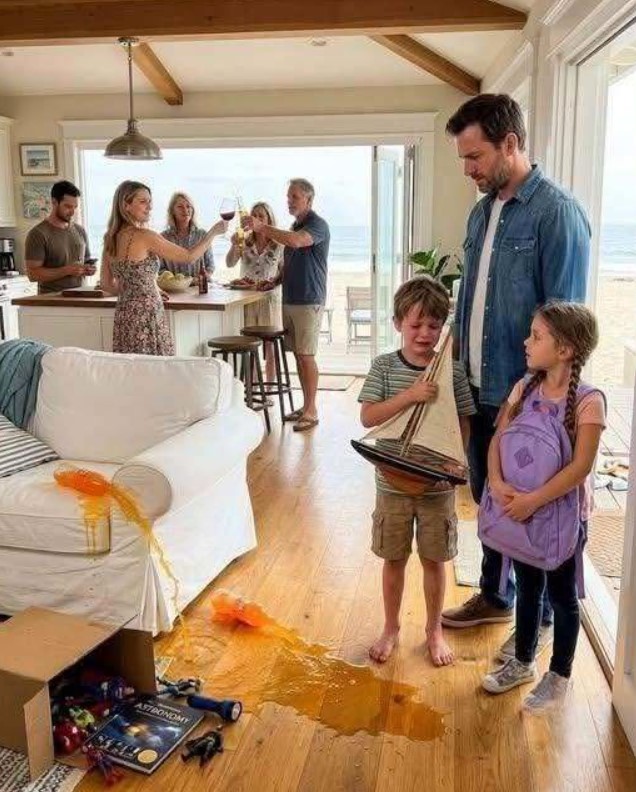
Jenna’s wineglass stopped halfway to her mouth.
She stared at Claire as though the realtor had just spoken another language.
Then she looked at me.
“You listed the house?”
I nodded.
“You actually listed the house?”
“Yes.”
My mother put her glass down so hard that wine splashed over the rim.
“Daryl, what on earth are you doing?”
I turned toward her.
“Protecting my children.”
My father gave a short laugh.
“Don’t be ridiculous. You’re angry about a broken toy.”
I looked at Eli.
He was still standing near the sliding doors, holding the broken sailboat against his chest.
“It isn’t about the boat.”
Nobody answered.
I walked over to my son and crouched beside him.
“Eli, why don’t you and Zoe go outside for a few minutes?”
He looked uncertainly at me.
“Are we still staying here?”
I looked at him.
“No, buddy.”
His shoulders dropped.
“But we’re going somewhere you’ll never have to wonder if you’re wanted.”
He nodded quietly.
Zoe slipped her hand into his.
The two of them walked toward the porch.
Behind me, Jenna finally found her voice.
“You can’t sell this place while we’re staying here.”
I turned around.
“I’m not selling it because you’re staying here.”
I paused.
“I’m selling it because I bought it.”
Claire remained beside the doorway, calm and professional.
Jenna looked at her.
“You’re really going to show this house with us inside?”
Claire glanced at me.
“Would you like me to wait outside while the family gathers their belongings?”
I shook my head.
“No. The showing is happening as scheduled.”
Mark finally put his phone away.
“This is insane.”
“No,” I said. “What was insane was watching my children get pushed out of bedrooms in their own house while everyone toasted to ‘real family.’”
Jenna’s cheeks reddened.
“We were joking.”
“You changed the locks.”
“I asked about changing the locks.”
“You tried to take over the guest room.”
“Because the twins need space.”
“You told my children they couldn’t stay at their own beach house.”
She opened her mouth.
Nothing came out.
I continued.
“And then your sons destroyed Eli’s boat while everyone watched.”
My mother immediately interrupted.
“They’re children!”
“So is Eli.”
That silenced her.
My father rubbed his forehead.
“Daryl, let’s calm down.”
“I am calm.”
I looked around the room.
“You should be more worried about the people who aren’t.”
The first prospective buyer entered from the porch with Claire.
He glanced at the broken furniture, the luggage stacked along the hallway, and the sticky orange soda still shining on the floor.
“Is the property currently occupied?” he asked.
Claire smiled politely.
“It was temporarily occupied by family guests.”
Jenna stepped forward.
“We’re leaving.”
The buyer nodded.
“Of course.”
But his eyes remained on the floor.
I could see exactly what he was thinking.
He wasn’t seeing a luxurious summer cottage anymore.
He was seeing damage.
And responsibility.
Claire quietly pulled me aside.
“Do you want me to postpone the showing?”
“No.”
She nodded.
“Understood.”
Then she turned toward the buyers.
As they began walking through the cottage, Jenna followed me into the kitchen.
“You’re punishing me.”
“No.”
“You’re humiliating me.”
“No.”
“You know what Mom and Dad think about this family. You know how important this summer was.”
I looked at her.
“You’re right.”
She blinked.
“I do know.”
I pointed toward the doorway.
“And that’s exactly why I’m done pretending.”
Her expression softened for a second.
Then hardened again.
“You’d really sell the house over one argument?”
I shook my head.
“No, Jenna.”
I looked toward the broken sailboat sitting on the counter.
“This started long before today.”
She said nothing.
“You asked for one weekend.”
She looked away.
“Then you stayed longer.”
I continued.
“You brought your family here without asking. You stocked my kitchen with your things. You invited Mom and Dad for the summer. You tried to change my locks. You claimed rooms that belonged to my children.”
Jenna folded her arms.
“And you said nothing.”
“I was watching.”
That made her uncomfortable.
“Watching what?”
“Watching how far you thought you could go.”
Her eyes narrowed.
“And?”
“And now I know.”
From the living room came the sound of Claire explaining the property’s recent renovations.
My father approached us.
“Daryl, your mother is upset.”
“I know.”
“She thinks you’re destroying the family.”
I looked at him.
“My family is standing outside.”
He followed my gaze.
Eli was sitting on the porch steps beside Zoe.
The broken sailboat rested between them.
My father’s expression changed.
For the first time, he seemed to understand.
“You’re really doing this?”
“Yes.”
He sighed.
“You’ll regret it.”
“Maybe.”
I picked up the boat.
“But my son won’t.”
My mother appeared behind him.
She had tears in her eyes.
“I never meant for the children to feel unwanted.”
I looked at her.
“Then you should have stopped it.”
She looked down.
No argument came.
Jenna stood silently in the kitchen.
The same woman who had raised her wineglass and declared that summer was for “real family” was now surrounded by suitcases she would have to carry back through the front door.
Claire returned with the folder.
“Mr. Mercer, everything is ready.”
I nodded.
She handed me a document.
“The first offer has already come in.”
Jenna’s head snapped toward me.
“Already?”
I looked at the number.
It was higher than what I had paid.
Mark stepped closer.
“You’re actually going through with this.”
“Yes.”
“What happens to the house?”
“It goes to someone who understands that owning a place means taking responsibility for it.”
Jenna laughed bitterly.
“You’re unbelievable.”
I looked at her.
“No. I’m finally being clear.”
She picked up her wineglass.
For a second, I thought she might raise it again.
Instead, she set it down.
Then she walked toward the guest room.
She stopped at the doorway.
Eli’s clothes were still scattered across the floor where she had thrown them.
She looked at them.
Then at me.
“I’ll pack everything.”
“I know.”
She bent down.
For the first time that day, she picked up something that belonged to my son.
A small blue pajama shirt.
She folded it.
Then another piece.
My mother quietly began helping her.
My father carried the suitcases toward the front door.
Mark stood in the driveway making angry phone calls.
The twins were unusually quiet.
And Eli remained outside.
I sat beside him.
“Dad?”
“Yeah?”
“Are we going to have another beach house?”
I smiled.
“Maybe.”
He looked at the broken sailboat.
“Can we fix this one first?”
I took the boat from his hands.
“Absolutely.”
He smiled.
That was all I needed.
The cottage was sold three weeks later.
I never told my family how much I made from it.
I didn’t need to.
I used part of the money to buy a smaller place farther up the coast—one with fewer bedrooms, a little less space, and a view of the ocean that made Eli forget about the broken boat.
On the first night there, he sat on the porch with his astronomy book.
Zoe lay beside him with her purple backpack.
I repaired the sailboat at the kitchen table.
The mast wasn’t perfect.
Neither was the boat.
But when I handed it back to Eli, he smiled as if I had given him something brand new.
“Dad?”
“Yeah?”
“Is this our house?”
I looked at both of my children.
“Yes.”
He nodded.
“Good.”
Then he turned toward the ocean.
And I realized something I should have understood much earlier.
A home isn’t defined by its price.
It isn’t defined by its size, its view, or how many people can fit around the dinner table.
A home is the place where your children know, without having to ask, you belong here.
My sister had wanted the beach house.
My parents had wanted the family to stay together.
But my children needed something more important than either of those things.
They needed to know that their father would stand up for them when everyone else chose to look away.
And that was worth far more than the $940,000 I had once paid for a house by the sea.