I had walked away from my father years earlier after discovering what happened when someone refused to pay.
I thought leaving was the only way to protect myself and Eli.
I was wrong.
My father had never stopped keeping records.
He had never stopped watching.
And now I understood that the black ledger my son had discovered in the basement was connected to much more than old family business.
It was connected to me.
Eleven years earlier, when I was twenty-four, I had helped my father design the system that organized those records.
At the time, I was desperate to prove that I belonged in the family business.
I created codes.
I created categories.
I helped organize dates, payments, addresses, and initials.
I didn’t understand what the system would eventually become.
And I certainly didn’t understand that my father would keep using it long after I walked away.
The worst part was that my name was still at the top of the first page.
Not as a victim.
As someone who had once helped build the system.
Now my son had discovered it.
And my father was trying to use my past against me.
The Shoe Was Still Holding the Door
At 6:31 that evening, I returned to my father’s house.
I didn’t go through the front door.
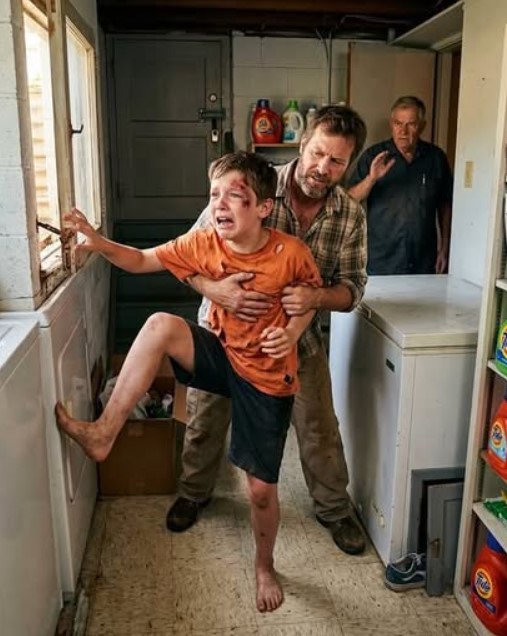
I entered through the laundry-room window Eli had broken while escaping.
The house was strangely quiet.
There was a faint smell of burnt coffee in the kitchen, and a grocery flyer had been folded beneath the sugar bowl as if someone had been sitting there only minutes earlier.
I didn’t turn on the lights.
I went straight downstairs.
I knew what I was looking for.
Behind the freezer was the narrow panel Eli had described.
And beneath it was my son’s missing shoe.
The torn heel was wedged underneath the hidden door, preventing the lock from catching.
For a second, I simply stared at it.
That small, dirty shoe had probably been the only thing standing between my father and the evidence he was trying to hide.
Eli had understood something important in that moment.
He hadn’t been thinking about evidence.
He had been thinking about making sure the door couldn’t close behind him.
I carefully photographed the shoe exactly where I found it.
Then I opened the panel.
The Room Behind the Freezer
The space was narrow and dark.
Along the walls were black ledgers.
Dozens of them.
Maybe more.
Some looked old enough to have been there for years.
Others appeared much newer.
The newest ledger was still open.
And there was my name.
I photographed every page I could without disturbing anything.
Dates.
Payments.
Addresses.
Initials.
Names that meant nothing to me.
Names that suddenly seemed very important.
Then my phone rang.
My father.
I answered.
He didn’t ask whether Eli was alive.
He didn’t ask whether my son was safe.
He went straight to the point.
“Bring me the book,” he said.
Then he offered me something that made my stomach tighten.
He said he could make sure Eli wasn’t placed in foster care.
It was the kind of sentence that sounded like concern if you didn’t know the circumstances.
But I knew my father.
He wasn’t offering help.
He was offering a trade.
The ledger for my son’s safety.
I didn’t accept.
Instead, I photographed more pages.
Then I uploaded the photographs somewhere my father couldn’t reach.
I wanted copies outside that house.
Copies that couldn’t simply disappear.
The Oldest Ledger
Then I opened the oldest ledger I could find.
That’s when I discovered something I had spent eleven years trying not to remember.
An entry connected my father to the crime that had destroyed my life.
It was there in black and white.
But seeing it wasn’t enough.
If I wanted anyone to understand what the record meant, I would also have to admit something about myself.
I had helped build the system.
I had created part of the structure my father later used.
I couldn’t erase that simply because I no longer wanted anything to do with him.
So I did something I had avoided for years.
I wrote the truth.
I named my own role.
I explained what I had known, what I hadn’t known, and what I had eventually discovered.
Then I attached the statement to an email addressed to the state investigator I had lied to years earlier.
My finger hovered over the screen.
For a moment, I thought about deleting it.
Then I remembered Eli lying in that hospital bed.
I pressed send.
At almost the same moment, I heard a key turning in the kitchen door.
My father had come back.
The Police Had Already Arrived
At 6:03 p.m., while I was still at the house, Officer Ruiz returned to Eli’s hospital room.
She told me that officers had reached my father’s property before he did.
The shoe was still under the hidden door.
The broken laundry-room window was still there.
And the blood Eli had left behind had been documented.
The police had not immediately touched everything behind the freezer.
They had secured the area and were obtaining the proper authority to search further.
That distinction mattered.
I didn’t want anyone rushing to conclusions simply because the story sounded unbelievable.
Eli had given them information.
His injuries supported his account.
The broken window supported the escape.
The shoe supported his description of the hidden door.
And the recorded calls showed that my father had been trying to control what happened afterward.
The evidence had to speak for itself.
My Father Tried Another Approach
While the officers worked, my father changed his strategy.
He stopped making direct threats.
Instead, his messages became almost gentle.
“Eli needs stability tonight.”
I saved it.
Then another arrived.
“You don’t have to turn one frightening misunderstanding into a permanent family break.”
I saved that too.
Then:
“Your brother is scared. I’m scared. You’re scared. Let people who love you help.”
I sent all three messages to the social worker.
I didn’t answer my father.
I didn’t want another argument.
I wanted everything documented.
Because I had finally understood something.
My father had spent years controlling conversations by making sure there were no witnesses.
Now there were records.
Phone calls.
Messages.
Medical photographs.
Police reports.
Hospital documentation.
And my son’s statement.
He couldn’t simply change the story anymore.
Eli Was Still Thinking About His Shoe
Back at the hospital, Eli woke again.
He was tired, bruised, and still recovering from the concussion and cracked ribs.
But one of the first things he asked was whether anyone had moved his shoe.
I told him no.
His shoulders relaxed.
“Good,” he said.
That one word stayed with me.
He wasn’t thinking about revenge.
He wasn’t thinking about the ledger.
He was thinking about whether the small thing he had done to protect himself was still there.
I told him the shoe was safe.
He closed his eyes again.
For a few minutes, I just sat beside him.
I had spent years thinking I needed to protect Eli from my family’s influence.
Now I realized I also needed to protect him from the stories my father had been creating about me.
My Brother Finally Broke
Later that night, my brother sent me a message.
“Dad says I did all of it.”
I read it twice.
Then another message arrived.
“He says I lost control and he tried to stop me.”
I didn’t respond.
Instead, I forwarded the messages to Officer Ruiz.
My brother had grabbed Eli.
My brother had helped keep him downstairs.
Whatever my father was saying now didn’t erase that.
But the messages revealed something else.
For the first time, my father and brother were no longer telling exactly the same story.
That mattered.
My brother called.
I didn’t answer.
Then he called again.
Eventually, I sent one message.
“Tell the truth to the police, not me.”
Nothing more.
The Hidden Room Was Finally Searched
A little before nine that evening, Officer Ruiz received confirmation that the search had gone farther into the hidden space.
The officers photographed everything before moving it.
They removed the freezer shelves.
They opened the narrow door.
And they found the black ledger exactly where Eli had said it would be.
They also found ordinary objects inside the room.
A folding chair.
Plastic storage containers.
An extension cord.
Old magazines with the mailing labels removed.
There was nothing theatrical about the room.
That almost made it more disturbing.
It looked like a place someone had been using quietly for a long time.
And the ledger contained exactly what Eli had described.
Dates.
Payments.
Addresses.
Initials.
My name appeared on the first page.
The entries began about sixteen months earlier.
That was the same month I entered the trauma program.
When I heard that, I felt something inside me go cold.
The addresses included places connected to my life.
My apartment.
Eli’s school.
The outpatient building.
My former workplace.
Two parking lots where custody exchanges with my ex had taken place.
Next to those addresses were amounts of cash.
And my brother’s initials appeared beside some of them.
I wanted to understand what it meant.
But I refused to guess.
The evidence needed to be examined properly.
My Father’s Story Was Starting to Collapse
My father had reported me to authorities before the ambulance had even reached my house.
That detail became extremely important.
His report claimed I was experiencing a mental health crisis.
He claimed I might arrive and remove Eli without permission.
And he identified my brother as a safe family caregiver.
But Eli had still been inside my father’s house when the report was made.
My father had already been creating his explanation before there was an escaped child to explain.
That didn’t automatically prove every allegation.
But it changed the timeline.
And timelines matter.
Especially when people are trying to convince authorities that their version of events happened differently.
My Brother Admitted More Than He Meant To
The next morning, my brother called.
I asked him one question.
“Did you know Dad had named you as Eli’s caregiver before Eli got hurt?”
He didn’t answer immediately.
Then he asked whether Eli was awake.
I didn’t respond.
Finally, my brother said:
“It wasn’t supposed to be like this.”
I waited.
He explained that our father had asked him to keep notes about me.
Where I went.
Whether I was late.
Whether Eli stayed overnight.
Whether I missed work.
Whether I looked tired.
Whether I sounded angry.
He said the money my father gave him was for gas, meals, and the time he spent checking on me.
He called it helping.
I asked whether he had taken the money.
“Yes.”
Then I asked whether the most recent ledger entry was his.
He went silent.
That silence told me more than an explanation would have.
My brother had been participating for much longer than I realized.
He hadn’t necessarily agreed to everything that happened to Eli.
But he had helped build a version of me that my father could use if he ever wanted to take control.
That was enough.
I Had to Protect Eli, Not Win an Argument
By then, I had been awake for too long.
Eli had two cracked ribs.
He needed rest.
He needed medication.
He needed food.
He needed follow-up care.
He didn’t need his father sitting beside him turning the hospital room into a courtroom.
So when he asked whether we could go home, I asked the doctor what needed to happen first.
There was no dramatic answer.
He needed another neurological check.
We needed discharge instructions.
We needed to understand his medication schedule.
He needed rest and supervision.
And we needed a safe place to go.
I did every one of those things.
Because that was what being his father meant.
Not winning.
Not exposing my grandfather’s secrets.
Not proving that I had been right.
Getting my son home safely.
The Report That Changed Everything
Before we left, the social worker asked me to sit down again.
The county had finished comparing the hotline report with the police timeline.
My father’s call had come before the ambulance reached my house.
Before anyone could know exactly where Eli was.
His report claimed I might take Eli during a mental health crisis while my son was still inside my father’s property.
I asked the social worker to repeat the timing.
She did.
I didn’t need an interpretation.
The sequence spoke for itself.
My father’s explanation had started before there was an escaped child to explain.
That was enough for me to understand why he had been trying so desperately to control the narrative.
The Temporary Order
With the hospital documentation, Eli’s statement, police information, and the safety concerns already recorded, I was able to request a temporary no-contact order.
I included my father.
And I included my brother.
That second name hurt.
More than I expected.
My brother and I had grown up together.
We had shared the same house.
The same parents.
The same childhood.
But being brothers didn’t erase what he had done.
Later that afternoon, he called from another number.
He said he could tell everyone that Dad had made him do it.
I asked him whether that was actually true.
He said:
“You know what he’s like.”
I looked at Eli.
Then I told my brother that wasn’t my question.
He didn’t answer.
He said we were still brothers.
I told him yes.
We were.
But being brothers didn’t mean I had to lie for him.
Then I ended the call.
Nobody Got the Ending They Expected
The temporary order was granted while the other investigations continued.
There was no dramatic courtroom scene.
Nobody was sentenced that day.
Nobody lost a mansion.
Nobody was suddenly erased from the family.
My father and brother simply couldn’t contact Eli or come to our home while the order remained in effect.
For the moment, that was enough.
The police still had questions.
The ledger still needed to be examined.
The circumstances surrounding Eli’s injuries still needed to be investigated.
My father’s actions still needed to be reviewed.
And my brother had his own decisions to answer for.
I didn’t need to decide the outcome myself.
I just needed to keep my son safe while the people responsible for investigating everything did their jobs.
The Yellow Coupon
When Eli and I finally returned home, he stopped beside the mailbox.
The yellow grocery coupon was still caught on the bent flag.
It looked exactly as it had when I found him.
For some reason, seeing it again made everything feel real.
I reached up, pulled it loose, and threw it into the recycling bin without reading it.
Then we went inside.
Eli checked the back door himself.
I let him.
For the next several nights, he slept on the couch because climbing into his bed hurt his ribs.
I slept in a chair beside him.
Sometimes he woke up and asked whether the doors were still locked.
I didn’t tell him there was nothing to worry about.
I got up.
I checked the locks with him.
Then I came back and sat down.
He needed reassurance.
Not empty promises.
The Shoe Came Home
A week later, the social worker told me that the immediate allegation against me was no longer being treated as a reason to separate me from Eli.
The rest of the investigation remained open.
The police still had questions about the ledger, the hidden room, Eli’s injuries, and what each adult had done.
I didn’t demand an instant ending.
Some things take time.
Nearly three weeks later, some of Eli’s belongings that had been held as evidence were returned.
His missing shoe came home inside a paper evidence bag.
I placed it on the kitchen table.
Eli opened the bag himself.
He turned the shoe over.
Dirt was still packed into the tread.
There was a gray scrape along one side from where he had jammed it underneath the hidden door.
He looked at it for a long moment.
Then he found the other shoe.
He sat down on the floor and put both of them on.
I asked whether he wanted me to throw the damaged one away.
“No,” he said.
So I left it alone.
Because that little shoe had become more than just something he lost while running away.
It had helped keep a hidden door from closing.
It had bought him time.
And in the end, it had helped lead us to the truth.
I had spent years believing that leaving my father’s world meant I could leave everything connected to it behind.
But the ledger showed me that the past doesn’t disappear simply because you stop looking at it.
My son forced me to look.
And this time, I didn’t look away.
I didn’t pretend my father was harmless.
I didn’t pretend my brother was innocent.
And I didn’t pretend my own past didn’t matter.
I told the truth about what I had done, what I had known, and what I had failed to see.
Because Eli deserved more than a father who promised that everything would be fine.
He deserved a father who would tell the truth, protect him, and stay beside him while the truth was being uncovered.
That was what I could give him.
And for now, that was enough.