When your teenage daughter suddenly notices a tiny, spiky bump on her neck the night before an important recital, it can feel like the worst possible timing.
She has spent weeks preparing, practicing, and getting ready for the performance. Now there is a strange little growth sitting somewhere everyone can potentially see, especially under bright stage lights. Naturally, the first thought may be, “What is that?”
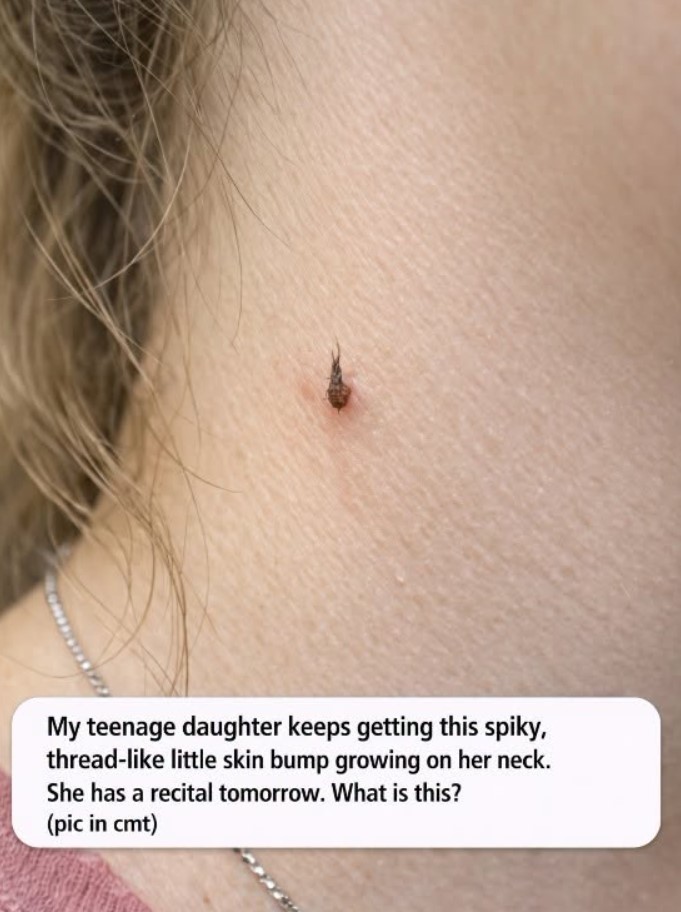
A small, thread-like bump on the neck can have several possible explanations. One common possibility is a filiform wart, a narrow type of wart that often has a finger-like or thread-like appearance and can occur around the face and neck.
The good news is that a small bump like this is often not an emergency.
However, it is important not to diagnose a skin growth based only on its appearance. A wart can sometimes resemble a skin tag or another type of skin growth, and a healthcare professional can determine what it actually is.
So if your daughter has a recital tomorrow, the goal tonight shouldn’t be to aggressively remove the bump. The better approach is to keep the area calm, avoid irritating it, and arrange an evaluation if it persists or has concerning features.
What Does a Filiform Wart Usually Look Like?
Filiform warts are different from the rough, rounded warts many people remember seeing on fingers or knees.
According to the American Academy of Dermatology, filiform warts can look like small threads or tentacles extending from the skin. They can be skin-colored or have another shade, including pink, gray, brown, or yellowish tones. They are commonly found on the face and can also occur around the neck.
The growth may be quite small, but because it sticks outward from the surface of the skin, it can be surprisingly noticeable.
A tiny growth that resembles a little thread, brush bristle, spine, or narrow finger is one reason a filiform wart might come to mind.
Still, appearance alone isn’t enough to confirm the diagnosis.
Why Can These Warts Appear on the Neck?
Warts are caused by certain types of human papillomavirus, commonly referred to as HPV.
The virus can enter the skin through tiny breaks or injuries that may be so small you never notice them. The American Academy of Dermatology explains that warts are common in children and teenagers and can spread through contact with infected skin or contaminated objects.
The neck can also experience plenty of everyday friction.
Collars, necklaces, scarves, backpack straps, sports equipment, and costume clothing can repeatedly rub against the skin.
That doesn’t mean friction itself creates a wart. Rather, irritated or broken skin can make it easier for a wart-causing virus to enter.
For a teenager who participates in dance, theater, choir, sports, or other activities, the combination of sweat, costumes, jewelry, and repeated rubbing can make a small existing bump more noticeable.
Does a Wart Mean My Daughter Has Poor Hygiene?
No.
This is particularly important for teenagers, who can become embarrassed very quickly when something unusual appears on their skin.
Having a wart does not mean that your daughter is dirty or that she has poor hygiene.
Warts are common, especially among children and teenagers. The viruses that cause common skin warts are widespread, and it is often impossible to determine exactly where or when someone was exposed.
A wart may also take time to become noticeable after the virus enters the skin.
So there may be no obvious moment when your daughter “caught” it.
Good hygiene is still useful. Washing hands, avoiding picking at the growth, and not sharing personal items such as razors or towels can help reduce the possibility of spreading a wart to another area or another person.
But there is no reason to make your daughter feel ashamed about it.
How Is a Filiform Wart Different From a Skin Tag?
Skin tags are another type of growth that commonly appears around the neck.
A skin tag is usually soft and hangs from the skin by a narrow stalk. It may look like a tiny piece of loose skin or a small teardrop-shaped growth. Skin tags are generally harmless.
A filiform wart tends to have a different appearance.
Instead of looking soft and floppy, it may appear pointed, narrow, thread-like, or almost brush-shaped.
That distinction can provide a clue, but it still doesn’t provide a definite diagnosis.
The American Academy of Dermatology recommends seeing a dermatologist if you’re uncertain whether a growth is actually a wart.
Could It Be a Pimple?
A pimple usually behaves differently.
An acne bump tends to have a broader base and may become red, swollen, tender, or filled with pus.
An ingrown hair can also create a small inflamed bump, particularly if hair removal has taken place around the area.
A filiform wart, on the other hand, may simply stick outward from the skin without the tenderness or swelling associated with an inflamed pimple.
If your daughter says the bump doesn’t hurt and mainly looks strange, that can fit with the appearance of a wart, although it still isn’t enough to confirm what it is.
What Should You Do the Night Before the Recital?
This is probably the most important part.
If the recital is tomorrow, don’t try an aggressive home removal method tonight.
Don’t cut the growth.
Don’t pull it off.
Don’t tie dental floss around it.
Don’t burn it.
Don’t scrape it with a nail tool.
And don’t experiment with a strong chemical treatment simply because you want it gone before the performance.
Trying to remove a tiny skin growth at the last minute can turn a relatively inconspicuous bump into a much more obvious red, swollen, bleeding, or irritated wound.
The American Academy of Dermatology specifically advises against trying to remove skin tags at home because of risks such as bleeding, infection, and scarring.
Gently Clean the Area
For tonight, keep things simple.
Wash the area gently with lukewarm water and a mild cleanser.
Don’t scrub the bump.
Don’t repeatedly touch it to see whether it feels different.
After washing, pat the skin dry rather than rubbing it with a towel.
The less irritation you create, the better the area is likely to look tomorrow.
Keep Jewelry and Clothing From Rubbing It
If your daughter’s necklace, costume neckline, scarf, or collar catches on the bump, try to keep that material away from it.
Repeated rubbing can make a small growth irritated and more noticeable.
If possible, choose clothing or a costume arrangement that doesn’t repeatedly scrape the area.
This is especially useful during a recital, when stage clothing may fit differently from ordinary everyday clothes.
What About Stage Makeup?
If your daughter normally wears makeup for performances, there’s no need to panic.
However, avoid covering the bump with a thick layer of makeup.
A heavy layer of concealer directly over a raised growth may actually make the texture more obvious.
Instead, if makeup is necessary, use clean hands or a clean applicator and apply products gently around the area.
Don’t repeatedly rub the bump trying to make it disappear.
After the recital, remove the makeup gently rather than scrubbing the skin.
What Should You Absolutely Avoid?
The night before a major performance is not the time for experimentation.
Avoid over-the-counter wart treatments on the neck unless a healthcare professional has recommended an appropriate product and method.
The American Academy of Dermatology notes that at-home wart treatment isn’t appropriate for everyone, and dermatologists recommend professional evaluation for warts on the face, changing or painful lesions, numerous warts, or situations where you’re unsure that the growth is actually a wart.
The neck can also be more sensitive than areas such as the palms or soles.
A treatment that irritates a thicker area of skin could leave a noticeable sore spot on the neck.
A small bump is usually easier to deal with after the recital than a freshly irritated wound.
Can a Filiform Wart Spread?
Yes, warts can spread.
The viruses that cause warts can move from one area of skin to another, particularly when the growth is picked, scratched, or otherwise irritated.
That’s another reason to encourage your daughter not to fiddle with the bump.
Avoid picking at it.
Avoid scratching it.
Don’t shave directly over it.
Don’t share razors, washcloths, or other personal items that come into close contact with the area.
Handwashing after touching the area is also a sensible habit.
These simple precautions can reduce opportunities for the virus to spread.
When Should a Doctor Look at It?
If the growth continues to be present after the recital, arranging a routine appointment with a primary care clinician or dermatologist is reasonable.
A dermatologist can often identify a wart by examining its shape and surface. If the diagnosis is uncertain, additional evaluation may sometimes be needed.
A professional can also discuss whether the growth should simply be monitored or removed.
If your daughter is particularly bothered by the appearance, that’s also a legitimate reason to discuss removal options.
Skin growths can affect confidence, especially when they appear somewhere visible.
How Are Filiform Warts Treated?
Treatment depends on exactly what the growth is, where it is located, and its size.
Dermatologists may use different approaches to remove warts. Depending on the situation, treatments can include freezing, minor surgical removal, or other medical therapies.
For a small growth on the neck, the clinician will consider the location carefully because the goal is not simply to remove the wart but also to minimize irritation and the possibility of scarring.
Healing time depends on the treatment used.
That is another reason not to attempt a last-minute removal before an important event.
What If It Keeps Coming Back?
If your daughter repeatedly develops similar growths, that’s worth mentioning to her healthcare professional.
A recurring or apparently new lesion may still be a common wart, but repeated growths should be evaluated rather than continually treated at home without knowing exactly what they are.
If several new lesions appear in a short period, professional evaluation becomes even more useful.
The same applies if the growth isn’t behaving like the typical wart you expected.
Warning Signs That Should Be Checked Sooner
Most small warts are harmless, and many eventually disappear. However, there are situations in which you shouldn’t simply wait.
Have the growth evaluated sooner if it:
- Changes rapidly.
- Becomes painful.
- Bleeds without being bumped or scratched.
- Develops a very unusual or dark color.
- Has an irregular appearance.
- Becomes an open sore.
- Grows unusually quickly.
- Is accompanied by a larger lump underneath the skin.
- Is joined by many new growths over a short period.
The American Academy of Dermatology recommends dermatology evaluation when a wart is changing, painful, bleeding, or when you’re uncertain that the growth is actually a wart.
These signs don’t automatically mean something dangerous is happening. They simply mean the growth deserves a proper examination instead of a guess.
What About a Hard, Horn-Like Growth?
A very hard, cone-shaped or horn-like projection is somewhat different from the soft, thread-like appearance of a typical filiform wart.
A condition called a cutaneous horn can produce a hard, keratin-filled projection from the skin. These growths can have several underlying causes, some benign and some requiring further evaluation.
That doesn’t mean a teenager with a tiny thread-like bump has a cutaneous horn.
The point is simply that not every unusual projection from the skin is automatically a wart.
If the growth is unusually hard, rapidly changing, painful, or otherwise doesn’t look like a typical wart, a healthcare professional should examine it.
A Simple Plan for the Next 24 to 72 Hours
For tonight, keep the area clean and leave the bump alone.
Avoid cutting, pulling, burning, freezing, scraping, or applying harsh chemicals.
Keep necklaces, collars, and costume materials from repeatedly catching on it.
If stage makeup is needed, use clean tools and apply it gently around the area rather than aggressively covering the growth.
After the recital, take another look at the bump in good natural light.
Taking a clear photograph can also be useful. You can compare the photograph with one taken several days later to see whether the growth is changing.
If it remains present, schedule a routine appointment with her doctor or dermatologist.
This gives you a much better opportunity to find out exactly what it is and discuss appropriate treatment.
Try Not to Let a Tiny Bump Ruin a Big Day
For a teenager, a three-millimeter bump can feel enormous.
Adults sometimes forget just how intense self-consciousness can be during adolescence. A small change in appearance can seem impossible to ignore when you’re preparing to stand under bright lights in front of an audience.
So the parent’s role isn’t only about the skin.
It’s also about reassurance.
Remind your daughter that one tiny skin growth doesn’t define how she looks, how she performs, or how other people see her.
The audience will be paying attention to her performance, not measuring a tiny bump on her neck.
If it turns out to be a filiform wart, it is a common and generally treatable skin problem—not a reflection of her cleanliness or anything she did wrong.
The Bottom Line
Based on the description of a small, spiky, thread-like growth on a teenager’s neck, a filiform wart is one reasonable possibility. These warts have a characteristic thread-like appearance and can occur on the face and neck.
But a written description cannot confirm the diagnosis.
A skin tag, another benign growth, or a different skin condition can sometimes look similar. That’s why the safest approach is to avoid aggressive treatment based on a guess and have the growth examined if it persists or concerns you.
For the night before the recital, the simplest plan is often the best one: gently clean the area, prevent clothing or jewelry from rubbing it, leave it alone, and avoid last-minute attempts to cut or chemically remove it.
After the performance, arrange a routine medical or dermatology appointment if the bump remains.
And if it starts changing rapidly, becomes painful, bleeds on its own, develops an unusual color, or otherwise looks significantly different, have it evaluated sooner.
A tiny bump may feel like a huge problem when you’re standing in front of the bathroom mirror the night before a recital. But it doesn’t have to take over the evening. Protect the skin, reassure your daughter, let her focus on what she has worked so hard to accomplish, and deal with the skin growth calmly afterward.