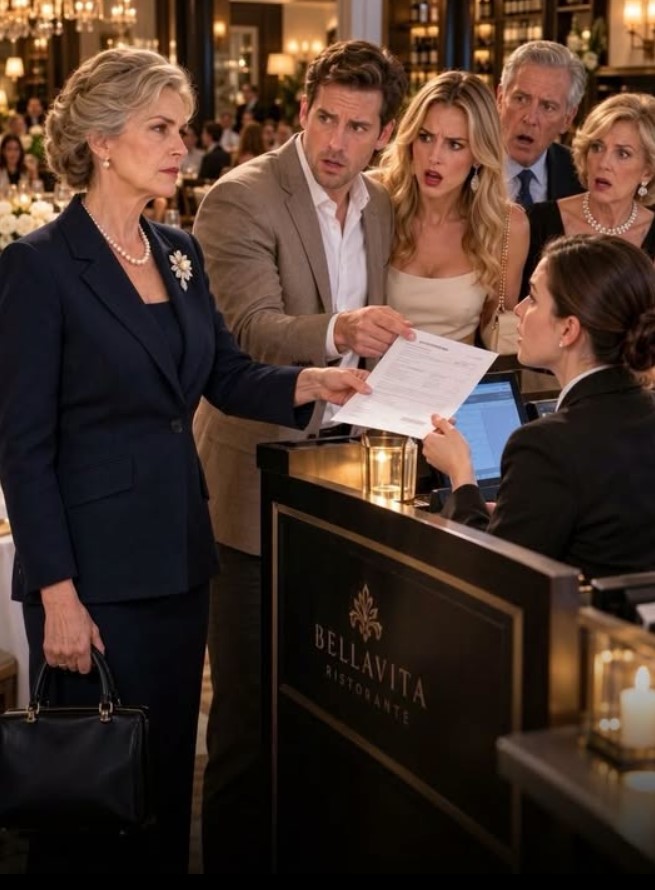
“His father’s middle name was James.”
Those were the words that finally exposed the truth about my son.
My name is Margaret Whitmore. I am sixty-eight years old, a widow, and a woman who once believed that raising a child with love and sacrifice would guarantee a special place in his heart.
That Mother’s Day, I discovered how badly I had misunderstood my own family.
I had gone to Bellavita, an elegant Italian restaurant in downtown Boston, hoping to enjoy a quiet dinner. Families filled the tables, mothers received flowers, and champagne glasses sparkled beneath the soft lights.
I sat alone.
Three weeks earlier, I had invited my son, Adam, and his wife, Vanessa, to celebrate Mother’s Day with me.
Vanessa answered his phone.
“We’re celebrating with my parents, Margaret. It’s really a family occasion.”
I remember staring at the telephone, wondering whether I had heard her correctly.
“Am I not family?”
She laughed dismissively.
“Don’t be dramatic.”
So I stopped asking. I put on my favorite navy suit, pinned my late husband’s pearl brooch to my lapel, and took myself out to dinner.
I ordered pasta, enjoyed every bite, and paid my $86 bill. I was preparing to leave when I spotted Adam standing near the entrance with Vanessa, her parents, and several other relatives.
His father-in-law, Graham Price, wore an expensive Rolex. Vanessa’s mother, Celeste, carried a designer handbag that probably cost more than my first car.
Adam noticed me, and his smile disappeared.
“Mom? What are you doing here?”
“Having dinner, sweetheart.”
Vanessa glanced at my empty table.
“Alone? How depressing.”
Celeste exchanged an amused look with her husband.
“Some mothers really can’t let go.”
I swallowed the humiliation and turned toward the exit.
“Enjoy your evening.”
Then I heard Adam speaking to the restaurant manager.
“The membership number is 000147. Margaret Whitmore. Just charge everything to her account.”
I stopped walking.
The manager, a young woman named Sofia, looked uncertain.
“Sir, this is a Founder’s Reserve account. Authorization is required.”
Adam pulled a folded document from his jacket.
“I’m her son. I have authorization.”
Vanessa casually joined the conversation.
“Mother’s getting forgetful. She doesn’t understand financial arrangements anymore.”
Graham leaned toward Sofia.
“We’re booking a private reception. Thirty-eight thousand dollars. Her membership covers it.”
Thirty-eight thousand dollars.
My son had excluded me from Mother’s Day, then brought his wife’s entire family to spend my money.
Sofia looked from Adam to the document, then toward me.
“Mrs. Whitmore, I need to ask you something privately.”
Adam immediately stepped between us.
“There’s no need for that. My mother gets confused about these things. I handle her financial arrangements.”
I looked directly at him.
“Since when?”
He hesitated before answering.
“Since you started forgetting things.”
“Really? What did I forget?”
His expression tightened.
“Mom, please. Not here.”
“Then answer one simple question. What was your father’s middle name?”
Adam stared at me. The restaurant seemed to grow quieter.
“Robert,” he finally replied.
I felt something cold settle in my chest.
My late husband’s middle name was James.
Adam had just demonstrated that he was willing to lie about anything if it helped him get what he wanted.
I turned to Sofia.
“Please freeze the transaction. That document is not authorization from me.”
Adam’s face drained of color.
“Mom, you’re making a mistake.”
“No, Adam. I’m correcting one.”
I explained that I had never authorized a $38,000 charge. I also made it clear that nobody had permission to use my account simply because they were related to me.
Graham tried to regain control of the situation, insisting that the family had already made arrangements. Vanessa accused me of embarrassing everyone.
But the manager was no longer listening to them.
She was listening to me.
My Founder’s Reserve membership was not an ordinary dining privilege. I was one of the principal investors in Bellavita, and membership number 000147 belonged to the woman who controlled the restaurant’s ownership interests.
Adam had assumed that my account was an unlimited source of money he could access whenever he pleased.
He had never bothered to understand what it actually represented.
Sofia asked us to move into a private office while she reviewed the documents. I agreed, but only because I wanted everything handled properly.
What we uncovered was worse than a single attempted charge.
There had been an earlier request to change the billing address on my account to a property in Boston’s Back Bay. The request had been submitted by Daniel Price, Graham’s nephew.
The records also showed that Adam had repeatedly asked questions about my membership privileges.
Then Sofia found another document: a proposed transfer of part of my investment in Bellavita to Price Hospitality Group.
My signature appeared on the paperwork.
It was not my signature.
I felt the weight of the situation settle over me. This was no longer a family misunderstanding. Someone had been trying to use my name, my money, and my business interests without my permission.
When I confronted Adam, he finally admitted that Graham’s company was in financial trouble. He claimed he had been trying to help his wife’s family secure financial backing.
“You could have asked me,” I said.
“You would have said no.”
“And that gave you the right to forge my signature?”
He had no answer.
Graham then revealed that Vanessa possessed an old copy of a letter from my late husband, Richard.
According to Vanessa, the letter suggested that Adam would eventually inherit Bellavita.
For a moment, I wondered whether Richard had left instructions I had misunderstood. But I knew my husband well enough to recognize that people were twisting his intentions to suit their own needs.
I contacted my attorney, Helen Brooks. She instructed the restaurant to preserve every document and record, freeze the disputed transaction, and prevent any further changes to my account.
The planned reception was canceled.
The following days brought more revelations.
Daniel eventually sent a scanned copy of Richard’s letter. Its contents were nothing like the story Vanessa had been telling.
Richard had written that I controlled the Bellavita shares. Adam might one day take responsibility for the business, but only if he demonstrated the character and judgment necessary to lead it.
The final decision would be mine.
Richard had also made one thing unmistakably clear: nobody should pressure me into surrendering what I had built, and nobody should confuse my love for my son with an obligation to hand him everything he wanted.
Daniel’s message included a demand for $2 million in exchange for the original letter, along with a demand that we abandon any challenge to the estate arrangements.
Helen immediately referred the evidence to the appropriate authorities for investigation.
The truth was finally coming into the open, but it brought no satisfaction. I had spent decades believing my son would always be someone I could trust. Now I had to accept that he had knowingly participated in something that could have cost me far more than money.
A few days later, Adam came to my house.
He looked exhausted. Gone was the confident man who had stood in the restaurant pretending to control my financial affairs.
“I knew the signature wasn’t real,” he admitted. “I kept telling myself I was helping everyone. But I knew what I was doing.”
I listened without interrupting.
He told me he intended to cooperate with the investigation, find a job, and stop relying on me to solve every problem in his life.
“I don’t expect you to forgive me,” he said. “I just wanted you to know that I’m going to take responsibility.”
I wanted to believe him. He was still my son, and a mother’s love does not disappear overnight.
But love could no longer mean protecting him from the consequences of his decisions.
Vanessa eventually moved out. Later, she came to apologize for the way she had treated me and for her part in what had happened.
I listened to her, too.
“I’m sorry,” she said.
“I’m glad you’re willing to tell the truth,” I replied. “But being sorry doesn’t erase what happened. Trust takes time, and you cannot demand it from me.”
She lowered her eyes. For once, she had no sharp reply.
The legal investigation continued over the following months. Graham’s company underwent restructuring, and Daniel faced scrutiny over his involvement in the disputed documents. Adam began rebuilding his life without expecting me to pay his bills or rescue him from every difficulty.
He found a job that paid less than he had once expected to earn. He moved into a modest apartment and started covering his own expenses. He and Vanessa eventually separated and began addressing their problems separately.
I did not celebrate their difficulties. I simply stopped taking responsibility for them.
Nearly a year after that Mother’s Day, Adam returned to Bellavita.
I was in the restaurant reviewing some business records when Sofia told me that my son was waiting near the entrance.
For a moment, I considered asking her to send him away.
Instead, I agreed to see him.
Adam approached my table carrying a handwritten letter.
“I wrote this because I didn’t know how to say everything out loud.”
I accepted the letter and read it slowly. He acknowledged what he had done without blaming Graham, Vanessa, or the circumstances. He admitted that pride had made him believe he deserved access to everything I owned. He also acknowledged that he had mistaken my love for weakness.
When I finished reading, I looked up.
“What do you want from me, Adam?”
He took a breath.
“Nothing. I wanted to apologize. If you’ll allow it, I’d like to have dinner with you. I’ll pay for it myself.”
For the first time in a long while, I saw no demand in his expression. He was not asking for my money, my signature, or my protection.
He was asking for an opportunity to sit with his mother.
I looked at the empty chair across from me.
“Sit down,” I said.
We ordered dinner. Adam paid the bill himself.
Our conversation was awkward at first. We spoke about work, the apartment, and the ordinary details of daily life. Eventually, we began talking about Richard.
Adam remembered the way his father used to make breakfast on Sundays and how he always insisted that promises meant something.
“He would have been ashamed of me,” Adam whispered.
“Your father loved you,” I replied. “But he also believed that people must be responsible for the choices they make.”
Adam nodded, wiping his eyes.
I did not tell him that everything was forgiven. Some wounds need more than one conversation to heal. I did not promise that the past would disappear or that our relationship would immediately return to what it had been.
But I stayed at the table.
And when dinner was over, I let him walk me to the door.
As I stepped into the evening air, I touched the pearl brooch pinned to my lapel. Richard had given it to me years earlier, long before Bellavita became part of our lives, when we were young enough to believe that love could solve almost anything.
I had lost the illusion that I could protect my son from every consequence. I had lost the comforting belief that family would never betray me.
But I had not lost myself.
I could love Adam without surrendering my independence. I could leave the door open without pretending that nothing had happened. And I could hope that the man he was becoming would eventually prove worthy of the trust he had once thrown away.
For the first time in a long while, I no longer felt the need to decide everything that very night.
I touched the pearl brooch once more and thought of Richard.
I knew what I had to do.
And that was enough.