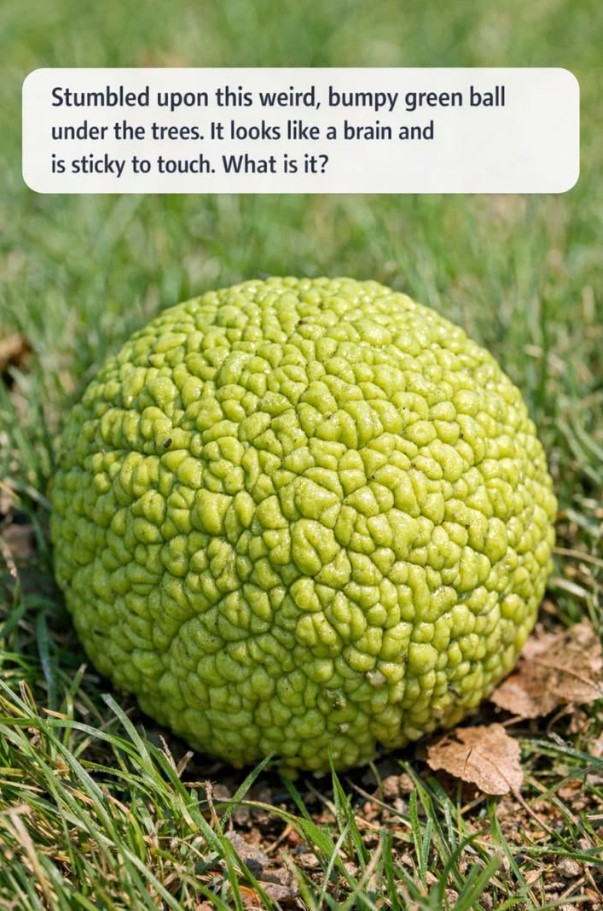
It’s the kind of discovery that makes you stop in your tracks. You’re walking under trees when suddenly you spot something unusual on the ground—a round, green object with a strange, brain-like texture. You pick it up, and it feels sticky. At that moment, questions start racing: Is it a fruit? A fungus? Something dangerous?
While it may look strange or even unsettling, this mysterious object is actually something natural and fairly well-known—once you know what to look for.
Let’s break down exactly what you found, why it looks so unusual, and whether you need to be concerned.
What it most likely is: an Osage orange
That odd, bumpy green ball is most commonly the fruit of the Osage orange tree (scientific name Maclura pomifera).
Despite its name, it’s not related to regular oranges. Instead, it belongs to the same plant family as mulberries and figs.
These fruits are often nicknamed:
- “Monkey balls”
- “Hedge apples”
- “Brain fruit”
And once you see one, it’s easy to understand why.
Why it looks like a brain
The surface of this fruit is deeply wrinkled and uneven, forming a pattern that closely resembles the folds of a human brain.
This happens because:
- The fruit is made of many small units fused together
- Each part grows at slightly different rates
- This creates the bumpy, folded texture
The result is a very distinctive appearance that can look unnatural at first glance.
Why it feels sticky
If you touched it and noticed a sticky residue, that’s completely normal.
The fruit contains a milky, latex-like sap that:
- Oozes out when handled or damaged
- Feels tacky or glue-like
- Can cling to your hands
This sticky sap acts as a natural defense mechanism against pests and environmental damage.
Is it dangerous to touch?
In most cases, it is not dangerous.
You can safely:
- Pick it up
- Examine it
- Smell it
However:
- The sap can be messy
- Some people may experience mild skin irritation
It’s a good idea to wash your hands after handling it, just to be safe.
Can you eat it?
Technically, it’s not considered poisonous—but it’s also not edible in any practical sense.
The fruit is:
- Extremely hard
- Very fibrous
- Bitter and unpleasant
While the seeds inside can be eaten in theory, they are difficult to extract and not commonly used as food.
For most people, it’s best to treat it as non-edible.
Why it falls from trees
These fruits grow on female Osage orange trees and typically fall to the ground in late season.
They are:
- Large and heavy
- Green to yellow-green in color
- Often found scattered under trees
Historically, they may have been eaten by large prehistoric animals capable of breaking them open. Today, only certain animals like squirrels bother with them.
Common myths about these strange fruits
“They repel spiders and insects”
This is a very common belief, but evidence is limited.
While the fruit contains compounds that may have mild effects, it is not a reliable pest control method.
“They are poisonous”
This is not accurate.
They are not toxic to touch, but they are also not suitable for eating due to their texture and taste.
Could it be something else?
In most cases, a large, brain-like green ball points strongly to an Osage orange. However, other tree-related objects can sometimes cause confusion:
- Seed pods (like sweetgum balls) – usually spiky, not brain-like
- Tree galls – typically smaller and less structured
- Fungal growths – often softer and less uniform
The combination of:
- Brain-like surface
- Large size
- Sticky sap
makes Osage orange the most likely match.
What should you do if you find one?
You have a few options:
- Leave it where it is (wildlife may use it)
- Use it as a natural decoration
- Dispose of it if it’s in your yard
There’s no need to remove it unless it’s in the way.
Conclusion :
Finding a strange, bumpy green ball that looks like a brain can be surprising, but it’s usually nothing to worry about. In most cases, what you’ve discovered is the fruit of the Osage orange tree—a unique and fascinating part of nature.
Its unusual appearance, sticky texture, and large size make it stand out, but it is generally harmless. While it’s not something you’d want to eat, it’s perfectly safe to handle with basic precautions.
Moments like this are a reminder of how diverse and unexpected nature can be. What looks strange or even alarming at first often turns out to be something completely natural once you understand it.